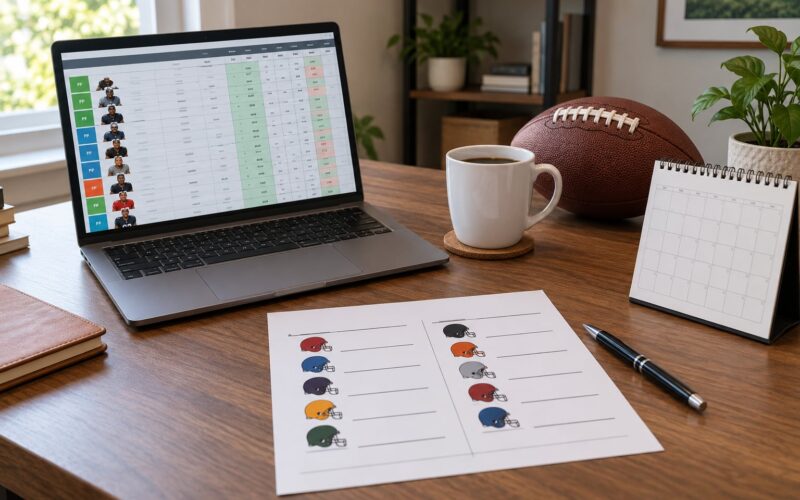
If you are searching for how to manage your team during the fantasy playoffs, the answer is a repeatable routine you run every week rather than a string of panicked decisions. Set the goal, audit the roster against real matchup data, cut through injury noise, add on waivers only when the expected value beats your bench, build a Plan B for every game script, then lock the lineup and stop touching it. That whole cycle takes about an hour a week.
Updated for the 2026 season. The playoff window is short, two or three weeks in most leagues, so decisions you would normally let marinate for a few days now cost you a season on Wednesday night.
Table of Contents
- What You Need
- Step-by-Step: How to Manage Your Team During the Fantasy Playoffs
- Set Your Playoff Goals
- Audit the Roster and Matchups
- Check Injury and Role Updates
- Use Waivers Without Chasing Hype
- Build a Game-Script Plan
- Lock the Lineup Before Kickoff
- Common Mistakes
- Frequently Asked Questions
- Do you still make waiver pickups in the fantasy playoffs?
- What happens to fantasy teams during the playoffs?
- Should I drop my injured player in the playoffs?
- How do byes work in the fantasy playoffs?
- What are the best playoff settings for fantasy football?
- Conclusion
What You Need
You do not need a paid subscription to do this well. You need the right information in the right order, and most managers have the pieces but assemble them badly.
- Your full roster, including bench slots. Not just starters. Most of the decision-making in the playoffs happens between the last starter and the first bench player.
- Tiered rest-of-season rankings. Weekly rankings go stale fast; tiers built from playoff schedules last longer because they group players with similar roles rather than exact projections.
- Matchup data. Points allowed per game to the position, plus target share and snap counts from the last three weeks. Defensive schemes matter more than raw points allowed.
- One reliable injury source. The official injury report designations on Sunday morning, plus a team beat writer or a team-specific forum thread for role news that never shows up on the injury report.
- Your league settings written down. Scoring format, roster size, number of playoff teams, whether lineups lock on Tuesday or Sunday, and the tiebreakers. Tiebreaker rules decide more playoff games than people expect.
- Notes on your opponent. If you can see what your matchup opponent is likely to start, that shapes everything. If you cannot, assume they play the same instinct you do.
Step-by-Step: How to Manage Your Team During the Fantasy Playoffs
Run these six steps in order every week, starting the Monday after your playoff opener. The order matters because each step narrows the decisions available to you in the next one.
Set Your Playoff Goals
Write down three things before you look at any player: a primary target, a secondary target, and a risk tolerance. The primary target is the finish you actually want, usually the championship. The secondary target is the next round down, and it matters because it tells you when a high-variance lineup is rational.
Risk tolerance is the piece most managers skip. In a single-elimination Week 1, a zero-floor lineup that scores 90 points and loses is worse than a high-ceiling lineup that scores 140 and wins. In the championship round with a double-bye, floors get more valuable again, because losing the title ends it while a moderate week just costs you margin.
Survivor pools and one-and-done leagues invert this. There, ceiling beats floor every single week, because you are not trying to out-score one opponent, you are trying to survive a field.
Audit the Roster and Matchups
Go through your roster position by position and sort every player into one of three buckets: safe weekly starter, bench player worth starting, or player you should have dropped weeks ago. The third bucket is usually the biggest.
Then check the opponent for each starter. A wide receiver facing a team that has not dropped a single pass to the position in three weeks is a downgrade regardless of how good he has been. So is a tight end on a team that has not scored in the red zone. Two great weekly scorers facing those situations lose to two mediocre ones facing soft divisional opponents, and that happens often enough to plan for.
Write the swap list before you touch the waiver wire. Managers who add first and sort later end up with a roster full of players they cannot logically start.
Check Injury and Role Updates
Sort every injury report item into actionable or noise. An offensive guard who is questionable is noise for a fantasy roster. A running back who did not practice midweek, whose team has a backup with three straight weeks of 20-plus carries, is actionable. A tight end listed as a full participant but buried behind two other tight ends on the depth chart is a role signal, not an injury.
Practice reports during the regular season were noisy because players were managing injuries through a 17-week schedule. In January, teams are managing them differently. Stars who miss practice usually sit, and the leagues that pair them with reliable backups usually have already told you the replacement will get real snaps.
Snap counts from the previous week are the cleanest role signal available. If a player had a full-game share and a low target share, his role is still expanding. The reverse usually means he is a placeholder the week after.
Use Waivers Without Chasing Hype
You should still be adding players in the playoffs, but the standard changes. During the season you add upside because you have 15 weeks to recover from a bad pick. In the playoffs, you add only when the player’s weekly ceiling is high enough to matter in the one week you will actually use him.
Ask three questions before you click add. Is this player a guaranteed starter on his own team, or a blocked backup? Does his matchup allow his ceiling? Is there anyone better available on the wire right now, because the waiver order is unforgiving and reverse claims only work on players someone else dropped in error?
Popularity is not information. A player added by five of your leaguemates because a bad beat writer liked him is a worse target than a player nobody wants because his team lost its starting quarterback. Volume without a role is a trap, and hot opponents get talked about before their actual production justifies it.
Handcuffing only works if your running back is injured, so treat it as insurance rather than a weekly strategy. Stashing an extra quarterback for the injury replacement only pays off once, and it only pays off if the backup is genuinely a downgrade from what you already have.
Build a Game-Script Plan
For each key player on your roster, write down what happens if the game goes the way you expect, what happens if it goes wrong, and who on your bench replaces him. Three lines per player, done on Tuesday, saves you from improvising at 11:40 on Sunday morning.
Game scripts work in both directions. A team likely to be behind throws more, which can lift a target share and a garbage-time touchdown total for a receiver nobody in your league starts. A team likely to be ahead runs on the ground in the fourth quarter, which quietly kills the value of a pass-catcher you started for the upside.
Build your best correlation cases too. Pairing a quarterback with his top target raises the ceiling of both players when the game stays close, and it lowers both when it does not. That trade is worth taking in a single-elimination week and usually wrong in a double-bye championship against a strong opponent.
Lock the Lineup Before Kickoff
The final routine should take ten minutes, not an hour. Check injury report designations once they publish. Confirm no player you started is on a team that changed its quarterback or that declared a player out late. Verify your tiebreaker math if your opponent is within about 15 points of you. Then submit.
Set a hard cutoff, usually Saturday evening, after which you do not make changes. Every speculative swap you make after the cutoff costs you time and attention, and it makes a genuine late scratch harder to catch. The one exception is an injury designation that names a player in your lineup, and that one is worth acting on immediately.
Lineups are locked in many one-and-done and best ball formats before the playoffs even start. If yours is, this entire routine collapses into a single week of work before the bracket opens, and it should happen before the final regular-season games rather than after.
Common Mistakes
Chasing last week’s numbers. A 30-point week pulls a player up every ranking on Monday. By Sunday, your opponent has the same information and the value has already been spent. Rank on tiers and role, then let the box score be a fact rather than a forecast.
Moving the roster for no reason. A drop-and-add every Sunday feels active and is usually noise. If your waiver claim does not have a real path to a starting lineup, it is just a bench player with worse text next to it.
Overreacting to one injury. Confirm the player is actually expected to miss before you re-plan the week. Reporters list marginal players as doubtful routinely, and rebuilding a lineup around a designation that clears by Friday costs you the better matchup plays.
Ignoring bench upside. The last starter on your bench in a single-elimination week often has a better ceiling than the third-best player at that position in your league. Bench players are cheap to own and free to start.
Not reading your own settings. Whether you play matchup or total points, whether lineups lock Tuesday or Sunday, and how ties break are the three facts that most change strategy. A manager running total points should not be punting a great offensive player at goal-line stands the way a matchup manager should.
Managing an eliminated team badly. This one annoys surviving managers more than it hurts you. Once you are mathematically out, decide whether to keep playing seriously or to stop taking players off the wire so the live teams can make better moves. Saying so in the league chat goes a long way.
Refreshing instead of deciding. Stat-watching fatigue is the most common complaint in league chats, and playoff weeks are where it peaks. Set your research window, finish inside it, and go do something else.
Frequently Asked Questions
Do you still make waiver pickups in the fantasy playoffs?
Yes, but the bar is different. With two or three weeks left, only add a player who is a likely starter and whose matchup supports his ceiling. Players with volume but no defined role, and backups blocked by a healthy starter, are not worth a roster spot at this stage. Check the wire once a day and stop.
What happens to fantasy teams during the playoffs?
Surviving teams lock a lineup each round and are paired head to head. You advance by out-scoring your opponent and are eliminated the week you lose. Teams that lose usually drop into a consolation bracket if one is configured. The number of teams, the byes and whether lineups lock early all depend on your league settings.
Should I drop my injured player in the playoffs?
Drop a player only when a team has officially moved someone else into that role, or when your replacement produces more reliably. An injury designation alone is not enough, because the practice report and the replacement’s workload are what tell you whether the loss is real. Keep the player if the league keeps him on your roster and no better option exists.
How do byes work in the fantasy playoffs?
A playoff bye is a week where your league’s seeded teams skip a round, usually because the playoff field is smaller than the number of rounds. Two division winners getting a first-round bye is common in 12-team leagues. Check the bracket before Wild Card weekend so you know which round you are actually playing and how many weeks you have.
What are the best playoff settings for fantasy football?
For a 10 or 12 team league, four playoff teams keeps the window tight and the stakes clear. Combining two regular-season weeks into one playoff round reduces variance, which most managers want. Matchup scoring over total points fits single elimination. A consolation bracket and defined tiebreakers prevent the arguments that end leagues.
Conclusion
Do this in order: write down the round you are trying to reach and the risk level that fits it, then sort every roster player into starter, bench upgrade or drop. Check role news, add on waivers only when a player has both a real path to starts and a matchup that supports him, write your Plan B for every key player on Tuesday, and lock the lineup Saturday with one scheduled check for Sunday injury news. Then stop refreshing.
How to manage your team during the fantasy playoffs is mostly resisting moves that feel productive. The managers who survive the bracket are the ones making a short list of justified changes and executing it, while everyone else trades players on Sunday afternoon and hopes.