You can sometimes win a fantasy football league from last place, but the honest version of that sentence comes with a math problem attached: the gap you have to close, divided by the weeks that remain, has to be a weekly score your roster can actually produce. In most redraft leagues that number is achievable well into October and close to impossible by Week 12. This guide walks through how to run that calculation, diagnose what put you behind, and rebuild a roster, waiver wire, and weekly lineup that produce points instead of noise.
The managers who claw their way out of last are almost never the ones who had the best draft. They are the ones who accept the diagnosis quickly, stop paying emotional prices for sunk costs, and take advantage of a structural advantage nobody at the top of the standings has: eliminated league mates who no longer have anything to protect.
This guide reads in about eight minutes. Every step below works in a week-to-week redraft league, and the adjustments for dynasty and keeper formats are called out where they matter.
Table of Contents
- What You Need
- Step-by-Step: The Last-Place Comeback Plan
- Step 1: Run the Comeback Math and Set a Real Target
- Step 2: Diagnose Why You Are Actually Last
- Step 3: Fix the Roster at Its Weakest Position
- Step 4: Rebuild the Waiver Wire for a Low Priority Spot
- Step 5: Trade With the Managers Who Have Nothing Left to Lose
- Step 6: Set the Lineup for Ceiling, Not for Safety
- Step 7: Track Weekly Progress and Adjust the Plan
- Common Mistakes That Kill Comebacks
- What to Do When the Season Is Already Mathematically Over
- Frequently Asked Questions
- Can you realistically win a fantasy football league from last place?
- Should a last-place fantasy football team make aggressive trades?
- How many points per week should a last-place team improve?
- Is rebuilding better than trying to climb from last place?
- Should I start a player because of a favorable matchup?
- How often should a last-place manager review the roster and waiver wire?
- Conclusion: Start With the Audit
What You Need
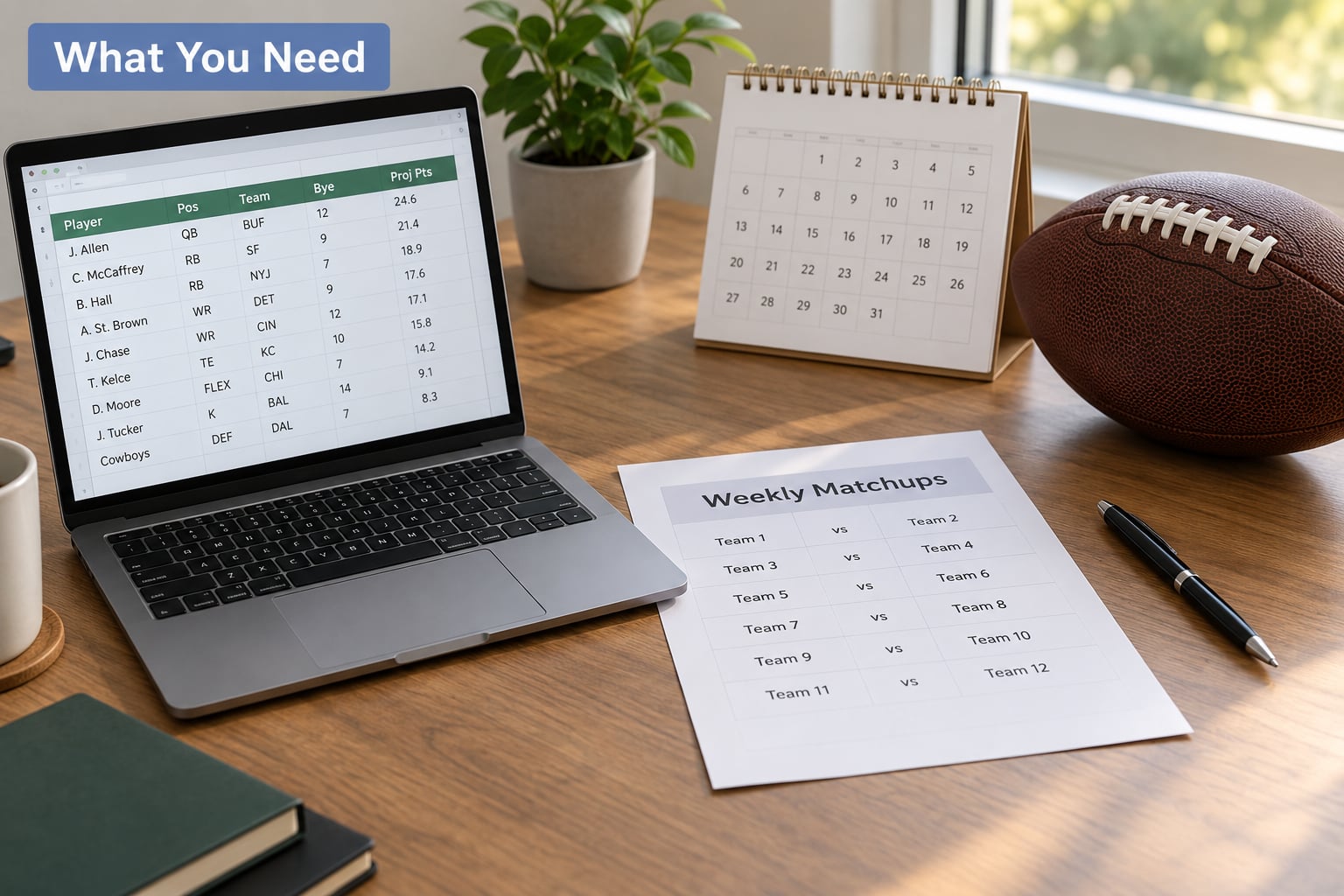
Five things. If you have these in front of you before you make a single move, most of the bad decisions people make in a lost season simply do not happen.
Your league settings, written down. Points per reception, bonus scoring, number of playoff teams, wild card structure, tiebreakers, roster size, how many IR or flex slots you have, and whether waivers are rolling or reverse. The scoring format alone can explain your record. A manager running a 0.5-point-per-reception PPR league has a different ceiling than someone on half-PPR, and if your scoring awards rushing touchdowns but punts on passing touchdowns, your kicker logic changes too.
The standings with points for and points against. Your record is a lagging indicator. Points against tells you how much damage your schedule is doing, and points for tells you whether your roster is theoretically in contention or genuinely gone. A 2-10 team with 1,450 points for and 1,700 against is usually in a league where scoring is low; the same record in a high-scoring league is a different story entirely.
Your exact waiver rules. Rolling priority or reset weekly, free agent acquisition budget or fixed weekly budget, reverse order or not, who gets priority after a tie. This determines your entire strategy. If waivers roll and you are last in the standings, you will claim something, eventually, and how you plan for that is the subject of Step 4.
Injury and role information, read daily. Practice reports, depth chart news, and coaching changes. Late in a season, projection sites lag badly; the information that matters most is often sitting in a coach’s press conference on Wednesday afternoon.
A weekly tracker. One row per week: score, optimal lineup score, points at each position, waiver claims won, and roster moves. Fifteen minutes on Sunday night. Without it you cannot tell whether your plan is working or whether you are simply busy.
Step-by-Step: The Last-Place Comeback Plan
Step 1: Run the Comeback Math and Set a Real Target
Before you decide whether a comeback is possible, work out two numbers: the weekly score you need, and the weekly ceiling you can realistically hit. The first is arithmetic. The second is a judgment call about your roster, and it is the number that actually decides your strategy.
Take the gap between you and the next team up the standings, or between you and the last playoff spot, and divide it by the weeks remaining. A team sitting 70 points behind sixth place with eight weeks to play needs about 9 points per week above its current pace. That sounds small. It is not, if the team above you is averaging 130 a week and you are averaging 88.
Now estimate your ceiling. Take your best weekly lineup of the season so far, add the projections for the players you expect to add, and add a margin. A manager whose best week all year was 118 has a realistic ceiling of roughly 130. If your required pace is 140, no amount of waiver work gets you there, and pretending otherwise is how people end up selling their entire future for a bad trade.
| Situation | What the math says | What to do |
|---|---|---|
| Required weekly score is under 80 percent of your realistic ceiling | The playoff spot is genuinely reachable | Full attack: waiver overhaul, trades, ceiling lineups |
| Required weekly score sits between 80 and 100 percent of your ceiling | Reachable but only with a strong run of weeks | Add floor so one bad week does not end it; trade for consistency |
| Required weekly score is above your ceiling | Championship is off the table | Target a playoff spot or rebuild deliberately (Step 7) |
| Even the best-case finish lands you fifth in a six-team playoff | Season is over on paper | Shift to spoiler play and next-year value |
One more thing belongs in this step: the format. In a week-to-week league, every week is a fresh scoreboard and a single good week matters enormously, which favors ceiling-seeking lineups. In a season-long points league, you simply need to out-score the teams above you cumulatively, so consistency and avoiding injury weeks matter more. Check which one you are in before you decide how risky to get.
It also helps to have a replacement baseline. Points above replacement is a simple way to compare two players at different positions: estimate what a waiver-wire player of the same position would score, subtract that from each player’s projection, and the bigger number is the better player. It strips out the noise of position scarcity and tells you whether a trade actually improves your team.
Step 2: Diagnose Why You Are Actually Last
Six things put a team in last, and they call for completely different fixes. Guessing at the cause is why the same recovery advice fails for half the managers who read it. Find your row, then work that row.
| Failure mode | Symptom | The specific fix |
|---|---|---|
| Bad draft construction | Thin at one position, nothing on the bench, starters are replacement-level | Stop trading starters. Trade bench depth for a genuine starter at your thinnest spot |
| Injury and unluckiness | Points for is competitive, points against is awful | Handcuff insurance, plus streaming defenses to blunt the schedule damage |
| Wrong players held too long | Bench is full of guys with no path to starting | Cut all of them this week; empty roster spots are wasted waiver priority |
| Zero waiver activity | Roster is your draft-day roster plus one pickup | Rebuild the waiver list this week and claim every borderline starter you can get |
| Bad lineup decisions | Optimal score is well above what you actually submitted | Check every Sunday submission; the gap is free points |
| Overactive churn | You made 14 roster moves and the team got worse | Stop trading, set a two-week minimum on every add |
The optimal-score check is the one most managers skip and the one that pays fastest. Compare the lineup you submitted with the lineup you would submit now. If your lineup spotter shows you left six points on the table, that six points is not a one-time thing; over eight weeks of the same habit it is the difference between a real playoff chance and none.
There is a seventh possibility people rarely admit, which is that the league format is stacked against them. In some leagues the standings are so compressed that a bad stretch puts you last by luck of the schedule. Look at points against before you accept blame for your own decisions.
Step 3: Fix the Roster at Its Weakest Position
Once you know the drought, repair it there. Upgrading everywhere is how teams stay mediocre, and a manager in last has no margin for moves that improve the average while improving nothing.
Identify the position that has cost you the most points against a reasonable expectation. Starters are supposed to average a set number of points per week by position; the gap between that baseline and what you actually got is your drought. A receiver who has started eight games and never exceeded six points is a permanent hole, and one waiver claim at that position is worth more than a trade for a marginal upgrade at a spot you already own twice.
Then cut the dead weight. Any bench player without a realistic path to a start, plus a role change, plus a healthy schedule is going to score zero for the rest of the year. Cut him today, because every empty roster spot is a wasted waiver priority slot and a wasted trade chip.
Where the format allows it, exploit the flex spots. In a two-flex league, a mediocre starter is not a problem if he pairs with a real one; in a superflex league, a bench quarterback you will never start is not a problem if you plan to trade him before the deadline. Know which of your players are trade assets and which are filler, because a filler player is the one you offer when an eliminated manager will take almost anything.
Add injury insurance in the form of running back handcuffs on your own starter. It looks wasteful in a points-per-reception scoring system, and it is still the cheapest insurance on the board. One workhorse carries his backup to a season-ending injury, and without the backup you are streaming your way out of a playoff spot in Week 11.
Step 4: Rebuild the Waiver Wire for a Low Priority Spot
Waiver priority inverts almost everything you think you know. At the top of the standings, waiver order is a minor convenience; the team with the first claim gets first pick of the best player on the wire each week. At the bottom, it is the thing standing between you and a roster upgrade, so it changes what you should be targeting.
If your league uses rolling priority, being last does not mean you claim nothing. It means that whenever a manager above you wants a player and gets it, you move up a slot, and eventually a player sits there and nobody serious claims him. If your league resets weekly, the same thing happens inside a single week. If your league uses FAAB, your bid simply has to beat the others, and you should assume there are four or five other managers bidding on anything genuinely good.
That produces a clear priority order for a manager at the bottom: go after the players other managers consider unfashionable.
| Priority | Target | Why |
|---|---|---|
| 1 | Any player likely to start for a team with a soft schedule | Schedule is unscouted and creates a floor nobody projects |
| 2 | Handcuffs of starters you already own or can get cheaply | Free insurance on your biggest injury risk |
| 3 | Offensive linemen with favorable playoff-path schedules | Low bidder count in most leagues, streaming upside late |
| 4 | Deep bench receivers on teams with multiple injuries ahead | Someone has to start, and the wire forgets them first |
| 5 | Quarterbacks off a bad run whose coach just changed | Cheap upside with a defined catalyst |
| 6 | Hot-week running backs with a price spike | Everyone bids. Managers consistently report these collapse within a couple of weeks |
That last row is worth a warning. Fantasy managers keep pointing to the same pattern: a running back who goes off in one game, gets bid on by half the league, and finishes the season well outside the top of his position. A big week raises a price faster than it raises a floor.
On FAAB, set a budget in writing before waivers open. Split it into a per-week allowance plus one reserve you only touch for a genuine injury replacement or a player in the last playoff spot. Spending your whole budget in Week 6 on a hot outlier leaves you with nothing to add a starting quarterback in Week 10, which is when losing teams get found out.
Use drop-and-re-add to buy priority. In a long-running thread on r/fantasyfootball, a manager who was 0-4 with an outside chance described dropping a player he owned to the very bottom of his waiver order, then re-adding him later in the week to jump ahead of other bidders who wanted that same player for a different reason. On rolling-priority platforms the mechanic is simpler: drop a player nobody wants, which pushes other claims up the list and hands you a better slot for your real target.
Last, go two to three weeks ahead. Look at schedules, not just this week’s projections. A defense facing a bottom-five offense two weeks from now will be available on waivers before anyone starts it.
Step 5: Trade With the Managers Who Have Nothing Left to Lose
Your single largest competitive edge is that you are last. A contender protects future value on every deal. An eliminated manager is pricing a player at rest-of-season value, and that is a sale you will rarely find elsewhere in the league.
Work the order of the league in two groups. Eliminated managers are the easy ones; their buy price is low because their title hopes are gone. Managers who cannot win the league but are still competing for a playoff spot or a better finish are the second tier, and they still want to protect next season.
What can a last-place manager offer that a contender cannot? Uncertainty. A contender must send players with defined future value, which means their offers are predictable and easy to decline. You can offer a player whose ceiling you genuinely rate higher than his price, and you can say so, because you are not worried about your 2027 core.
That means your best currency is mid-tier talent in positions where the league has depth, not your best player. A manager in last has nothing to protect, so a horizontal swap that helps them at running back helps you at wide receiver. Size every offer so the eliminated manager ends up with something that would start for them this year. If a trade helps you and would not help them, it will sit unanswered until the deadline.
Make your offers in batches rather than one at a time. Three realistic offers cost you nothing and produce more replies than one hopeful offer, because everyone in a fantasy league is watching the message feed.
Two rules override everything else. Never offer a trade that insults the other manager; the reputational cost lasts longer than the season. And never reneg on an accepted offer to scrape together one more good week. You will be in the league with these people next year.
If nobody responds at all, that is information, not rejection of you personally. Try the eliminated managers at the bottom of the standings list first, and try them before the trade deadline, when their roster has more obvious holes.
Step 6: Set the Lineup for Ceiling, Not for Safety
Here is where the standard advice breaks. Almost every general fantasy guide tells you to start your studs, and for most of the season that is correct. When you are chasing a weekly pace above your average, it is a constraint, not a rule.
The reasoning is straightforward. A manager in last needs a week at the top of their range, not a week in the middle of it. A star running back who scores 22 points as a ceiling is worth more to you than two backup receivers who will combine for 12 in most weeks and 20 in one of eight. You are shopping for variance, because median outcomes do not close gaps that large.
That does not mean benching your best player every week. It means benching him in the specific weeks where the replacement has a clearly higher ceiling against a soft opponent, and starting him everywhere else. A favorable matchup, a defined role, and a real workload beat a big name on a bad schedule, and that trade is legitimate all season long, not just when you are behind.
Stream defenses and kickers every week. They are worth the least when drafted and the most when added. Look two or three weeks out for a defense facing a team that has scored almost nothing, claim it the week before it plays, and let the rest of the league fight over it after.
Use in-game changes where your platform allows them. A late injury ruling or a weather report that clears a passing attack can add real points in one week, and in a comeback chase those points are not trivial.
Be honest about boom-bust players, though. If a player’s floor is zero, starting him in a week where you need 130 and he has a shot at 40 is a reasonable gamble. Starting him in a week where you can win with 95 is how you hand away a week you already had.
Step 7: Track Weekly Progress and Adjust the Plan
Run a short review every Sunday night, before you check the final scores. Score for the week, optimal score for the week, roster moves made, waiver claims won and lost, points at each position, and injuries that hurt you. Fifteen minutes, and it is the difference between a comeback and a hope.
If your submitted lineup keeps landing 10 to 15 points below your optimal score, the problem is your process, not your roster. Fix the process before you touch anything else, because it is free.
Then match the calendar to the strategy. The approach changes as the season tightens, and a manager who keeps making Week 6 moves in Week 12 wastes the run.
| Stage | Primary goal | Actions |
|---|---|---|
| Weeks 1 through 6 | Fix the roster | Reorder priority list, cut dead weight, one acquisition per week, no trades yet |
| Weeks 7 through 10 | Add scoring | Trade hard with eliminated managers, expand waiver targets beyond your usual positions |
| Trade deadline | Convert depth into starters | Sell surplus at peak value, add injury insurance, reassess the ceiling math |
| Final two to three weeks | Prepare for the playoff cutoff | Two weeks of planning, defenses on good playoff-path schedules, no bench churn |
| Playoff weeks | Play the roster you have | Minimal changes, exploit each opponent’s weakest player |
Two thresholds decide everything. First, if you are still required to hit your ceiling every single week to reach the playoff spot, you are not going to get there, and holding on to the plan just delays the moment you accept it. Second, if your roster is suddenly within reach, stop rebuilding. Every speculative move you make in the final stretch is a move that can cost you the spot you fought for.
For dynasty and keeper managers, the math at this stage is completely different. A 3-11 season costs you a second-round pick and nothing about next year’s roster. Sell the aging veterans you would not start in three years, acquire two younger assets per trade, and finish with a foundation you can build on.
Common Mistakes That Kill Comebacks
Dumping the whole waiver budget on one player. The temptation is real because the move feels decisive. It usually leaves you with nothing for the injury replacement in Week 10, which is the week that actually decides a playoff spot.
Trading away good players to a manager in a better position. A contender with a strong roster rarely helps you and often replies with a lowball offer. An eliminated manager has no reason to say no.
Chasing one great game. A waiver pickup who explodes for 28 points will be expensive next week and mediocre the week after. Managers consistently report that same arc, and it is the reason the late-season trending list inverts so often.
Holding sunk costs. A player you have been waiting three weeks on is still the wrong player. The only thing keeping him is the argument you had with yourself in Week 5.
Leaving roster spots empty. Empty bench spots waste waiver priority and trade chips. A mediocre body is worth more than nothing.
Ignoring tiebreakers. If your league breaks ties on head-to-head records or points against, and you are level with another team, that tiebreak is part of the math in Step 1. Play for it deliberately.
Playing spoiler by sabotaging your own ceiling. Streaming against your own playoff hopes to spite a manager you dislike does not win anything, and those people remember. If you want to play spoiler, target the team that is already clinching first.
Letting the league’s tiebreaker rules stay vague. If you plan to propose a change mid-season, propose it early, in writing, and with a reason. A proposal that arrives after you have lost three weeks running does not get voted through.
What to Do When the Season Is Already Mathematically Over
Some seasons end before the playoff cutoff, and pretending otherwise wastes a season you could use for something better. Play the spoiler, but do it deliberately.
Target schedules, not records. Find the team that is most likely to win the league and start the players that team sits on the bench for a bye week. Hoard the quarterback and defense your expected playoff opponent will rotate out, so they face your lineup holding a player they cannot start.
In keeper and dynasty formats, spend the remainder of the season building rather than chasing. Two-for-one trades with eliminated managers, buy young upside on offense, and resist any move that only pays off this season.
In redraft, convert the season into a draft plan instead. Write down the three roster-construction mistakes that cost you the most, and the two waiver claims you should have made in August. That document is worth more than the standings.
And keep the league intact. The managers who quit or go silent are the ones who end up not invited back. Set up a weekly rivalry, propose a points wild card for the last playoff spot as a league vote, or agree on a playoff consolation bracket. A league that runs another year is worth more to you than the placebo points in the final three weeks.
Frequently Asked Questions
Can you realistically win a fantasy football league from last place?
Sometimes, yes, and the answer is arithmetic rather than attitude. Divide your points gap to the playoff spot by the weeks remaining to get the weekly score you need, then compare that to a realistic ceiling built from your best week this season plus your projected adds. Below about 80 percent of your ceiling, the spot is genuinely reachable. At or above your ceiling, the title is off the table, so aim at a playoff berth or a rebuild.
Should a last-place fantasy football team make aggressive trades?
Make more trades than usual, not riskier ones. The value of trading from last is that you have nothing to protect, so you can offer mid-tier talent other managers value more at their position than you do. Target eliminated managers first, since their buy price is at rest-of-season value. Never insult an offer and never reneg on an accepted deal, because those managers are still your opponents next season.
How many points per week should a last-place team improve?
Run the division yourself: take the gap to the next team or the final playoff spot and divide by weeks remaining. Add the result to your current weekly average, and that is the pace you need. Compare it against your realistic ceiling rather than a perfect week. If the required pace sits above your ceiling, no waiver strategy closes it, and it is time to shift goals.
Is rebuilding better than trying to climb from last place?
It depends on the format. In redraft, a mathematically dead season is better spent on spoiler play and writing down your draft mistakes for next year. In keeper and dynasty, rebuilding is usually right even when a playoff spot is still within reach, because a lost season costs a draft pick but not your roster. Judge the decision by what your league keeps after the season, not by this season’s standings.
Should I start a player because of a favorable matchup?
Yes, and this is good advice in every situation rather than only when you are behind. A favorable opponent, a defined role, and a real workload make a player worth starting regardless of his name. The last-place twist is that you should push harder toward ceiling, so a favorable matchup on an upside player can outweigh a tougher matchup on your established scorer. Weekly role news matters more late in the season than stale projections.
How often should a last-place manager review the roster and waiver wire?
Weekly for the roster, daily for the wire. Rebuild your waiver list every Tuesday and Thursday so claims are ready the moment they process, and re-rank it after every injury. Review the roster itself once a week with the tracker open, checking your submitted lineup against your optimal lineup, since the gap there is usually free points. Re-run the comeback math at the trade deadline as well.
Conclusion: Start With the Audit
The first move is the audit, not the waiver claim. Pull your points gap, divide it by your weeks remaining, compare the number against a realistic weekly ceiling, and write down which of the six failure modes in Step 2 owns your season. That single hour decides whether you are chasing a playoff spot or building for next year.
From there, fix one controllable weakness a week, keep your waiver budget intact for the injury you have not had yet, trade into managers whose title hopes are finished, and set lineups for ceiling when the math says you need a big week. Comebacks from last are real, and the ones that work all come down to the same thing: honest numbers, patient moves, and a roster that gets steadily better.