Fantasy football positions explained in plain terms: a standard roster is one quarterback, two running backs, two wide receivers, one tight end, one flex, one kicker and one defense/special teams unit, sitting on a bench behind them. The position list barely changes from league to league. What changes is how each position scores and which of them runs out of players first.
That second part is where most first-year managers get tripped up. A running back and a wide receiver both finish a drive, but one eats the ball and the other catches passes, so their week-to-week production follows completely different paths. Get the roles and the scoring drivers straight and the rest of the draft mostly handles itself.
Here is how each position actually works, what it produces, and how it changes week to week. Updated for the 2026 season.
Table of Contents
- Fantasy Football Positions Explained at a Glance
- How many players are on a fantasy football team?
- What Are the Main Offensive Positions?
- Quarterback: one player, dozens of touches
- Running back: heavy volume, narrow path
- Wide receiver: volume that depends on the quarterback
- Tight end: the hybrid with the thinnest talent pool
- How Do Offensive Positions Affect Fantasy Strategy?
- What Are the Main Defensive Positions?
- How Do Defensive Positions Affect Fantasy Strategy?
- Which Positions Are Most Valuable in Fantasy Football Drafts?
- Why scarcity decides draft order
- Where value hides
- League type changes everything
- How Do You Use Positions in Weekly Lineup Decisions?
- Frequently Asked Questions
- What are the main positions in fantasy football?
- Is running back still the most important fantasy football position?
- What is the difference between a wide receiver and a tight end?
- Should I prioritize one position over another in my draft?
- How do flex positions work in fantasy football?
- What defensive position should I target first?
Fantasy Football Positions Explained at a Glance
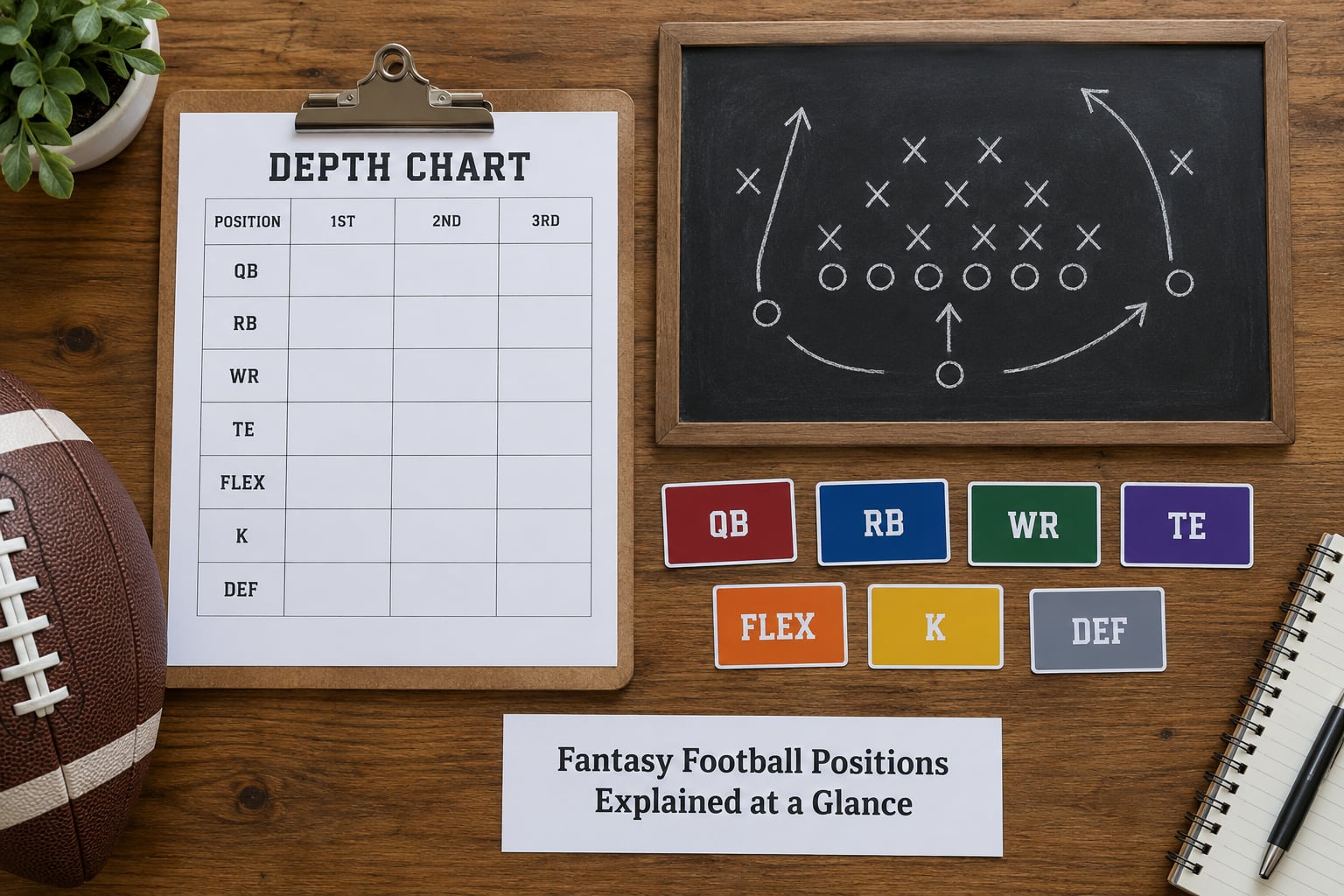
A standard 12-team roster starts nine players: QB, RB, RB, WR, WR, TE, FLEX, K and D/ST. The remaining seven or so spots make up your bench, and those are where you stash depth for injuries and bye weeks.
| Position | Starter slots | Real-world job | What drives fantasy points | Draft consideration |
|---|---|---|---|---|
| Quarterback (QB) | 1 | Calls plays, throws and runs | Passing yards, touchdowns, rushing yards, turnovers | Scoring is reliable, supply is deep. Wait unless your league is superflex. |
| Running back (RB) | 2 | Carries the ball, blocks, receives passes out of the backfield | Rushing yards, receiving yards and receptions, touchdowns | First position to go scarce. Early picks get traded up to secure one. |
| Wide receiver (WR) | 2 | Runs routes down the sideline and middle | Receptions and receiving yards, touchdowns | Value swings most with scoring format. Third receivers go late and score like stars in PPR. |
| Tight end (TE) | 1 | Blocks, catches passes, lines up alongside or in place of a receiver | Receptions and receiving yards, touchdowns | Traditionally thin at the top. Late-round picks often post starter numbers. |
| Flex (FLEX) | 1 | Fills at RB, WR or TE, whichever your lineup needs | Whatever that position scores | Best single spot for the value pick. Takes any of the three skill positions. |
| Kicker (K) | 1 | Kicks field goals and extra points | Field goals made, distance, extra points, kicker is perfect | Draft last or never. Weekly stream instead. |
| Defense/Special Teams (D/ST) | 1 | The whole defensive unit as one rostered entity | Sacks, interceptions, fumble recoveries, defensive touchdowns, points allowed | Draft last or never. Weekly stream instead. |
How many players are on a fantasy football team?
Most 12-team leagues carry 16 players: 9 starters and 7 bench spots. Ten-team leagues usually drop to 15, while superflex and dynasty leagues often run 18 to 22 because they need starting-caliber depth beyond the starters.
The bench exists for one reason, which is absorbing a bad week. A bench is not a place to store your fifth-best receiver, and it is not where you draft players you think are good. It is depth insurance, and each spot should have a job attached to it, usually tied to a specific starter you own.
Platform defaults differ more than most guides admit. ESPN, Yahoo, Sleeper, CBS and NFL.com each ship with their own roster template and scoring, so two people in the same draft room can be playing by different rules without anyone noticing. Check your league settings before you build a single cheat sheet, because the positions listed in your lineup settings are the ones that actually count.
What Are the Main Offensive Positions?
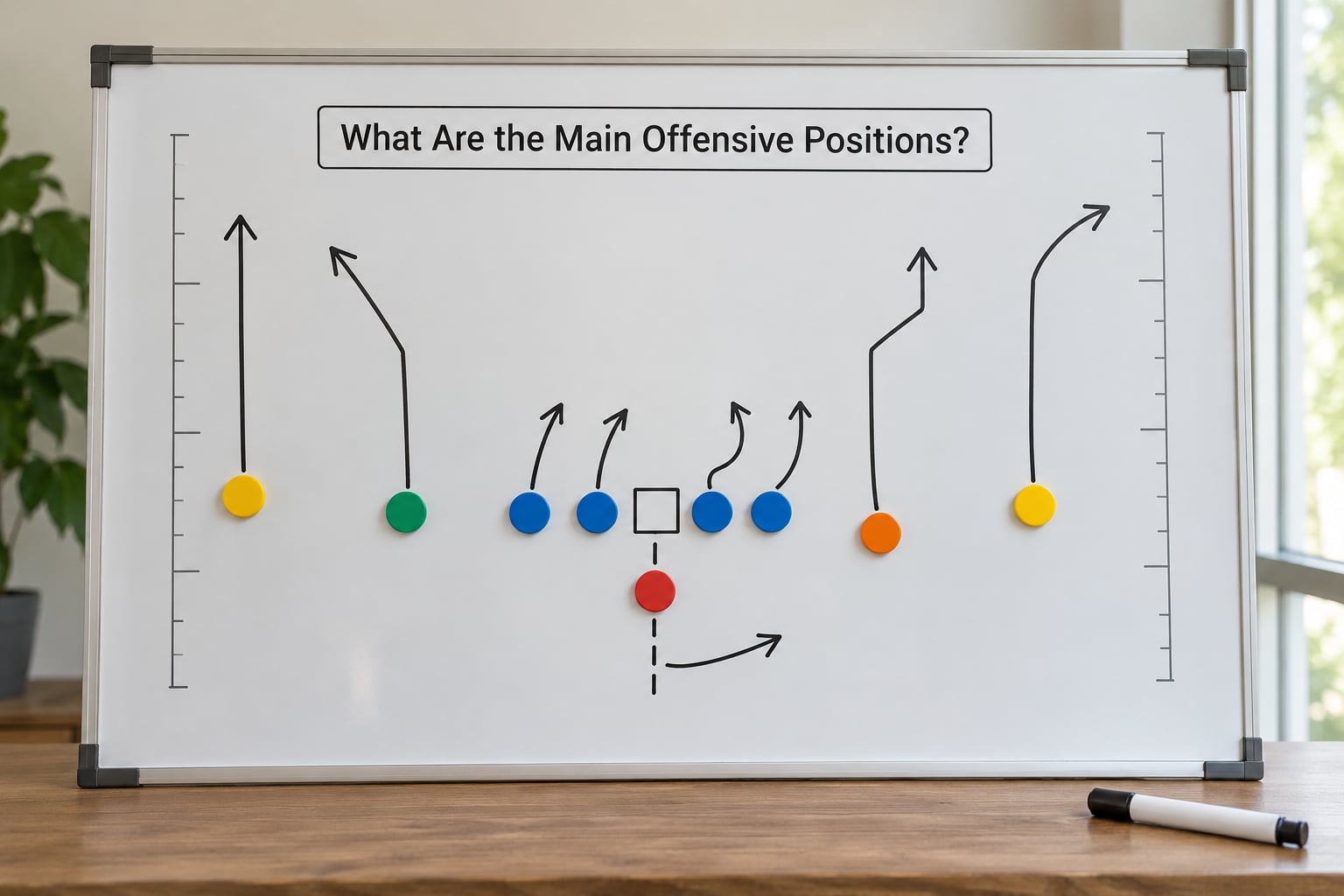
Offense is where most of your weekly fantasy points come from, and four positions carry it. Each one touches the ball a different number of times, which is why they score on different schedules.
Quarterback: one player, dozens of touches
The quarterback is the only position on the field who touches the ball on nearly every play. Throws for 300 yards, runs for a first down, survives a sack, takes a kneel to bleed the clock. In most scoring systems the quarterback is your highest weekly scorer outside of a huge running back game.
The fantasy numbers that matter are passing yards, passing touchdowns, rushing yards and rushing touchdowns, minus interceptions. Scoring settings change the math: some leagues award a bonus for a quarterback who throws four or more touchdowns, others penalize interceptions heavily, and a few score passing yards differently once you pass a threshold.
Running back: heavy volume, narrow path
A running back takes handoffs, pitches, screens, checkdowns and the occasional route out of the backfield. Early downs are usually his, short-yardage situations are usually his, and the goal line is his when the offense gets there on the ground.
Because he touches the ball less than a quarterback, his fantasy points arrive in bigger, lumpier chunks. A bad game is very possible when the offense is passing all day. His ceiling comes from goal-line carries and receptions, which is why a receiver who works the slot can be graded as a running back on some platforms.
Wide receiver: volume that depends on the quarterback
A wide receiver runs a route, catches a pass, gains yards. What he does not do is get handed the ball on a designed run. His fantasy production tracks targets first, yards second, touchdowns last.
That single fact separates receivers from running backs. A receiver’s weekly output rises and falls with his quarterback’s arm and the play calls, not with how many times he was handed the ball. Third receivers on high-volume offenses are a well-known fantasy loophole, and in points-per-reception scoring they can outscore a star running back.
Tight end: the hybrid with the thinnest talent pool
A tight end blocks on run plays, lines up in the slot, runs routes and, on many teams, lines up next to a receiver as a fourth passing option. He produces like a receiver but operates less often than one.
Only a handful of tight ends are dependable weekly performers. Everyone else is a lottery ticket on target share. That thin group is why tight end runs exist, and why a mid-round tight end who finds a stable role often outperforms a receiver drafted two spots earlier.
How Do Offensive Positions Affect Fantasy Strategy?
Volume is the whole game. A player who touches the ball 20 times has more ways to score than one who touches it eight, and that predictability is why quarterbacks and workhorse backs anchor a roster. Low-volume players need efficiency or a perfect matchup to hit their ceiling.
Goal-line work matters more than yardage. One touchdown beats 15 fantasy yards of rushing in most formats, so offenses that run at the goal line create fantasy value that yardage totals hide.
Scoring format decides who benefits from volume. Points-per-reception rewards catchers, so receivers and tight ends rise in value. Standard scoring cares mostly about touchdowns and yards, so running backs hold their edge. Half-PPR sits in between and is the format most forgiving of a mistake in either direction.
Then there is volatility. Quarterbacks are the least volatile because the ball comes back to them. Running backs are the most volatile because their workload can vanish on the first series. Receivers land in the middle, swinging on target share and game script. Build your bench around that spread rather than around talent alone.
What Are the Main Defensive Positions?
Most leagues treat defense as a single rostered unit, D/ST, rather than as individual players. You pick a team’s entire defensive group and score whatever that group produces.
Individual defensive player leagues, shortened to IDP, score individual defenders instead. Four groups show up: defensive linemen (defensive ends and defensive tackles), linebackers, cornerbacks and safeties. Some leagues add defensive ends as their own slot.
Linebackers are usually the IDP scoring engine because they make the most tackles. A tackle is the easiest defensive statistic to record, and linebackers get most of them. Defensive linemen earn their points through sacks and pressures, while cornerbacks and safeties depend on passes that are contested or thrown at them.
How Do Defensive Positions Affect Fantasy Strategy?
Defense is the hardest part of the league to project. A unit can be good in real football and score six fantasy points, because sacks and takeaways arrive randomly and one defender can eat a whole week’s output.
Team context is what makes it forecastable. Look at sacks per game, points allowed per game, and whether the opposing offense gives up big plays. An aggressive pass rush facing a quarterback who protects the ball poorly is the profile you want. A defense facing an efficient run-first offense usually scores nothing.
Scoring settings decide whether the position deserves attention at all. Leagues that reward interceptions, forced fumbles and defensive touchdowns reward gambling on a big-play unit. Leagues that score nothing but points allowed turn the position into a weekly coin flip, which is exactly why streamers leave it empty and add the best available defense each Tuesday.
Which Positions Are Most Valuable in Fantasy Football Drafts?
There is no universal ranking, because position value comes from the intersection of scoring settings, league size and roster format. What is universal is scarcity: a position group with few usable players gets drafted earlier than a position group with many.
Why scarcity decides draft order
Best player available only works when the talent pool at each position is roughly even. It usually is not. A typical draft runs out of reliable running backs before it runs out of quarterbacks, so the running backs go first, even if the best player on your board is a wide receiver.
That is the logic behind the early running back picks everyone argues about. Take a top back before the scarcity hits and you own the position. Take another team’s fourth receiver instead and you are hoping that group survives to your pick.
Where value hides
Quarterbacks are the safest late-round value because the supply of 15-plus point passers is deep. Tight ends are the classic value pick for the same structural reason, with only a few dependable options and a long tail of players who take over an offense’s passing share.
Wide receivers are the most format-dependent pick of all. In points-per-reception, WR3 and WR4 are legitimate weekly starters. In standard scoring, those same players are bench fillers and your extra receiver picks should go to running backs.
League type changes everything
A redraft league resets every season, so weekly floor matters more than long-term upside. A dynasty league values rookies, age and contract length over next week’s points, which pushes you toward receivers and tight ends even when a running back is on the board. A best ball draft removes weekly decisions entirely, so you optimize purely for ceiling, which pushes toward upside everywhere. A superflex league inserts a second starting quarterback, and quarterbacks jump from late-round filler to first-round priority overnight.
How Do You Use Positions in Weekly Lineup Decisions?
Your lineup is a fresh puzzle each week, and the position labels above tell you how much flexibility you actually have. Start with expected role, then matchup, then injury news.
Role first. A quarterback who is a clear favorite to throw 40 times outranks a quarterback with a slightly better matchup but a running-heavy script. A receiver who is the first option on every play is safer than one sharing the target load.
Matchup second. A cornerback who follows the opposing team’s best receiver for most snaps turns a start into a question mark. A tight end facing a defense that gives up little to the position loses most of his appeal.
Game script last, because it is the least reliable. A projected blowout can produce fewer fantasy points than the numbers suggest, since the favorite may slow down in the second half. Expecting a pass-heavy game from a team that has run for 40 yards in three weeks is a gamble, not an argument.
Use the flex spot to solve a lineup problem rather than to add a player for the sake of it. If your flex is best used as a receiver, use it as a receiver. In superflex, hold your second quarterback on the bench until you need him, then move him in for the biggest gain available.
Frequently Asked Questions
What are the main positions in fantasy football?
A standard roster has nine starting slots: one quarterback, two running backs, two wide receivers, one tight end, one flex, one kicker and one defense/special teams unit. The flex can be filled by a running back, wide receiver or tight end. On top of that you carry a bench of seven or so players for injuries and bye weeks, so a full roster is usually 16 players in a 12-team league.
Is running back still the most important fantasy football position?
Running backs still matter most for one reason: they run out first. There are rarely more than a dozen dependable backs, so they get drafted ahead of comparable receivers, and a top back gives you weekly volume plus goal-line work. That said, importance depends on scoring. In points-per-reception leagues, a third receiver on a high-volume team can score more than a mediocre back.
What is the difference between a wide receiver and a tight end?
A wide receiver lines up wide, runs routes every down and works the sideline and middle of the field. A tight end blocks on running plays, lines up next to a receiver or in the slot, and appears in the passing game less often. Because of that lower volume, only a few tight ends are consistent, which is why a later-round tight end can be a better bet than an earlier-round receiver.
Should I prioritize one position over another in my draft?
Let scarcity set the order rather than your favorite players. Take a top running back early because good ones disappear, then draft the best receiver available rather than forcing a tight end round early. Most drafts still follow a rough pattern of one running back, several receivers, then quarterbacks and tight ends late. In a superflex league, quarterbacks move to the front of that order.
How do flex positions work in fantasy football?
A standard flex spot accepts a running back, wide receiver or tight end, and you start whoever gives you the most projected points at that moment. A superflex spot adds quarterbacks, and sometimes running backs, to the eligible list, so you can start two quarterbacks. Check your league settings, because some platforms treat backup quarterbacks as eligible at flex while others do not.
What defensive position should I target first?
In a standard league you should not target one, because you roster the whole D/ST unit and add the best matchup each week instead. In IDP leagues, linebackers are the usual first target since they collect the most tackles. Draft defensive linemen or defensive ends next if your scoring rewards sacks, and consider cornerbacks and safeties mainly in leagues that score interceptions and defensive touchdowns.
Open your league settings before anything else, because the roster and scoring tabs tell you exactly which positions you are playing for. From there, draft from scarcity, take the best player available at every other pick, and leave the kicker and defense for weekly adds. Get those three things right in 2026 and the weekly lineup decisions take care of themselves.