
Most managers check strength of schedule in October and forget it. That is backwards. Knowing how to use strength of schedule for the fantasy playoffs is about narrowing three or four specific weeks down to one opponent per week, then matching that opponent against every roster decision you have left. The basic rule: a lower schedule rank number means an easier run of opponents, and the number matters far more for a defense than for a quarterback.
The mistake I see most is treating SOS as a season-long grade. It is not. A player who draws four soft opponents in October can end up facing the league’s best pass defense in January, and a lineup built on the September version of that schedule is worthless by Week 15.
This guide walks through the whole process in six steps. It takes about an hour to set up properly, and doing it before your final waiver deadline pays for itself every week after.
Table of Contents
- What You Need
- Step-by-Step: How to Use Strength of Schedule for the Fantasy Playoffs
- Step 1: Identify whether your league uses playoff tiebreakers
- Step 2: Build a playoff strength-of-schedule view
- Step 3: Separate playoff tiers from regular-season projections
- Step 4: Apply the schedule adjustment to start-sit decisions
- Step 5: Use the playoff bracket to plan waivers and trades
- Step 6: Recheck late and avoid false precision
- Common Mistakes
- Frequently Asked Questions
- How do I use strength of schedule for the fantasy playoffs week by week?
- What are the best fantasy schedules for the playoffs?
- Is a higher strength of schedule better in fantasy football?
- How is strength of schedule calculated for fantasy football?
- Which defenses are best for the fantasy playoffs?
- When should I start using strength of schedule for the playoffs?
- Conclusion
What You Need
Strength of schedule only works if the underlying numbers are current and position-specific. Gather these before you build anything.
League settings, read carefully. Scoring format first, because PPR and standard scoring produce completely different points-allowed numbers. Then tiebreaker order, playoff week dates, roster size, and whether you play the championship in Week 16 or Week 17.
A schedule-adjusted points-allowed table by position. Raw opponent win-loss record is close to meaningless for fantasy purposes. A 9-7 defense that gives up 22 fantasy points per game to slot receivers is not elite, whatever its record says. Look for points allowed per game to the running back, wide receiver, tight end, and quarterback positions separately.
Rest-of-season projections. Most sites publish their full-season projections in September and never revise them. For playoff planning you want the weekly projections for weeks 15 through 17 specifically.
The actual playoff bracket. Most platforms will not show you another team’s opponent until seeds are clinched. Build the bracket yourself from the published schedule, because provisional matchups drive waiver priorities.
Defensive injury news and depth chart notes. Losing a starting edge rusher changes a defense’s points-allowed profile more than any game-plan adjustment. Track it weekly from the injury report rather than relying on a static table.
Two or three current game lines. Implied team totals tell you the expected pace and scoring environment. A team projected for 21 points creates more first downs, more snaps and more chances for everyone involved.
Step-by-Step: How to Use Strength of Schedule for the Fantasy Playoffs
Step 1: Identify whether your league uses playoff tiebreakers
Open your league settings and find the playoff tiebreaker order. Most platforms default to a long chain: head-to-head record, then total points for, then total points against, then strength of schedule, then win percentage, then head-to-head head-to-head, then random. Some sites put SOS high in that list. A few dynasty leagues even use strength of schedule as the very first tiebreaker.
Know two separate things here, because managers confuse them constantly. The SOS tiebreaker in most league software is opponent win-loss record, a very different number from schedule-adjusted points allowed. If your platform uses opponent record as a tiebreaker, it is calculated automatically and you have nothing to do but check it. If you want to manage it manually, you need the points-allowed table instead.
Here is how a tie actually falls. Suppose two teams finish the regular season tied at 8-6. Team A went 6-2 against playoff teams, Team B went 2-6 against them. Team A wins the head-to-head record tiebreaker outright. Now suppose both teams finished 8-6 with identical opponent records, and both scored the same total points. That is where points against enters, and a team that spent the season absorbing bad opponent schedules can lose the tiebreaker on points against even while winning on points for. Read your own league’s chain, because the order changes what you should optimize in the final three weeks.
Step 2: Build a playoff strength-of-schedule view
Now build the actual view. Open a spreadsheet with one row per NFL team and one column per playoff week, then fill in the opponent and mark difficulty. That is the entire deliverable, and it takes about twenty minutes with the published schedule.
Rank opponents using schedule-adjusted points allowed for each position rather than win-loss record. Do it per position, because a defense can be awful against running backs and excellent against receivers, and one overall number hides that completely.
Then layer in the things that move a single week’s projection rather than a season average:
- Projected opponent defensive quality using recent points allowed, not the full-season number. The last eight to ten weeks carry far more signal than a Week 1 to Week 17 average.
- Expected scoring environment. Check the implied team total. High totals mean more snaps and more targets for everyone.
- Venue splits. Some teams play markedly worse at home, and the road schedule in a playoff stretch is rarely balanced.
- Rest and travel. A Thursday game followed by a Sunday game compresses a player’s opportunity; a short week hurts the offense more often than the defense.
- Recent opponent quality. A defense that gave up 30 points a game to a stretch of terrible offenses is not actually bad.
When the grid is finished, average the three playoff-week ranks per team per position. That average is your number, and it is the only strength-of-schedule figure you need for the rest of the postseason.
Step 3: Separate playoff tiers from regular-season projections
A player’s season-long projection and his playoff-week projection are two different numbers, and conflating them is the most expensive error in playoff planning. A running back averaging 15 points per game who faces three top-eight defenses in Weeks 15 through 17 is not a 15-point-per-game player for your playoff run. He is closer to an 8-point-per-game player, and that belongs in your flex decision.
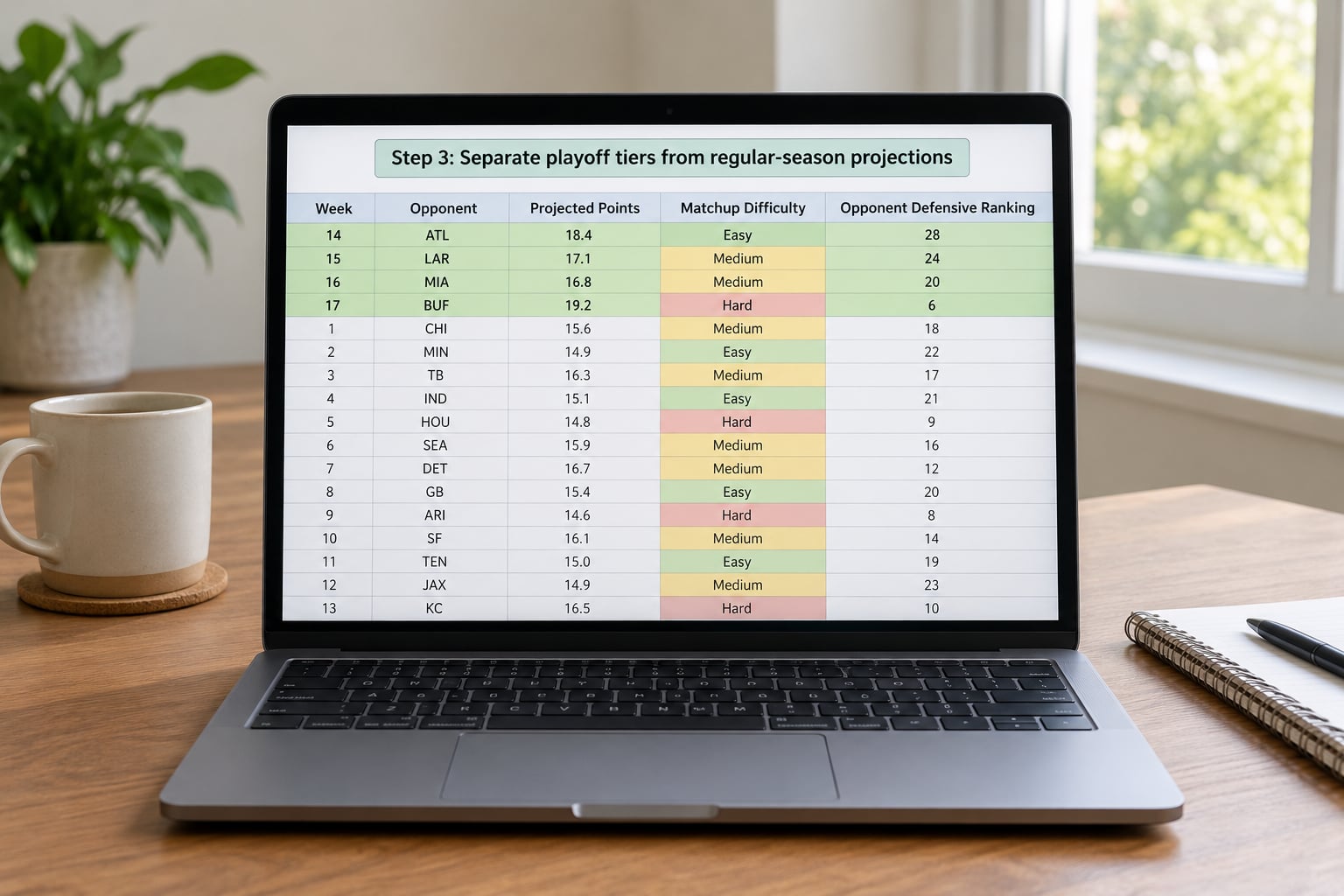
Split your roster into three playoff tiers for each position. Tier one is players whose weekly projection stays within about a point of their season average. Tier two is players whose playoff projection rises because of soft opponents. Tier three is players who fall hard because of tough opponents.
The second group is where value hides. A backup tight end with a mid-tier season projection facing the two worst defenses against tight ends in the playoffs is a legitimate week 15 flex option that a season-average view would never surface. That is the practical payoff of doing the separation at all.
Keep one number in mind while you do this: a one-point-per-game swing across three weeks is roughly three points on your total, which is often the margin between advancing and going home. Schedule work moves margins of three to eight points when it is done well. That is enough.
Step 4: Apply the schedule adjustment to start-sit decisions
Use schedule strength as a tiebreaker between similar players, never as the first filter. The order that works for me is: expected opportunity first, matchup second, role third, injury news fourth, schedule fifth.
Here is a compact example. You have two flex options and only one slot. Player A is projected for 8.4 points per game against a defense that allows 8.9 points per game to slot receivers. Player B is projected for 7.6 points per game against a defense that allows 6.1 points per game to slot receivers. On raw projection, A starts. Adjusting for the opponent, B’s 7.6 becomes roughly 9.1 and A’s 8.4 becomes roughly 7.7, so B starts.
That kind of swap is a real edge, but only under three conditions: the two players have similar role and opportunity, the opponent’s defensive profile is stable rather than distorted by one or two blowout games, and neither player is questionable on the injury report. When two players are separated by more than about two points per game of raw projection, the matchup adjustment rarely closes the gap.
Adjust for position too. A wide receiver’s week depends heavily on target share, and a favorable pass-rush matchup for the opposing defense is often a stronger signal than a favorable points-allowed number. For running backs, offensive line quality and whether the team is behind often matter more than the opposing front.
Step 5: Use the playoff bracket to plan waivers and trades
Waivers and trades are where schedule data has the highest leverage, because the decision happens before the games do. Run waivers in brackets, and only target a player whose playoff weeks line up with your specific path.
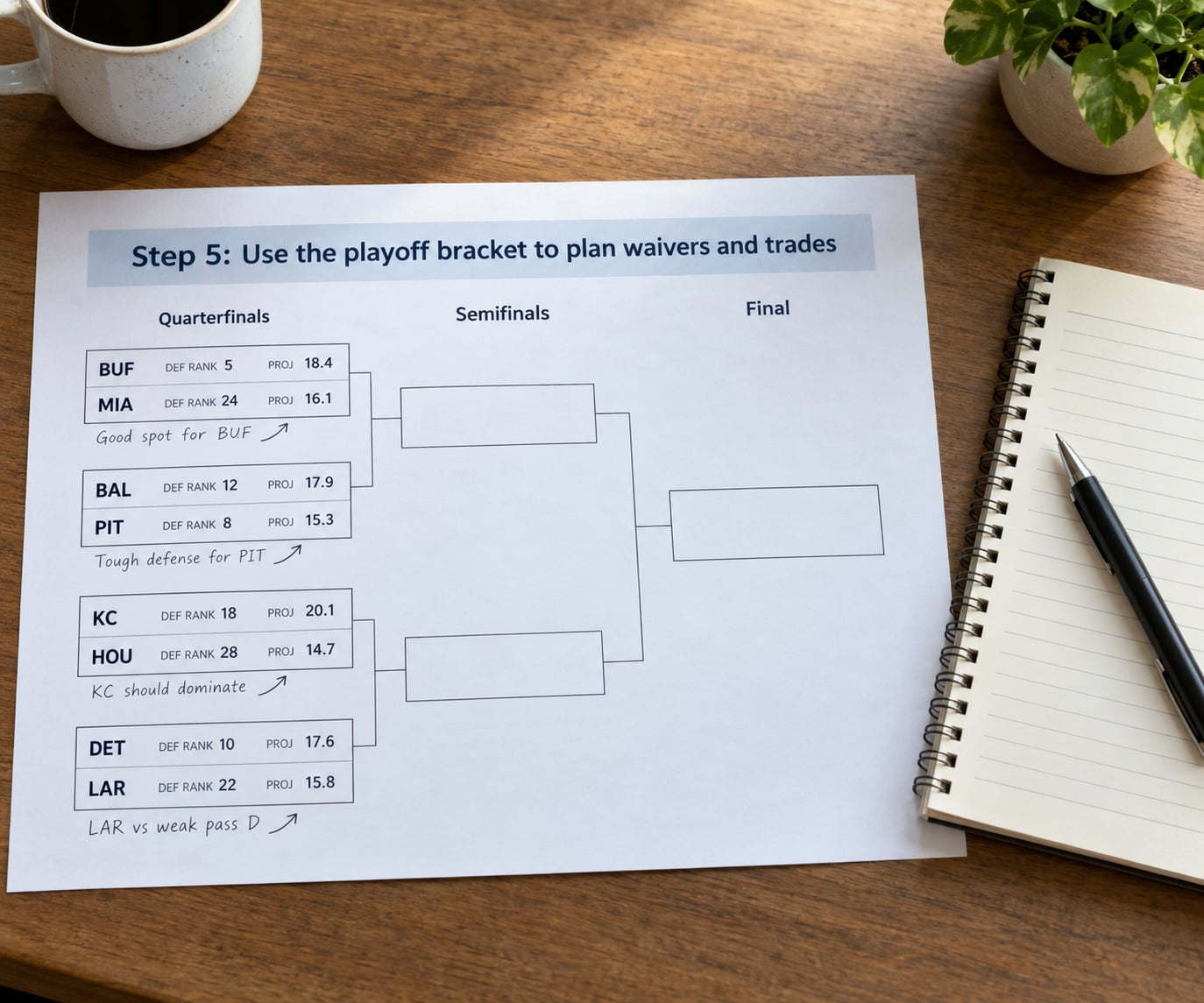
The bracket is the part most managers skip. If you are the five seed and the four seed cannot catch you, your likely opponents are known and you can plan against them exactly. If you are the eight seed in a twelve-team league, your opponents depend entirely on how the final regular-season week shakes out, so plan for the two most likely paths rather than one.
For quarterbacks and defenses, this is straightforward streaming. A defense facing an opponent that allows 30 fantasy points per game to D/ST is worth a claim every week, even with a losing record. The same logic applies to a backup quarterback throwing against the league’s worst pass defense, and to a tight end streaming option. In those positions the schedule is the primary decision, not the player.
For trades, schedule data cuts both ways. Buy low on a player whose playoff weeks are soft, especially at running back or tight end where talent gaps narrow. Sell high on a star with a brutal three-week gauntlet remaining, because that star’s next three performances will carry a depressed price.
Do not target a player solely because of one favorable matchup. That is how waiver claims turn into dead roster spots. Ask whether the whole playoff stretch is workable, and whether the player has a defined path to touches.
Step 6: Recheck late and avoid false precision
Schedule data decays fast in December. Recheck these five things in the week before each playoff round.
Injuries. One starting defender out can move a defense’s points-allowed number several spots in a single week. Rebuild the column for the round rather than carrying the old one forward.
Weather and game times. Wind and precipitation reliably suppress passing game scripts in exposed stadiums, and late games carry more scoring. Thursday games compress rest.
Line changes. An offensive line shuffle changes rushing efficiency more than any statistical adjustment will tell you.
Rotation news. A team eliminated from the playoff picture with nothing to play for may rest starters in Week 17. If your championship is Week 17, this can cost you more than any matchup edge.
Opponent incentives. A team sitting at 3-12 still has to play, but a team holding the second seed with a locked position on the calendar does not need to win. Check standings, not just records.
The honest limit here: schedule adjustment explains maybe a quarter to a third of weekly scoring variance on its own. The rest comes from opportunity, role, talent and luck. Use the schedule view to break ties and to plan four to six weeks out, not to lock a lineup on Tuesday morning when the injury report is still thin.
Common Mistakes
Trusting preseason schedule-adjusted rankings all the way to January. They were built on projected opponent strength from August. By Week 15 the actual numbers are better. Fix: recalculate with the last eight to ten weeks of real points allowed before your first playoff round.
Using overall team SOS instead of position-specific SOS. A defense can be top-five against running backs and bottom-ten against tight ends, and one blended number erases that. Fix: keep separate columns per position.
Treating schedule as a guarantee. A soft opponent does not create touches. A backup running back with two carries behind a lead blocker still produces nothing on the best schedule in football. Fix: require a role before you let the matchup influence your lineup.
Ignoring scoring format. Points-allowed tables built for PPR leagues mislead standard-scoring managers, and the reverse is also true. A receiver’s PPR value is volume and reception volume, not touchdowns. Fix: read the scoring settings before you trust any table.
Ignoring that the season number and the playoff number are different. This is the error with the largest cost. Fix: recalculate every starter’s projection for weeks 15 through 17 using their actual opponents.
Forgetting roster fit and rest policies. In dynasty and best-ball leagues the trade-deadline date matters more than the matchup, because the player leaves your roster when the season ends. Fix: check the deadline first, then decide whether schedule changes the trade’s value.
A few habits that help: store last week’s final scores in your spreadsheet, since in-season data beats preseason data every time; cross-check two independent sources before acting on a big waiver claim; and write down the reason for each roster move, because you will want to know in Week 17 why you made it.
Frequently Asked Questions
How do I use strength of schedule for the fantasy playoffs week by week?
Build one column per playoff week, then fill in each opponent and mark that opponent’s schedule-adjusted points allowed for the relevant position. Average the three ranks to get a single number per team per position. From there, recalculate the weekly projection for every starter so you can separate players whose playoff projection rises from those whose falls.
What are the best fantasy schedules for the playoffs?
The best playoff schedule is a low average rank at your own position, not a good team record. Look for teams whose three playoff opponents rank near the bottom of the league in points allowed to that position. Adjust the number for venue, rest and expected scoring environment, since a defense giving up points at home usually gives up fewer on the road.
Is a higher strength of schedule better in fantasy football?
It depends on the convention. Most tables rank 1 as the easiest schedule and 32 as the toughest, so a lower number is better. Some platforms invert that and rank 1 as the hardest. Always check the legend before reading a chart, and confirm whether the site measures opponent win-loss record or schedule-adjusted fantasy points allowed.
How is strength of schedule calculated for fantasy football?
The basic method is: for each opponent, record the fantasy points they allow per game to a position over a recent window, rank those values league-wide, then average the ranks across your playoff weeks. A manual version ranks each opponent, sums the ranks across the playoff stretch, and divides by the number of games. Stronger versions weight recent weeks more heavily.
Which defenses are best for the fantasy playoffs?
Rank defenses by points allowed to the D/ST position rather than by sacks, turnovers or win-loss record. Also consider points allowed to opposing offenses overall, plus opponent pace and implied team totals. A defense facing a slow, low-scoring opponent can rank well in the stats and still be a bad stream every week.
When should I start using strength of schedule for the playoffs?
Start around Week 10, when the playoff field begins to take shape and the remaining schedule matters more than results to date. Build the full grid by Week 12, refresh the defensive injury columns before each playoff round, and do your most consequential waiver and trade work in the week before the final regular-season game.
Conclusion
Strength of schedule earns its keep in the playoffs because the season narrows to a handful of games, and a handful of games is exactly what a good matchup projection can improve. Find your tiebreaker order, build the playoff-week grid by position, split your roster into playoff tiers, then use the numbers as a tiebreaker between similar players and as the primary logic for streaming and waiver adds.
Do one thing before your next waiver deadline: check the tiebreaker chain in your league settings, because if SOS sits above points against in your league, the strongest part of this process is not a matchup decision at all.