
Positional scarcity is the degree to which the best players at a position sit far above everyone else, and you can measure it instead of guessing at it. To calculate positional scarcity in fantasy football, set a replacement-level baseline for each position, subtract that baseline from every projection to get points above replacement, then divide positional demand by the number of players left above replacement. That index tells you when reaching is rational.
The whole method is about 30 minutes of spreadsheet work once your inputs are ready. Below is the formula set, a full worked example with numbers, and the draft-day rules that come out of it.
Most writing on this topic is old. The QB12/RB24/WR30/TE12 baseline convention that most managers still quote traces back to a 2013 column, and the numeric positional breakdowns ranking beside it are older still. Rebuilding the math with your own roster rules and current projections is the difference between a method and a slogan.
One warning before we start. Scarcity is not value. A position can be genuinely scarce while the best player available at it is mediocre, and that is exactly how people end up reaching on the wrong name.
Table of Contents
- What You Need Before You Calculate Positional Scarcity
- Step-by-Step: From League Settings to a Draft Board
- Step 1: Establish Your League’s Replacement Baseline
- Step 2: Estimate the Replacement-Level Player at Each Position
- Step 3: Calculate Positional Scarcity With a Scarcity Index
- Step 4: Check Draft Capital and Realistic Availability
- Step 5: Apply Scarcity Without Ignoring Player Quality
- Step 6: Recheck Scarcity During Your League and Each Week
- Common Mistakes When Calculating Positional Scarcity
- Frequently Asked Questions
- What is positional scarcity in fantasy football?
- What makes one fantasy football position scarce?
- Should I draft the best player available at a scarce position?
- How does positional scarcity change in dynasty leagues?
- Is ADP the same as positional scarcity?
- Conclusion: Start With the Replacement Player
What You Need Before You Calculate Positional Scarcity
- Your league settings, written down: number of teams, roster slots per position, flex and superflex rules, and scoring format.
- Projections for every relevant player, with weekly points and expected games played.
- Current average draft position from at least one consensus source.
- An availability list covering injuries, suspensions and rookies expected to absorb meaningful snaps.
- A spreadsheet. That is the whole toolkit.
Knowing how to calculate positional scarcity in fantasy football starts with the inputs, not the formulas. A textbook scarcity index built on someone else’s roster construction is still wrong for your league, and no amount of spreadsheet polish fixes bad inputs.
Scoring format is the input people skip. Standard, half-PPR and PPR do not produce the same conclusion about tight ends, and a scarcity number calculated under one format cannot be carried into another. Change your league’s scoring and you recalculate, every time.
Step-by-Step: From League Settings to a Draft Board
Step 1: Establish Your League’s Replacement Baseline
Replacement level is the last player at a position you would actually start in your league. Not the league average, not the final name on the list. The final name on the list is a roster filler.
Start from raw demand. Twelve teams starting one tight end each means twelve tight ends have starter jobs, so the twelfth tight end on any board is your replacement tight end by definition. Same logic for two running back slots per team in a twelve-team league: the running back you would use as the twenty-fourth is your replacement running back.
The QB12/RB24/WR30/TE12 convention gets used as the default because it assumes a twelve-team league with three wide receivers and one tight end per team. It is a starting point, not a law. Here is how the settings move it:
- Flex spots widen the pool of usable players, so replacement lines sit a little earlier and the drop-off you are protecting against gets smaller.
- Superflex is the big one. Two quarterbacks per team in twelve teams means twenty-four starters wanted, so the quarterback replacement line moves from roughly the 12th to somewhere around the 20th.
- PPR scoring shifts replacement value toward pass catchers, because one reception carries the same weight in every league but totals far more across a season in PPR.
- Two tight end or two WR slots double the demand at that position and move its line earlier, which is why the same scarcity index means something different in every league.
Write your baseline down before you touch projections. Most bad scarcity math is really bad baseline math wearing a costume.
Step 2: Estimate the Replacement-Level Player at Each Position
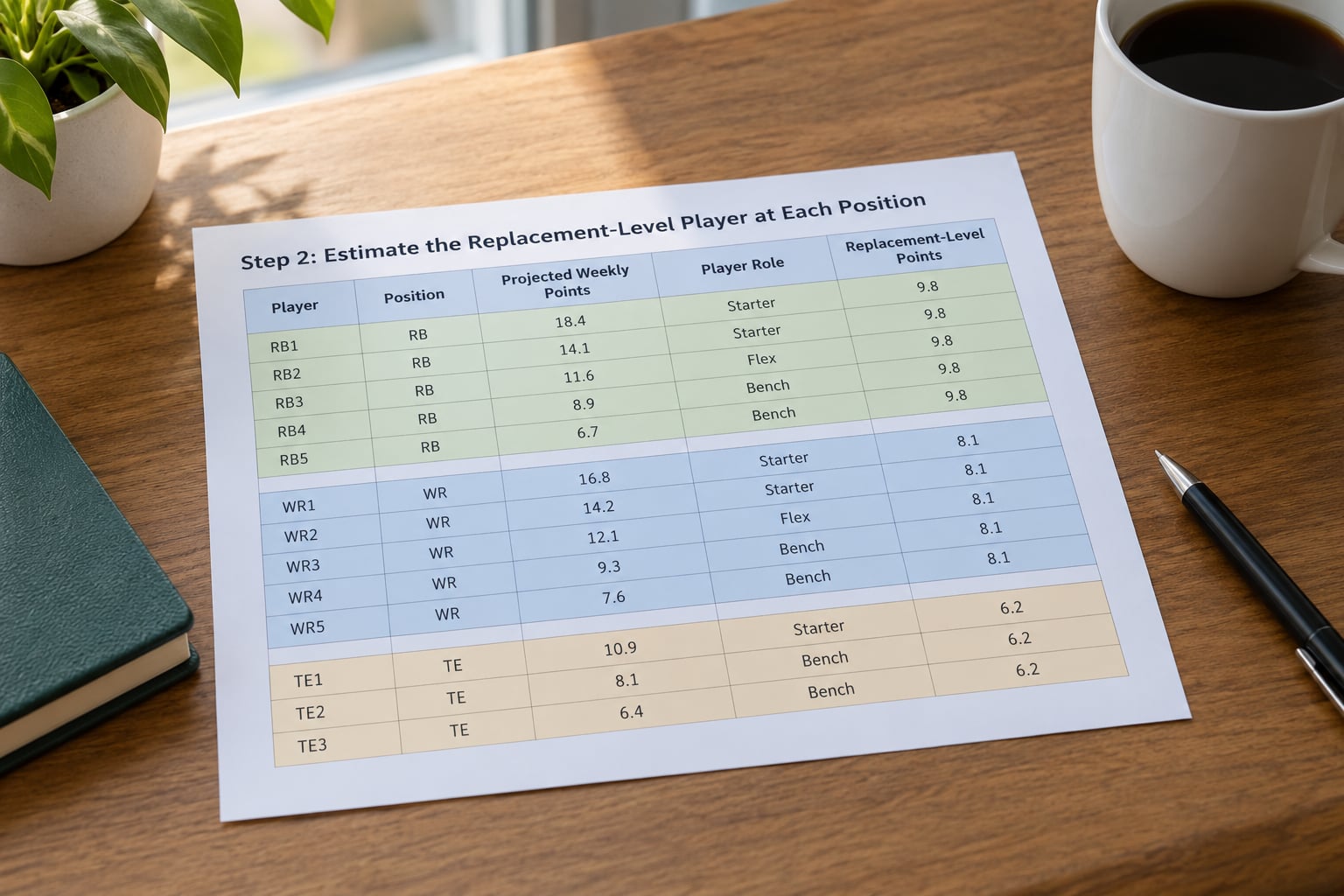
The replacement player is not a specific person. It is a projection: the last player at that position whose weekly output you would accept at that spot. Find that line by sorting your projections at each position, dropping down to the replacement rank, and asking whether the names just below it are guys you would actually start.
Three filters decide where the line sits. Projected weekly points tell you the output. Weekly role tells you whether that output is sustainable. Expected games played tells you whether it survives the season.
The table below is an illustrative read for a twelve-team PPR league with one flex, using made-up but plausible seasonal projections.
| Position | Baseline convention | Replacement line | Players above replacement | Replacement points |
|---|---|---|---|---|
| Quarterback | QB12 | 12th QB | 15 | 248 |
| Running back | RB24 | 24th RB | 20 | 262 |
| Wide receiver | WR30 | 30th WR | 34 | 196 |
| Tight end | TE12 | 12th TE | 8 | 178 |
Notice what happened to tight ends. Twelve teams need twelve starters, but only eight tight ends project above starter-level output. That gap is the whole story, and the next step measures it.
Step 3: Calculate Positional Scarcity With a Scarcity Index
The scarcity index is one line of arithmetic:
Scarcity Index = Positional Demand ÷ Players Projected Above Replacement Level
Read it slowly. Numerator: how many starter jobs your league creates at that position, which is teams multiplied by starting slots, with flex counted loosely. Denominator: how many players project above the replacement line you just set.
An index above 1.00 means demand outruns supply, so the league runs out of real starters before the draft runs out of players. An index below 1.00 means there are more good-enough options than jobs, and depth is cheap.
Pair it with the drop-off figure, which measures how far the top of the position sits above its own replacement line:
Drop-off % = (Elite Player PAR − Replacement Points) ÷ Replacement Points × 100
PAR means points above replacement, and it is just projected points minus the replacement points from Step 2. Same league, same format, same table of players, and PAR is comparable across positions. Change formats and it stops being comparable.
| Position | Starting demand | Above replacement | Scarcity index | Elite-to-replacement drop-off |
|---|---|---|---|---|
| Quarterback | 12 | 15 | 0.80 | 53% |
| Running back | 24 | 20 | 1.20 | 26% |
| Wide receiver | 30 | 34 | 0.88 | 84% |
| Tight end | 12 | 8 | 1.50 | 80% |
Tight ends score highest, which matches what these league types usually produce: a shallow pool of real starters, so the last one standing is worth a reach. Quarterbacks score lowest despite a large drop-off, because plenty of quarterbacks project above replacement and a starter job is only worth 1.20 a week.
That contrast is the useful part. Drop-off alone says tight ends and receivers have a cliff. The scarcity index says only tight ends have a shortage of actual starters. Use both.
Step 4: Check Draft Capital and Realistic Availability
An index of 1.50 is only useful if the player you want is still there when you pick. Average draft position tells you what the market thinks, and a big disagreement between your scarcity board and consensus ADP is where the value lives.
| What you see | What it means | Draft move |
|---|---|---|
| Scarcity index at or above 1.30 and the player goes well above consensus ADP | The market is underpricing a real shortage | Reach, but only inside a round or two of your own valuation |
| Scarcity index at or above 1.30 but you have no slot at that position until round 9 | The shortage is real and irrelevant to you | Take the best player available, keep the need in mind |
| Scarcity index below 1.00 and the price matches ADP | Depth is plentiful and correctly priced | No premium, draft on need later in the draft |
| High index, but every good option is already off the board | The shortage happened before you arrived | The premium is gone. Draft down, not up |
Roster construction decides how many of these situations you will face. Two tight end slots in a twelve-team league puts you in the market every year, whether the index agrees or not.
Step 5: Apply Scarcity Without Ignoring Player Quality

Scarcity gives you a reason to look at a position. Quality decides whether you take the player. Check ceiling, floor, injury profile, role and projected availability before the position name does any work in your head.
A tight end with a 1.50 index is still a bad pick if his floor is three points a week and his ceiling depends on a rookie quarterback. Scarcity describes the supply curve. It says nothing about whether this particular player sits near the top of it.
Two practical rules keep this honest. Draft up only when the position is short on starters and the available player is inside his own tier. Otherwise take the best player available and let the scarcity situation find you a few rounds later.
Step 6: Recheck Scarcity During Your League and Each Week
A pre-draft scarcity index goes stale the moment your league moves. One team takes two tight ends in round two and your replacement line shifts by three names. Running backs do not survive contact with a season, and receivers leave practice reports with hamstrings every August.
The reset rule is worth internalizing: once every team has a starter at a position, the scarcity premium at that position goes to zero. There is no longer anything to protect yourself from. In the r/fantasyfootball thread comparing value-based drafting, tiers, ADP and scarcity, that behavior came up as intuitive but rarely explained, and it is the single most useful correction to pre-draft scarcity thinking.
A weekly check takes five minutes:
- Has a starter at this position been traded away or dropped?
- Did an injury push a replacement-level player below the line?
- Do my league mates still have the number of players above replacement that I counted on draft day?
- Is the waiver wire cheaper than it was at the draft?
Rerun the index with the new counts, not new opinions. Scarcity is arithmetic, so recheck it like arithmetic.
Common Mistakes When Calculating Positional Scarcity
- Treating raw ADP as scarcity. ADP tells you price, not supply. Correction: use ADP only as the comparison line against your own scarcity board.
- Ignoring your own roster rules. A generic QB12/RB24/WR30/TE12 baseline applied to a superflex league badly understates quarterback value. Correction: rebuild the baseline from your slot count.
- Using one threshold for every position. Eight projected points above replacement means something different at tight end than at running back. Correction: find the replacement line position by position.
- Overvaluing scarcity at thin positions. A high index at a position nobody drafts until round 10 buys you nothing. Correction: pair the index with your draft slot.
- Counting injured and low-volume players. A player projected for 200 snaps is not above replacement. Correction: filter on projected games and role before you count.
- Applying season scarcity to weekly lineup decisions. Drafting a tight end early because the position is scarce does not mean starting him in a week where your running back has a great matchup. Correction: keep the draft decision and the lineup decision separate.
The most common confusion in draft communities is treating scarcity as value. A scarce but merely average player is not valuable, he is just expensive. That single distinction is the difference between a reach and a mistake.
For draft day, recalculate the index after every two or three picks and pre-load the one or two positions where the index and consensus ADP disagree most. For weekly play, the scarcity math tells you what the league owns, not who starts on Sunday.
Frequently Asked Questions
What is positional scarcity in fantasy football?
Positional scarcity is the degree to which a position’s top performers sit far above the rest of the field in projected points. You measure it by setting a replacement-level baseline for the position, calculating each player’s points above replacement, and comparing demand against the number of players left above that baseline. A position with few real starters and a wide gap between the best and the replacement is scarce, and its elite players carry a draft premium.
What makes one fantasy football position scarce?
Two things make a position scarce: not enough players who project above starter-level output, and a large gap between the elite players and that replacement line. Tight ends often score high because a twelve-team league needs twelve real starters and only a handful project above the line. Quarterbacks usually score lower because plenty of quarterbacks project above replacement even though the gap at the top is wide.
Should I draft the best player available at a scarce position?
Only when the position is short on starters and the player sits inside his own tier. Scarcity justifies attention, not selection. Compare ceiling, floor, injury profile and expected games played before you let a high scarcity index pull you off the board. If quality is genuinely close, the scarce position wins, because that shortage will not exist on your turn later.
How does positional scarcity change in dynasty leagues?
In a dynasty startup, the window is longer, so scarcity applies to a run of drafts rather than one afternoon. The tight end class matters in year one and then the position rotates. You should count young players at a position as part of the supply over several years, and put more weight on age curves and opportunity than on a single season’s drop-off figure.
Is ADP the same as positional scarcity?
No. Average draft position records what the market pays for a player, while positional scarcity describes how supply and demand behave at his position. They usually agree, and the interesting situations are where they do not. Use ADP as the comparison line against your scarcity board, and use the gap between them to find where your draft differs from the room.
Conclusion: Start With the Replacement Player
Four actions, in order: audit your roster rules and set a replacement baseline at each position, convert your projections to points above replacement, divide positional demand by the number of players above replacement, then compare the result with consensus ADP before you draft up.
That is how to calculate positional scarcity in fantasy football without a black-box score. If you do nothing else this week, pull up your league settings and confirm your baseline lines. Everything downstream of that number is only as personal as the settings you started with.