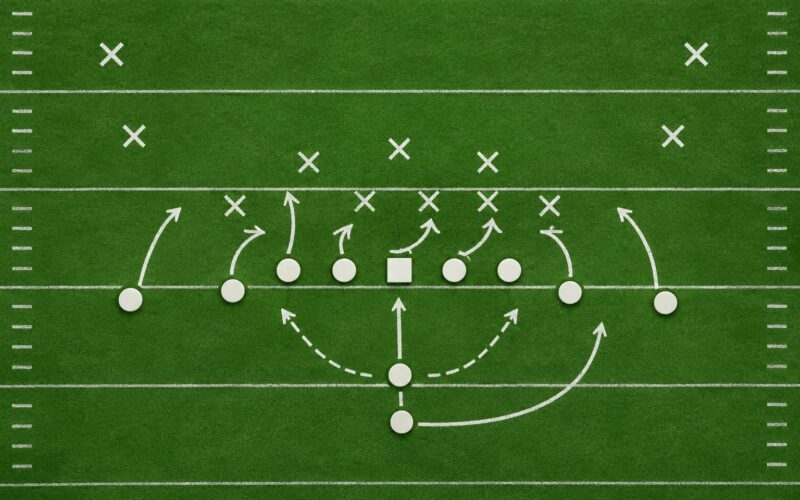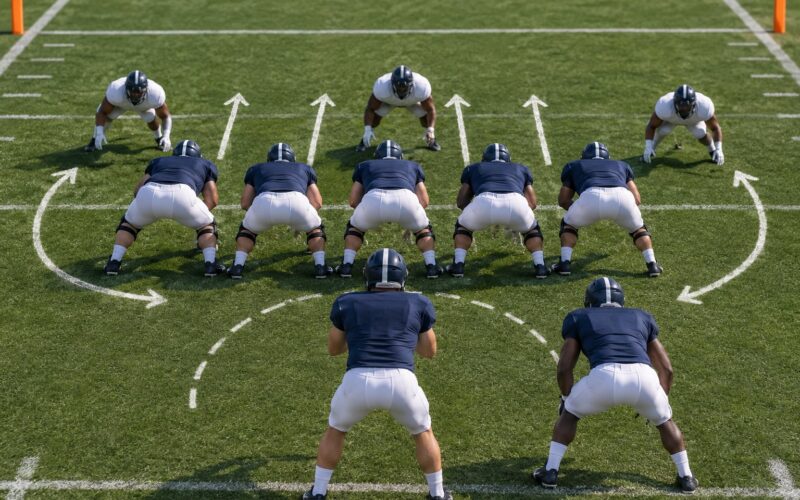
Pass rate over expectation (PROE) is the gap between how often a team actually passes and how often it should have passed given the down, distance, score and time remaining. A positive number tells you an offense is more pass-happy than the situation demands. That matters for fantasy football because volume is the first input in every projection, and raw pass rate lies about volume constantly. Knowing how pass rate over expectation affects fantasy value comes down to one question after that: does the extra volume land on players who are actually used?
The important part, and the part most previews skip, is that PROE is a team number. Turning it into fantasy value means asking one more question: does this team’s extra volume land on players who are actually used? I have watched plenty of high-volume offenses produce almost nothing at the receiver position, and the reason always comes back to target concentration.
Here is how the metric works, where it holds up, and where it stops helping.
Table of Contents
- What Is Pass Rate Over Expectation?
- How Is the PROE Formula Calculated?
- How to Interpret Positive and Negative PROE
- How Pass Rate Over Expectation Affects Fantasy Value
- What Does a High PROE Mean for Fantasy Players?
- What Does a Low PROE Mean for Fantasy Players?
- Why Raw PROE Numbers Can Mislead You
- How to Adjust Fantasy Value Using Pass Rate Over Expectation
- How Many Games of PROE Should You Trust?
- How Pass Rate Over Expectation Differs by Position
- How to Use PROE in Weekly Lineup Decisions
- How to Use PROE in Draft and Dynasty Strategy
- Frequently Asked Questions
- Is a high pass rate over expectation always good for a fantasy football player?
- How is PROE different from target share and pass rate?
- What is the best sample size for evaluating pass rate over expectation?
- Does PROE matter more for quarterbacks, receivers, or running backs?
- Should I react to a large one-week PROE change?
- What to Do First
What Is Pass Rate Over Expectation?
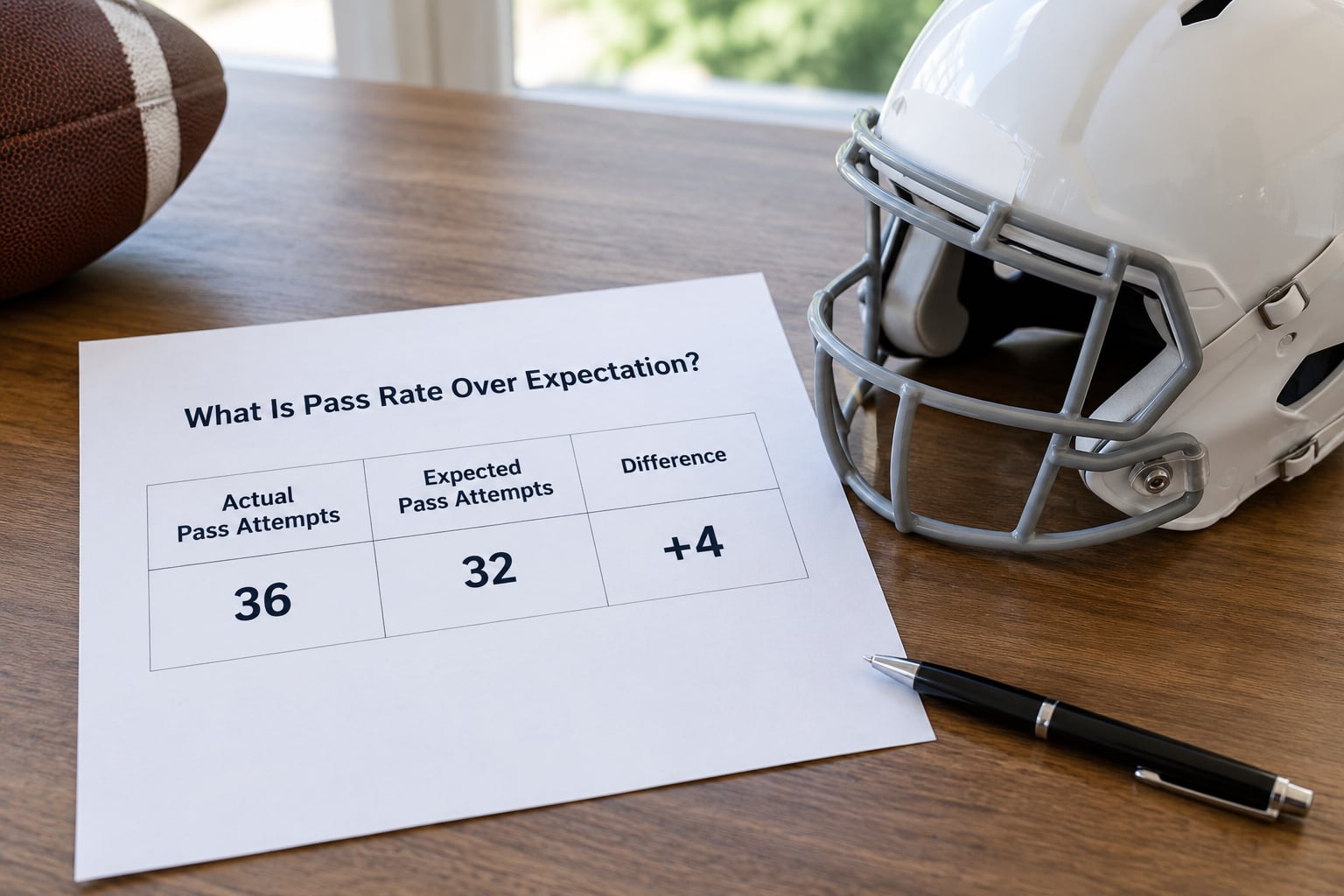
PROE compares a team’s actual pass rate to the pass rate the context of its drives would have predicted. Every offensive play gets an xpass probability, the estimated chance a called pass was the right decision, from the play-by-play probability model built on nflfastR data. Average those probabilities across the offense’s plays and you have the expected pass rate. Subtract it from the actual pass rate and the difference is PROE.
That subtraction is the whole idea. A team trailing by 21 in the fourth quarter will throw a lot, and its raw pass rate will look elite. Strip out the situations that forced those throws and the number collapses. What is left is intent, the part a coach chose before the score made the decision for him.
How Is the PROE Formula Calculated?
Three steps, and you can reproduce all of them with any play-by-play tracker.
- Count actual passes. Dropbacks that end in a pass attempt, including scrambles that turned into throws. Special teams plays do not count.
- Sum the xpass probability of every offensive play the team ran, then divide by the number of plays to get the expected pass rate.
- Subtract expected from actual. Express both as a percentage of plays and take the difference. Positive means more passing than context. Negative means more running.
Here is an illustrative week, not a real team’s numbers.
| Step | Value | Note |
|---|---|---|
| Offensive plays | 68 | Excludes special teams |
| Actual pass attempts | 47 | 69.1% actual pass rate |
| Sum of xpass probabilities | 44.1 | Expected pass attempts |
| Expected pass rate | 64.9% | 44.1 divided by 68 |
| PROE | +4.2 percentage points | 69.1% minus 64.9% |
Sign convention is worth remembering because the phrase gets used loosely. Positive PROE is above expectation. Negative PROE is below. Neutral, in most published thresholds, sits within about plus or minus two percentage points, and I would treat anything inside that band as no signal rather than as a mild lean.
How to Interpret Positive and Negative PROE
| PROE reading | General read | Fantasy read |
|---|---|---|
| +5% to +8% or higher | Pass-first identity | More dropbacks each week than schedule alone would predict |
| +2% to +5% | Pass-leaning | Mild upward nudge to volume assumptions |
| -2% to +2% | Neutral | Do not adjust anything on this |
| -5% to -8% or lower | Run-first identity | Fewer targets available for pass-catchers, more carries for backs |
These are convention bands, not laws. League pace changes the baseline, so a run-first number in a high-scoring season is less extreme than it looks. I would rather look at a team’s own direction over its last several weeks than at a single printed threshold.
How Pass Rate Over Expectation Affects Fantasy Value
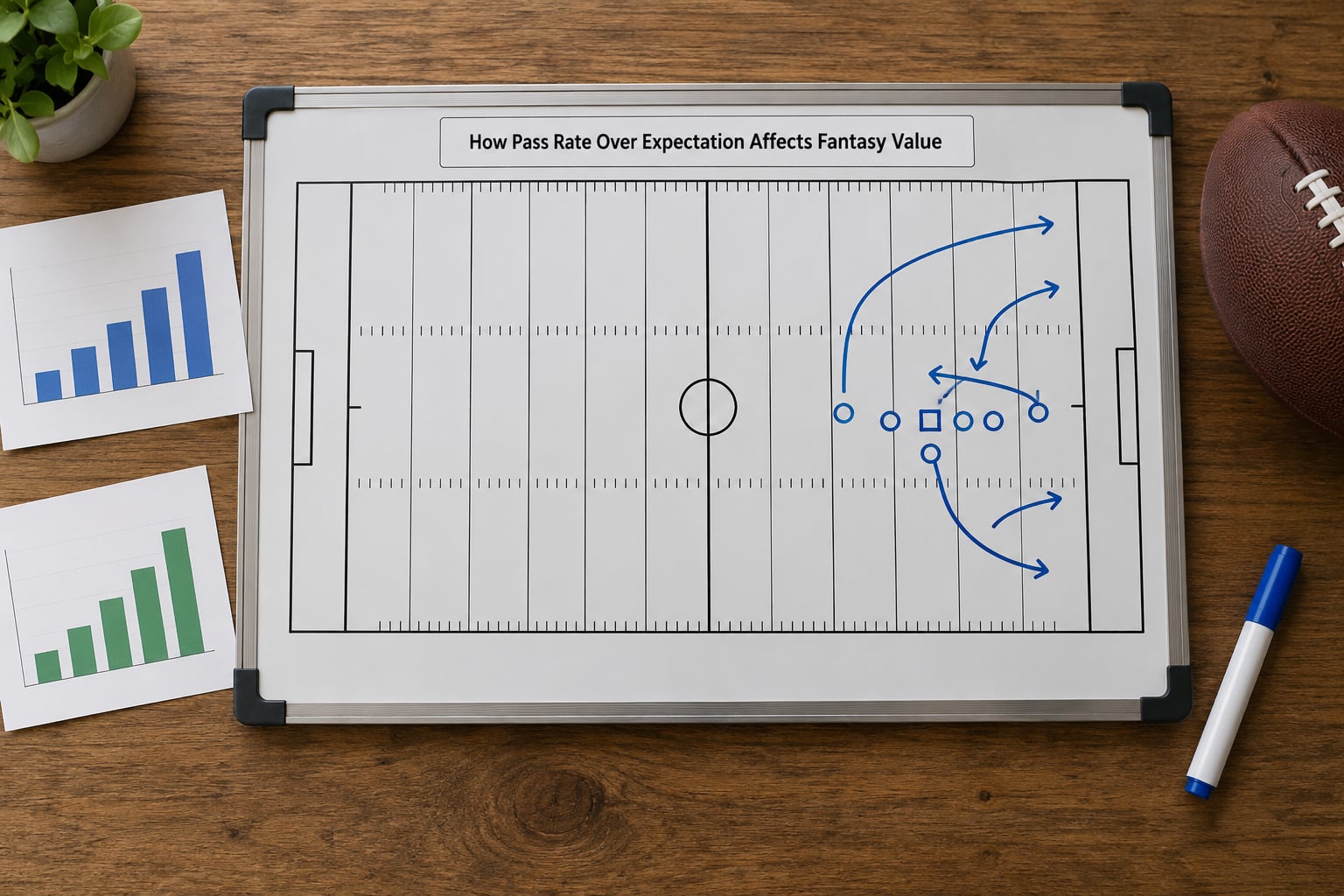
How pass rate over expectation affects fantasy value runs through one channel only: opportunity. Extra passes create extra dropbacks, dropbacks create targets, and targets are where fantasy points come from. Everything else is distribution, and distribution is a player-level question.
The transmission chain runs like this.
- Team PROE rises. More plays end in a pass attempt than the context required.
- More dropbacks. The offense spends more of its play budget in pass concepts.
- More targets. Total targets for the offense go up.
- Target share splits that pool. A player gains volume only if they win a bigger slice of it.
- Air yards share decides the ceiling. Where those targets land in the field sets the upside.
- Scoring converts it. In half-PPR leagues a target is worth a fixed amount on top of receiving yards. In PPR it is more.
Steps one through three are arithmetic. Step four is where almost every mistake happens, and it is the step PROE cannot do for you.
What Does a High PROE Mean for Fantasy Players?
Sustained positive PROE means the offense has more passing volume available than its schedule explains. For a quarterback that is simply more dropbacks, and it usually lifts the floor of their weekly output. For a pass-catcher it means a bigger pie, not a bigger slice.
A wide receiver needs a rising target share on top of the team volume to actually change their value. If the offense is throwing 45 times a week and one player owns 40% of the targets, the other three are competing over scraps while the headline volume number climbs. Team volume expands the ceiling; target share decides who reaches it.
What Does a Low PROE Mean for Fantasy Players?
Persistently negative PROE shrinks the target pool. That is the single clearest effect on receivers and tight ends, and it is why a high-target wide receiver on a run-first offense is a different player than the same receiver on a neutral one.
For running backs the direction flips. Fewer passes usually means more carries, which supports a workhorse projection. One bad week of low PROE says almost nothing, because a single game can be decided by the opponent, the scoreboard and the weather.
Why Raw PROE Numbers Can Mislead You
Sample size is the big one, but there are five others worth naming.
- Small samples. A five-game window can swing wildly, and red zone PROE is built on a handful of plays per game.
- Game script leakage. Blowout margins and garbage time still influence the numbers unless you filter by neutral situations.
- Opponent strength. A defense that gives up passes under pressure can inflate a week’s raw figure.
- Coaching and quarterback changes. A new play-caller or a new starter under center rewrites tendencies, and last season’s PROE stops predicting anything.
- Frequency versus conversion. Volume without target concentration is the failure mode that costs people the most seasons.
That last one deserves emphasis, because it is the complaint I see most often from people in fantasy football forum threads. High passing volume, low target concentration, and nobody on the team beats their projection. Volume is a condition for scoring, not a substitute for it.
How to Adjust Fantasy Value Using Pass Rate Over Expectation
A repeatable five-step process, same order every week.
- Check the rolling trend. Look at a last-four or season-to-date figure, never a single week.
- Estimate the opportunity change. If team PROE shifted by about three points, that is roughly three more passes per 100 plays. Translate that into expected targets across a full schedule.
- Apply target share. Multiply the team target estimate by the player’s realistic share. This is where most volume optimism dies.
- Adjust the projection slightly. Move the player’s forecast a few percent, not a tier. PROE is one input, not the whole model.
- Check for double counting. If your projection already assumes a new offensive coordinator or a favorable schedule, PROE is likely already inside it.
Pair it with target share, air yards share, weighted opportunity and yards per route run. Most analysts treat PROE as the volume layer and the others as the quality layer, and that division keeps you from confusing a quarterback with a route-running specialist.
How Many Games of PROE Should You Trust?
Match the window to the decision you are making. A weekly lineup call and a dynasty valuation are not the same question.
| Sample window | Reliability | Best used for |
|---|---|---|
| One week | Very low | Nothing on its own. Game script dominates. |
| Rolling 4 weeks | Moderate | Start/sit calls and weekly matchup research |
| Rolling 8 to 12 weeks | Good | Waiver wire adds and role-change detection |
| Season to date | Good but lagging | Redraft baselines and player targets |
| Year over year | Directional | Dynasty trend and scheme-change signals |
Early in the season, treat PROE as a hypothesis rather than a fact. Once a team has eight or nine games of neutral data, the number starts telling you what the offense wants to do.
How Pass Rate Over Expectation Differs by Position
The metric is the same for everyone. What changes is how much of the transmission chain you can actually see and act on.
| Position | High PROE effect | Low PROE effect | What you still need |
|---|---|---|---|
| Quarterback | More dropbacks, higher weekly floor | Fewer attempts, fewer fantasy points | Red zone touchdown rate, sacks, rushing |
| Wide receiver | Bigger target pool | Shrunken target pool | Target share and air yards share |
| Running back | More pass-down work for pass-catching backs | More carries for early-down backs | Goal-line work and pass-catching volume |
| Tight end | More targets if he is the primary outlet | Fewer chances in a two-tight-end blocking scheme | Route share and red zone usage |
Quarterbacks feel PROE most directly. Receivers feel it only in proportion to their share of it. Running backs feel it indirectly, and often in the opposite direction from what you would guess: a pass-heavy offense can hurt a non-passing back, while a run-heavy one guarantees early-down touches.
Tight ends are the position where team context matters most and shows up least. A high-PROE offense with a tight end running 20 percent of routes is a real opportunity. The same offense with a tight end at eight percent is a blocker wearing a jersey number.
How to Use PROE in Weekly Lineup Decisions
PROE is a tiebreaker, not a decision. Run it after you have a projection and a matchup read, not before.
- Set your threshold first. Decide what the player needs to hit, in targets or in points, for the matchup to be startable.
- Estimate expected team volume. Use neutral PROE plus the opponent’s own defensive tendencies.
- Check coverage. A pass funnel defense that concentrates targets under the coverage can override a low team PROE.
- Confirm recent role. Four weeks of PROE plus current target share tells you more than either alone.
- Price the game script. A favorite who falls behind will pass more than their PROE suggests, and a heavy favorite who is ahead will not.
Expectations also belong here. If a player needs eight targets and their realistic share supports six, the matchup is not as good as the schedule looks.
How to Use PROE in Draft and Dynasty Strategy
Over a season, PROE is less about one week and more about direction. A team whose neutral PROE has climbed two or three points since last season is telling you something about scheme, and scheme change is where dynasty breakouts come from.
That shift shows up first in role. When an offense gets more pass-happy, running backs lose early-down work, tight ends gain red zone looks, and the slot receiver’s route tree expands. A player whose role changed inside a rising PROE offense is a different valuation than the same player last season, and trade prices often lag that by a year.
For drafts, use season PROE as a tiebreaker on borderline wide receivers: a player on a pass-first offense needs fewer targets to produce than the same player on a neutral one. For keepers and trade targets, watch the year-over-year line rather than the current number, since teams change coaches and quarterbacks more often than they change identities overnight.
Do not let PROE replace film, target share or efficiency research. It tells you how many chances exist. Everything else decides what those chances are worth.
Frequently Asked Questions
Is a high pass rate over expectation always good for a fantasy football player?
No. High PROE means the team passes more than its game situations require, which expands the total number of targets available. It does not guarantee your player receives them. A receiver needs a rising target share and a share of the air yards to convert that extra volume into points. Plenty of high-volume offenses spread targets so thin that no individual player beats their projection. Treat PROE as the volume layer of a projection, never as the projection itself.
How is PROE different from target share and pass rate?
They measure different things. Pass rate is the raw share of plays that end in a pass, distorted heavily by score and time remaining. PROE subtracts the pass rate the context predicted, leaving only the intent. Target share is a player-level metric showing what portion of his team’s targets one player receives. PROE sets how big the pie is; target share decides the slice. You need both before either means anything.
What is the best sample size for evaluating pass rate over expectation?
Use a rolling four-week window for weekly lineup decisions and eight to twelve weeks for waiver wire and role-change calls. One week is too small because game script dominates. Red zone PROE needs even more, since only a handful of passing plays per game happen inside the twenty. Early in the season, treat any PROE reading as a hypothesis and wait for a fuller sample before adjusting a projection.
Does PROE matter more for quarterbacks, receivers, or running backs?
Quarterbacks feel it most directly, because extra dropbacks translate almost one-for-one into attempts. Receivers feel it only in proportion to their target share, so team volume can rise while their own role stays flat. Running backs feel it indirectly and often inversely, since more passing can remove early-down carries even as it creates more receiving work. Position matters more here than most PROE summaries admit.
Should I react to a large one-week PROE change?
Usually not. A single week’s figure mixes in opponent strength, score differential and pace, and PROE only strips out part of that noise. What you can do is look at whether the one-week move continues for two or three more weeks, which usually signals a real change in play-calling tendency. If the whole season trends that direction, adjust your projection slightly. If it was one game, leave it alone.
What to Do First
Open a neutral PROE tracker, pull the rolling four-week number for your best target, and compare it against that player’s target share before you change anything. If the two move together, nudge the projection up a few percent. If team volume is rising while the share is flat, leave the player alone.
That single check takes about five minutes, and it is the difference between reading pass rate over expectation as an answer and reading it as one more input in a projection.