Week 17 affects fantasy football playoffs because it stacks three separate events onto the same slate: the last or second-to-last NFL regular-season games, the week where rest and garbage-time lineups show up, and often your first or final playoff round. Whether those collide is decided by your league settings, not by the NFL. That is how two managers in the same NFL Week 17 can be playing for a title and for nothing at the same time.
Last updated: October 2026. Written to stay accurate no matter which NFL season your league is in.
If you take one thing from this: find out whether your league treats NFL Week 17 as a regular-season game, an elimination game, or your championship game. Almost every mistake managers make in Week 17 comes from answering that question late.
Table of Contents
- How Week 17 Affects Fantasy Football Playoffs
- Is Week 17 Usually the First Fantasy Playoff Week?
- How to Set Lineups for a Week 17 Fantasy Playoff
- Why Does the Week 17 Opponent Matter?
- How Do NFL Week 17 Situations Change Player Value?
- Scenario: the team has clinched its division
- Scenario: the team has clinched a top-four seed and a bye
- Scenario: the wild card seed is locked
- Scenario: the team is still fighting for a wild card
- Scenario: the team is eliminated
- Should You Start a Player on a Playoff Bye?
- What Tiebreakers Matter in Fantasy Playoffs?
- How Do Playoff Points Scoring Settings Change Strategy?
- Standard and PPR scoring
- Bonuses and negative plays
- Kickers and defenses
- Non-football roster spots
- How Week 17 Affects Fantasy Football Playoffs in Different League Types
- Redraft leagues
- Dynasty leagues
- Points-only and percentage-style leagues
- Head-to-head playoff leagues
- Frequently Asked Questions
- Is Week 17 the first week of fantasy football playoffs?
- Can a Week 17 NFL game count as a fantasy regular-season game?
- Should I start my best player even if his team has a playoff bye?
- Do NFL eliminated teams automatically hurt my fantasy playoff lineup?
- How early should I set my fantasy football playoff lineup?
- Conclusion: What to Do First
How Week 17 Affects Fantasy Football Playoffs
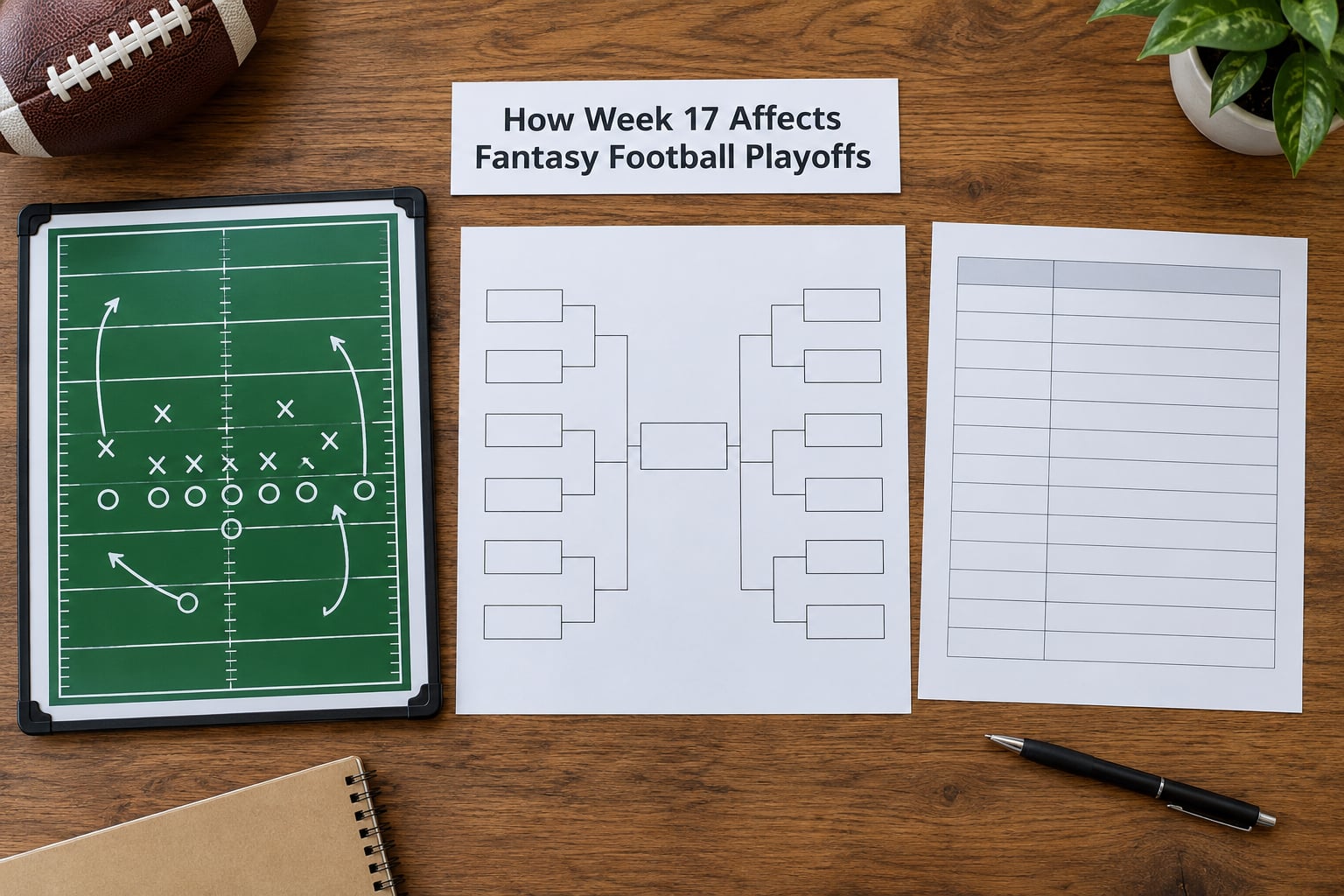
Week 17 affects your playoffs mainly through uncertainty. It is the week with the most NFL rest risk, the most eliminated teams, and the least predictable player usage, and all three land in the same lineup window.
Four things drive it. First, NFL teams that have clinched a division or locked a seed have less reason to play their best players. Second, teams eliminated from playoff contention often hand snaps to depth players late in lopsided games. Third, one big individual performance swings a weekly matchup harder in a single game than at any other point in the season. Fourth, a percentage-style league can decide its title on a single night.
The table below separates the three versions of Week 17 you will meet, because the strategy is different in each.
| Version of Week 17 | What it is | What it changes for your lineup |
|---|---|---|
| A normal Week 17 | Your league’s final regular-season games | Seeds and percentage standings are still moving; roster the players you want for later rounds |
| An extended Week 17 | A regular-season game that also counts toward some playoff tiebreakers or seeding | Late games can swing seeds and titles in the same night |
| A Week 17 playoff | A head-to-head playoff round decided by one slate | Rest risk, elimination and weather all matter far more than any season-long average |
Managers obsess over season-long projections in a week that punishes them for ignoring the specific game in front of them. A back with a fine yearly average facing the league’s best run defense is a different player in Week 17 than he was in September.
Is Week 17 Usually the First Fantasy Playoff Week?
Usually in a 17-game NFL season, and often not in an 18-game one. Your playoff dates come from the settings your platform’s commissioner chose, and the NFL calendar does not change them.
Three configurations cover almost every league:
- Weeks 15, 16, 17 — common in 10-team leagues and in seasons with 17 NFL weeks. Your championship is the last NFL regular-season week.
- Weeks 15, 16, 17, 18 — the standard for 12-team PPR leagues in 18-game seasons. Four rounds, one bye week, and the championship lands after the NFL regular season ends.
- Weeks 16, 17, 18 — a three-round setup used by smaller playoff fields or by commissioners who want a longer regular season.
Some platforms also let you set a championship week earlier than the final round, and dynasty leagues often run a separate title game in a week that has no head-to-head matchup at all. Check the league settings page rather than assuming, and check it before your matchup week, not during it.
How to Set Lineups for a Week 17 Fantasy Playoff
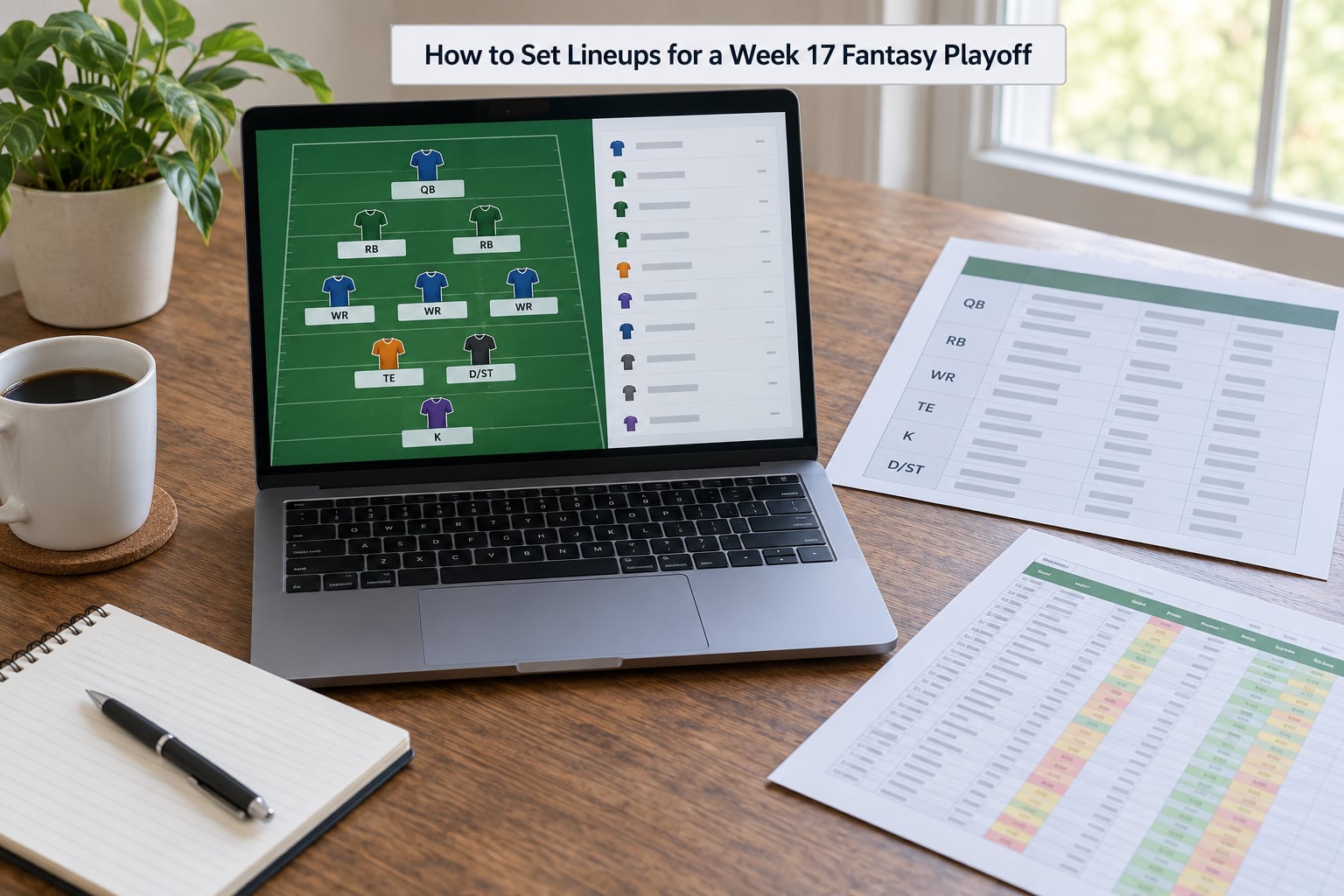
Run these seven checks in order, and you will have a defensible lineup instead of a guess. Most managers do the opposite and scramble on Sunday afternoon.
- Confirm the playoff calendar and your matchup. Know the date range, the number of rounds, and whether your opponent is the team you expect. A consolation bracket changes how much risk makes sense.
- Read the scoring settings again. Bonuses, negative plays, and non-football roster spots change which player is the best pick, not just which player is most popular.
- Find the lineup lock time. Some leagues lock at the first game, some at the individual game time, and some much earlier on Sunday. Later locks mean more usable backup information.
- Map every start to a backup you already own. On Sunday, before kickoff, a ready replacement is worth more than a hopeful add. Check the waiver wire before the Thursday deadline if a starter is doubtful.
- Sort your players by kickoff time. Early games tell you more before the late slate, and a Monday game can still flip a completed matchup.
- Check weather, roof status and travel for the outdoor night games. Wind and cold hit kickers and deep passing attacks harder than anything else on the slate.
- Know which tiebreaker could decide you. If you are tied on points, find out what the league uses before kickoff, not after the final game.
That checklist takes about fifteen minutes and it survives any league format, from a 12-team PPR redraft league to a dynasty title game.
Why Does the Week 17 Opponent Matter?
The Week 17 opponent matters because it decides which of your players are actually in their role that weekend. Projected points tell you who is likely to start; the opponent tells you how that player will be used.
A defense that gives up the most fantasy points per game to running backs is not the same as one that gives up the most yards. Goal-line work, short passes and garbage-time volume come from different places, and Week 17 exposes the difference. A team trailing at home in the fourth quarter will hand a receiver five catches he would never get in a 20-10 game.
| Matchup situation | What it usually supports |
|---|---|
| Favorable matchup against a depleted secondary | Start the receiver you would normally consider a sit |
| Favorable goal-line volume | Start the back who rarely gets carries but scores touchdowns |
| Tough run defense plus a bad passing defense | A pass-first build that leans on receivers and tight ends |
| Dome opponent facing a windy outdoor game | Kickers with a floor, and receivers against a depleted secondary |
| Dreadful opponent on both sides | Start the best player available and stop overthinking it |
One more opponent factor gets ignored: the opponent’s own playoff situation. A team eliminated from NFL playoff contention plays its starters because there is nothing else to do, which usually means normal snap shares and, occasionally, a fourth-quarter demolition that inflates or deflates your whole team at once.
How Do NFL Week 17 Situations Change Player Value?
NFL situation changes player value in predictable directions once you know which situation a team is in. These are scenarios, not player predictions, because the same situation produces different coaching decisions in different seasons.
Scenario: the team has clinched its division
Expect meaningful rest risk for a player whose best weeks are behind him. A veteran with a declining role is a more likely casualty than a young player the franchise sees as its future. Check whether the coach has already said anything about the rotation, because coaches rarely improvise this in Week 17.
Scenario: the team has clinched a top-four seed and a bye
Rest risk drops sharply here because the regular-season games still matter for seeding. Teams holding a secure seed pull starters earlier, but they rarely bench a quarterback. Rebuilding depth for a playoff run is a stronger motive than the one that exists in a dead division race.
Scenario: the wild card seed is locked
This is the group most managers get wrong. A locked team knows the playoff field cannot catch it, so it may play down, or it may treat the week as a tune-up for the postseason. Both are plausible, and there is no public rule. Treat these players as the ones to check twice and consider replacing.
Scenario: the team is still fighting for a wild card
Nearly every starter plays. Managers searching these threads for rest risk in a team with a live shot usually come up empty. If you want a safer floor in Week 17, a player on a team that still has something to play for is the better bet than an equal player on a team that does not.
Scenario: the team is eliminated
No reason to rest healthy starters, but plenty of reason to play the young guys in the fourth quarter. That cuts both ways: it is the scenario where a star posts a full stat line and then a teammate who was not even on your radar collects garbage-time production.
In dynasty leagues the reverse logic applies. Rotations in Week 17 are free information about role in the following season, so the week matters for your roster construction even when your title game was two weeks earlier.
Should You Start a Player on a Playoff Bye?
No decision is required beyond your platform’s lineup rules. A playoff bye belongs to the NFL team, not the player, and if your starter is active and not on a bye week, he simply has no game and scores nothing.
The common misconception is that you must drop or bench him. You do not. He stays on your roster, he stays in your lineup, and he contributes zero points that week. The lineup slot he occupies still matters, though: on many platforms you cannot replace a bye-week player with a free agent, which is why checking your roster’s bye assignments early prevents a genuinely empty slate.
The bye weeks that matter most are the ones that hit your roster during the playoff weeks. Pull up your league’s bye schedule now and see how many of your starters are missing a game inside your playoff window.
What Tiebreakers Matter in Fantasy Playoffs?
The tiebreaker that decides your title is the one your league actually configured, and the order is usually hidden in the settings page rather than on the main screen.
The most common set, in order, runs head-to-head record, then total fantasy points, then division record, then winning percentage, then most points against. Leagues that use total points against often produce the least satisfying outcomes, because a manager who dominated an easy schedule gets punished for it in a tie.
Verify your order before your matchup week. In percentage-style leagues with no tiebreaker at all, a tie on the final night can mean a split pot and co-champions, which is exactly the outcome players complain about most. If you are the commissioner, set the tiebreaker in the league settings before Week 15 rather than during the final.
A related setting is whether playoffs are decided by head-to-head results or by total points across the playoff weeks. Both are legitimate, and they reward very different lineups.
How Do Playoff Points Scoring Settings Change Strategy?
Scoring settings decide how much variance you should accept, and they rarely get checked during playoff weeks. A manager who assumed the wrong setting can lose a championship to a bonus nobody mentioned.
Standard and PPR scoring
PPR rewards targets and points per reception, which makes role clarity more valuable than touchdown efficiency. In a one-game playoff, that favors the receiver with a defined route tree over the runner who needs a goal-line touch to score.
Bonuses and negative plays
Leagues that award a bonus for a 300-yard game or a multi-touchdown bonus reward upside players whose typical range already misses. Leagues with negative points for turnovers, fumbles or interceptions punish the same players twice. In a head-to-head playoff the riskier build is often right, and in a points-style league it is usually wrong.
Kickers and defenses
Both are streamable, and both swing on conditions rather than talent. A kicker on a team favored by six points with a poor offense is a reliable floor. A defense facing a team that has already clinched everything is a coin flip, which is why plenty of championship lineups include a defense nobody would start in a neutral week.
Non-football roster spots
A pitcher slot or a non-football flex spot makes streaming normal rather than risky. It also means your bench is shorter, so the players you add on the waiver wire must be realistic starters, not deep lottery tickets.
Two structural settings are worth knowing about before Week 17. Some platforms remove all stats from a game that is cancelled before it starts, as happened with a Week 17 regular-season game called off hours before kickoff, and others void only the individual players affected. And a commissioner who scheduled a championship in Week 17 left no room to move a rescheduled game. Read that rule before you need it.
How Week 17 Affects Fantasy Football Playoffs in Different League Types
Week 17 lands differently in each league type, because the same NFL week can be a title, an elimination, or nothing at all.
Redraft leagues
Week 17 is where rest risk, elimination and waiver-wire moves all collide. Rosters reset after the season, so the practical question is simply whether your playoff window lands on the most volatile NFL week of the year.
Dynasty leagues
Week 17 matters less for one-week scoring and more for information. Rotations, coaching changes and free agents finishing a contract all shape the offseason. Even when the title was decided earlier, the week is where you learn what next year’s usage will look like.
Points-only and percentage-style leagues
Here Week 17 is usually pure volume: the whole league is alive, the last games decide seeds, and a single star’s collapse can cost you a top-four finish. Conservative lineups tend to hold up better here because every round matters.
Head-to-head playoff leagues
One slate decides it, so the lineup should be built for ceiling rather than floor. That is the format where a streamer against a rested defense genuinely wins championships, and also the format where a 70 percent win probability produces a split pot because of one Monday night game.
The range is the whole point. A matchup that looks like a comfortable win at one o’clock can finish level with a Monday night kicker, and a fair number of title games end with co-champions for exactly that reason. A single slate has a wider spread of outcomes than a whole season does.
Frequently Asked Questions
Is Week 17 the first week of fantasy football playoffs?
Usually in 17-game NFL seasons, and often not in 18-game seasons. Playoff dates come from your platform’s league settings rather than the NFL calendar. Many 10-team leagues run Weeks 15 through 17, while 12-team PPR leagues often use Weeks 15 through 18 or Weeks 16 through 18. Open the league settings page and look for the playoff configuration; those dates do not move if the NFL schedule shifts.
Can a Week 17 NFL game count as a fantasy regular-season game?
Yes, in any league whose regular season runs through Week 17. In those leagues that same slate feeds your season total, and in some formats it also decides seeds or a playoff matchup on the same night. That overlap is why managers get burned: a game can decide both your playoff position and your playoff result. Confirm whether your format mixes regular-season and playoff scoring before the week starts.
Should I start my best player even if his team has a playoff bye?
Yes, and there is no alternative to starting him. A playoff bye belongs to the NFL team, not the player, so an active starter with no game that week simply scores zero. He stays on your roster and in your lineup. The part that actually needs attention is your bench, since many platforms will not let you replace a bye-week player with a free agent. Check your roster’s bye assignments early.
Do NFL eliminated teams automatically hurt my fantasy playoff lineup?
Not automatically. An eliminated team has little reason to rest healthy starters, so early-game production is usually normal, but coaching decisions get aggressive once the outcome is settled. Late-quarter garbage-time snaps can lift an unexpected player or drain a defense. Treat eliminated teams as neutral rather than dangerous, and check which players are getting fourth-quarter volume in that specific game.
How early should I set my fantasy football playoff lineup?
Draft a version about a week ahead, then finalize after the final injury reports and once kickoff times are sorted. Early drafts let you spot empty slots, missing players on bye and a thin bench before waivers get crowded. Wait until Sunday morning and you inherit whatever the rest of your league already claimed. The one exception is kickers and defenses, which is fine to add as late as your platform allows.
Conclusion: What to Do First
Confirm your league’s playoff calendar and rules before you optimize anything. If your window ends in NFL Week 17, you are managing rest risk, elimination and weather in the same week; if it ends in Week 18, you are managing one more bye wave and a longer injury list. Treating NFL Week 17 and your fantasy Week 17 as the same date is the mistake that costs titles.