How to handle resting starters late in the season comes down to three checks: confirm the player is actually sitting, name the specific player taking his snaps, then compare that replacement’s expected opportunity against what he is replacing on your roster. Do those three things and a rest day becomes a ten-minute adjustment instead of a panicked rebuild. A manager who has done it before can run the whole process in about fifteen minutes on a Sunday morning.
The hard part is not the mechanics. It is that rest days land hardest on teams with the best records, which means the same strong squads handed you your best weekly scores now take them away in your championship week. Nobody made a bad call that week. The lineup just got thinner around you.
Rest happens in the final two or three weeks of the regular season, once a club has clinched a seed, run out of realistic playoff math, or simply decided its core plays better fresh in January. That timing is the entire problem, and it is worth learning to see coming rather than reacting to.
Table of Contents
- What You Need
- Step-by-Step: How to Handle Resting Starters Late in the Season
- 1. Confirm Whether the Player Is Truly Expected to Rest
- 2. Identify the Player’s Real Replacement
- 3. Estimate How Much Work the Replacement Will Receive
- 4. Check the Matchup and Game Environment
- 5. Decide Whether to Make the Swap
- 6. Recheck Late-Week Updates Before Kickoff
- Common Mistakes
- Frequently Asked Questions
- Should I bench my starter when his team says he is resting?
- What should I do if my fantasy player is resting in week 18?
- Which NFL teams are resting starters in week 18?
- How do leagues handle rest weeks during the playoffs?
- Do NFL teams rest starters before the playoffs?
- Should I drop a kicker or defense on bye week or during a rest week?
- Conclusion
What You Need
Before you touch your lineup, gather seven things. Most managers already have four of them and skip the rest.
Official team reports. Coach press conferences Wednesday through Friday, plus the club’s own social accounts. The phrase that matters is “we’ll see” versus a flat confirmation. Treat anything from a beat reporter without team sourcing as unconfirmed.
Role notes. Who this player is in the formation, not just his position. A starting tight end who runs 40% of routes is a different asset from a blocker who catches three passes a game, and a rest affects the two very differently.
Replacement candidates. At least two names per position, from the same team’s depth chart plus one waiver wire option outside that team. Having a second option pre-selected is what keeps you from making the first one that pops up in a panic.
Injury context. Check whether the player is nursing something. A player who missed practice with a minor issue and is being managed is very different from a healthy veteran getting planned rest.
Game script assumptions. What each team needs from this game. A team resting a running back because it will be up 28 points is handing the workload to someone in a blowout, which caps fantasy value quickly.
Matchup data. The opposing defense’s tendencies against that position, not just its season totals. A third-string back facing a front that has allowed almost nothing on the ground is still worth a look.
Your league settings. Scoring format, flex eligibility, roster limits, and the dates of your playoff weeks. The last one matters more than most managers realize, and I’ll come back to it.
Step-by-Step: How to Handle Resting Starters Late in the Season
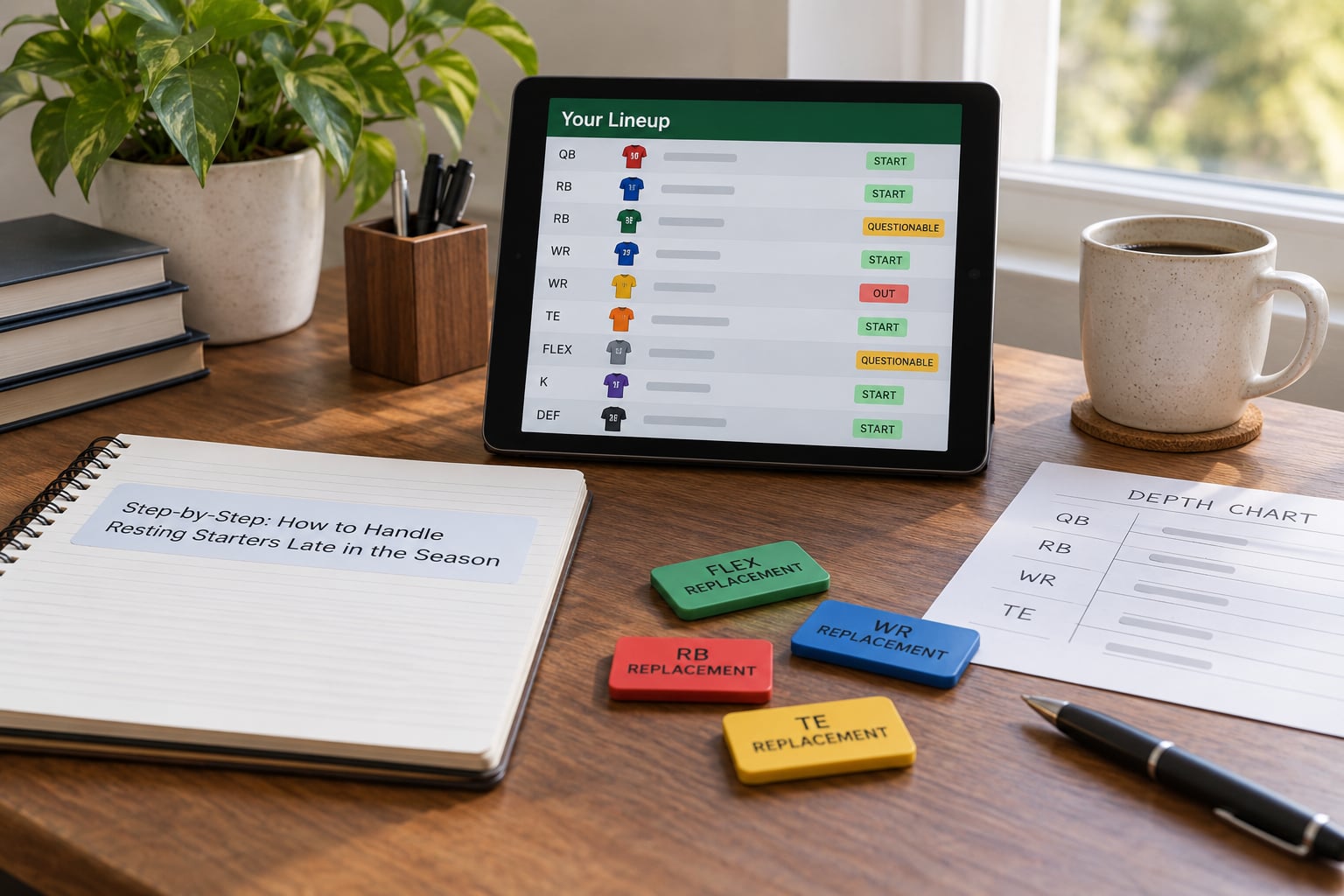
1. Confirm Whether the Player Is Truly Expected to Rest
Reports fall into four tiers, and they are not equal. The first is an official statement from the team or a direct quote from the head coach naming the week. That is as close to certainty as this sport offers.
The second tier is a team reporter with a sourcing chain: someone who was at the practice facility or on the call with a player. Treat this as likely but keep checking.
The third tier is aggregated speculation built on record and standings, the “this team has nothing to play for so look for rest” genre. That is reasoning about incentives, not news, and it is sometimes flat wrong. A coach who has publicly said he will play his starters because he wants to stay in the race will do exactly that.
The fourth tier is a social post from no particular source. Ignore it.
Source quality sets your confidence, and confidence should set how hard you work the rest of the process. An official report gets a full replacement search. A rumor gets a note in your phone and a check on Saturday.
2. Identify the Player’s Real Replacement
The backup listed on the depth chart is only a starting point. Look at recent snap counts, route participation, and who actually finished games ahead of him. Depth charts in late December are frequently a list of alphabetical order.
Then look at position competition. In a committee backfield, one “starter” sitting may shift the entire rotation rather than hand one player the job. In a committee receiving corps, the touches spread across three bodies and the vacated target share gets divided, which changes the math on every name involved.
Scheme matters as well. A team that leans on play-action and a single tight end can absorb a running back rest comfortably. A team that built its identity around a workhorse back with almost no committee behind him cannot, so the ball either goes to a low-end backup or to the passing game, which pushes value toward receivers and tight ends in that offense.
Write the name down before you search the waiver wire. Searching cold is how you end up with the most popular player on the platform and no idea whether he touches the ball.
3. Estimate How Much Work the Replacement Will Receive
An empty jersey is not automatically an upgrade. Build a simple projection instead of a hope.
Start with expected snaps. If the starter played 28 snaps and the backup has never exceeded 15, scaling that up by 30% gives you roughly the real ceiling, not the one in your head. Then apply touches and targets: a running back who only gets early-down work in a neutral script is a trap, and a receiver who inherits the slot of an outside receiver inherits his route tree too.
Goal-line and red-zone usage is where thin-replacement value hides. A team that does not want to injure its quarterback will hand the short-yardage snaps to the new back, and short-yardage snaps are where the biggest chunks of fantasy scoring come from.
Then run the blowout scenario. If the game script turns into a 24-point deficit by the third quarter, the replacement’s fourth quarter snaps get pulled and the floor drops toward zero. Fantasy managers routinely project a starter’s snaps and forget that garbage-time production belongs to whoever is still on the field.
4. Check the Matchup and Game Environment
Once you have a role, price the opponent. A backup with a defined workload facing a defense that gives up a lot to that position is a legitimate start, and often a good one.
Then adjust for pace and expected totals. Teams that pace fast and pass more create more opportunities for a substitute to be useful than teams that run three-and-outs. Weather in a late-season game can push volume toward a specific position, particularly in the wind or heavy rain, and indoor domes do the opposite.
Home field is a small but real edge for a player with an uncertain role, because a coach testing a backup will give him more work rather than less when the crowd is on his side.
Kickoff time matters too. A late Sunday game gives you one more batch of news and one more chance to react. A Thursday night game means your decision was made on Wednesday with less information than you wanted.
5. Decide Whether to Make the Swap
How to handle resting starters late in the season becomes a much easier question when you have a rule in advance instead of making it live. Here is the one I use.
Compare expected replacement opportunity against what the vacated slot currently holds, then check positional scarcity in your league. In a two-start RB setup, losing your lead back is painful because the replacements are thin. In a PPR flex where you can pivot to a receiver or tight end, the same rest is close to a non-event. Scarcity does more work than talent here.
Watch for the trade-up case. If the backup is projected to out-produce the player you would otherwise start, the swap is obvious even if the name is unfamiliar. Owners hesitate to start unowned players, then lose to one every season.
Also check roster rules before you drop anything. If your league has a locked playoff seed and a short bench, you may simply not have the room to add a stash. Know your limits before you need them.
And decide how long the absence lasts. One week of scheduled rest is a one-week problem. A coach saying a player will be managed through the end of the season is describing a role change, and in dynasty leagues that matters more than any single week’s points.
6. Recheck Late-Week Updates Before Kickoff
Reports change, and so do plans. A player flagged as resting on Wednesday can be active on Sunday because the team decided it needed him, and those reversals are not rare.
Build a short timeline instead of checking all day. Saturday afternoon, read the coach’s final comments and any team injury designations. Sunday morning at 9:00 a.m. Eastern, check the practice reports if your platform posts them, then check the gameday inactive list and late scratches closer to your typical kickoff.
Confirm the replacement’s status too. The player you swapped in may be the one limited or out, and finding that out at 12:55 is expensive. A quick scan of every player you changed saves the week.
Set your lineup, then stop. Re-checking past kickoff rarely produces information you can still use, and it produces a lot of stress.
Common Mistakes
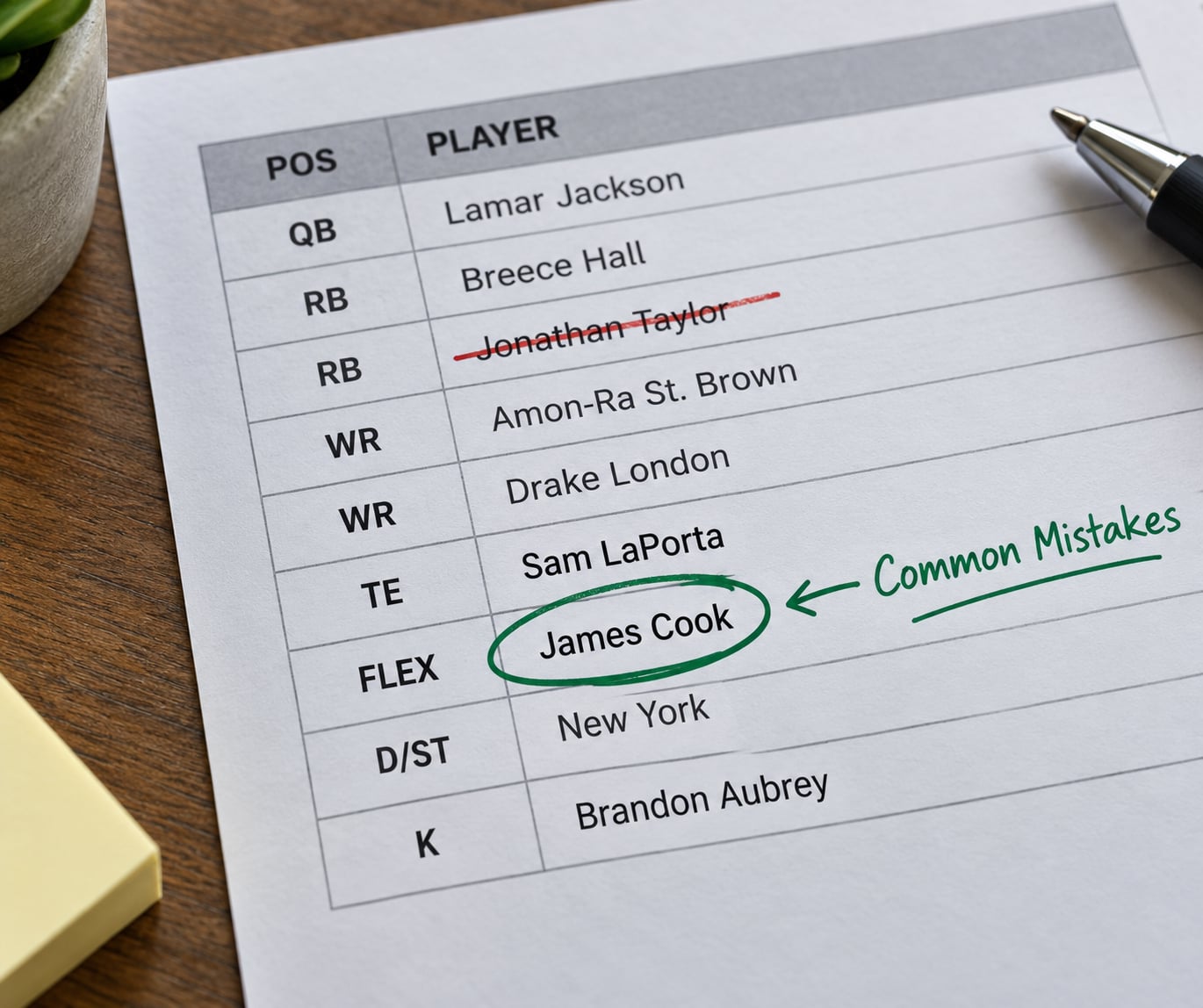
Benching the starter automatically. The point of a start-sit decision is expected value, not punishment. If the rested player is still the best option available to you, starting him is the right call. Resting wideouts often land on a bench that is thinner at the position, and swapping down to fill a gap can cost more than it gains.
Overreacting to a low-profile replacement. A deep backup on a bad team against a bad schedule is usually a floor player, not a breakaway. Take the modest projection or play someone with a real role.
Ignoring the role, focusing on the name. A starting tight end who runs most of the routes can survive one week without his quarterback. A wide receiver who catches three balls a game because he blocks on 70% of snaps cannot, regardless of his name.
Deciding too early. Reacting at 11 a.m. on Sunday means making the swap without knowing who is actually active. The information that resolves most of these calls arrives between noon and kickoff.
Applying one rule to every league. What is correct in a standard league with two starting running backs can be reckless in a dynasty league where the player has two years left. League format is not a footnote to the strategy, it is the strategy.
Ignoring your league’s playoff calendar. This is the mistake nobody writes about. If your commissioner set your playoffs to run through the final week, you are exposing your best roster to the highest rest risk of the year. Many managers have pushed their league to start playoffs one or two weeks earlier for exactly this reason, and it is a setting you control rather than something you accept.
Two habits reduce this damage all season. First, keep your bench stocked with two low-cost running backs from offense-friendly teams. Second, in dynasty leagues, take a flier on a backup whose team controls its playoff seeding; those guys are cheap now and start scoring in January.
Frequently Asked Questions
Should I bench my starter when his team says he is resting?
Sometimes, and the deciding factor is your replacement options rather than the starter’s status. If the next-best player available to you projects at least as high as the rested starter, make the swap. If the replacement is a deep backup and your starter is still your best play at that position, leave him in and accept the down week. In formats with flex slots the resting starter is usually still worth starting, because you have other options to fill around him.
What should I do if my fantasy player is resting in week 18?
Check whether week 18 even matters in your league, since some schedules treat it as a non-scoring or consolation week. If it counts, run the replacement search immediately rather than Sunday morning, because every other manager is looking at the same name. Then consider a second option: a matchup streamer against a favorable defense, or the handcuff of the player whose team is resting him. That stashed backup is usually available because nobody else wants him yet.
Which NFL teams are resting starters in week 18?
The teams most likely to rest starters in week 18 are the ones with nothing left to play for. Look for clubs sitting around seven or eight wins with a locked playoff seed, teams eliminated from playoff contention, and teams whose Week 18 opponent is a guaranteed win or loss. Because NFL schedules shift and records move, treat it as a read on the standings rather than a fixed list, and confirm with official team reports when the week arrives.
How do leagues handle rest weeks during the playoffs?
Most leagues just run their playoffs straight through the end of the NFL regular season, which exposes playoff teams to rest risk in the final week. Some commissioners shift playoffs earlier or add a play-all week at the end so no one loses a lineup to a rest day. If your league has never been burned by this, the problem may arrive without warning. Raising the issue mid-season, before playoff seeds are set, is easier than asking for a change once you are the team losing a week.
Do NFL teams rest starters before the playoffs?
They do, and it is a deliberate choice rather than an accident. Coaches with a locked seed have no reason to risk a player in a meaningless game, and the same logic applies to teams that have been eliminated. Some clubs announce planned rest in advance specifically so fantasy managers can prepare. The tells are a coach who has already secured his position and a Week 17 or 18 matchup with no competitive value for either team.
Should I drop a kicker or defense on bye week or during a rest week?
Drop them for a week if your roster has no room and you want a lottery ticket, but streamers on these positions are rarely more than borderline. The real cost is the roster spot and the risk of ending the week with an empty slot if something else goes wrong. Kicker and defense scoring also swings more week to week than most managers expect. Only drop them if the replacement opportunity is genuinely better than the points you are giving up.
Conclusion
Start with the report, not with your lineup. Confirm the player is officially sitting, name the specific replacement and estimate his snaps against the matchup, then compare that projection to what you would start anyway. If the rested starter is still the better play, start him.
Late-season rest is not something you can prevent, but you can prepare for it. A stocked bench, a clear replacement identified before the weekend, and a plan for late news turn a disrupted lineup into a routine adjustment in 2026.