A short bench in fantasy football means your league gives you only two to five reserve spots instead of the usual seven to ten. Handling one comes down to a single rule: every bench spot must have a named job, whether that job is injury cover, bye cover, or a genuine upside play. If you cannot name the job, the spot should stay open until something better shows up.
This guide takes about ten minutes to read and about twenty minutes to apply at the start of a week. It works for redraft, dynasty, keeper and auction leagues, and it is most useful to a manager who has already run out of bench spots by week six and does not know what to do about it.
If you remember one thing, remember this: a bench spot is a purchase, not a parking space. You are trading away the chance to own the next player who breaks out, so the spot has to buy something specific. The rest of this guide is how to decide what that something is, week after week, without panicking.
Table of Contents
- What You Need Before You Fix a Short Bench
- Do the bench budget math first
- How to Handle a Short Bench Step by Step
- 1. Audit Your Roster and Find the Real Problem
- 2. Separate This Week’s Need From the Long-Term Need
- 3. Work the Waiver Wire by Opportunity, Not Desperation
- 4. Fix the Weakest Link Before Chasing More Talent
- 5. Find Low-Cost Trade and Cut Options
- 6. Build a Weekly Short-Bench Plan
- Common Mistakes That Burn a Short Bench
- Frequently Asked Questions
- Should I put a kicker or a defense on my fantasy bench?
- Is it better to hold a handcuff or an upside stash on a short bench?
- When should I use Bench Boost if my bench is shallow?
- How do I recover once I have run out of bench spots?
- Is bench strategy different in a dynasty league compared with redraft?
- Why do I keep losing to players sitting on my bench?
- Conclusion: Audit First, Then Work a Ranked Plan
What You Need Before You Fix a Short Bench
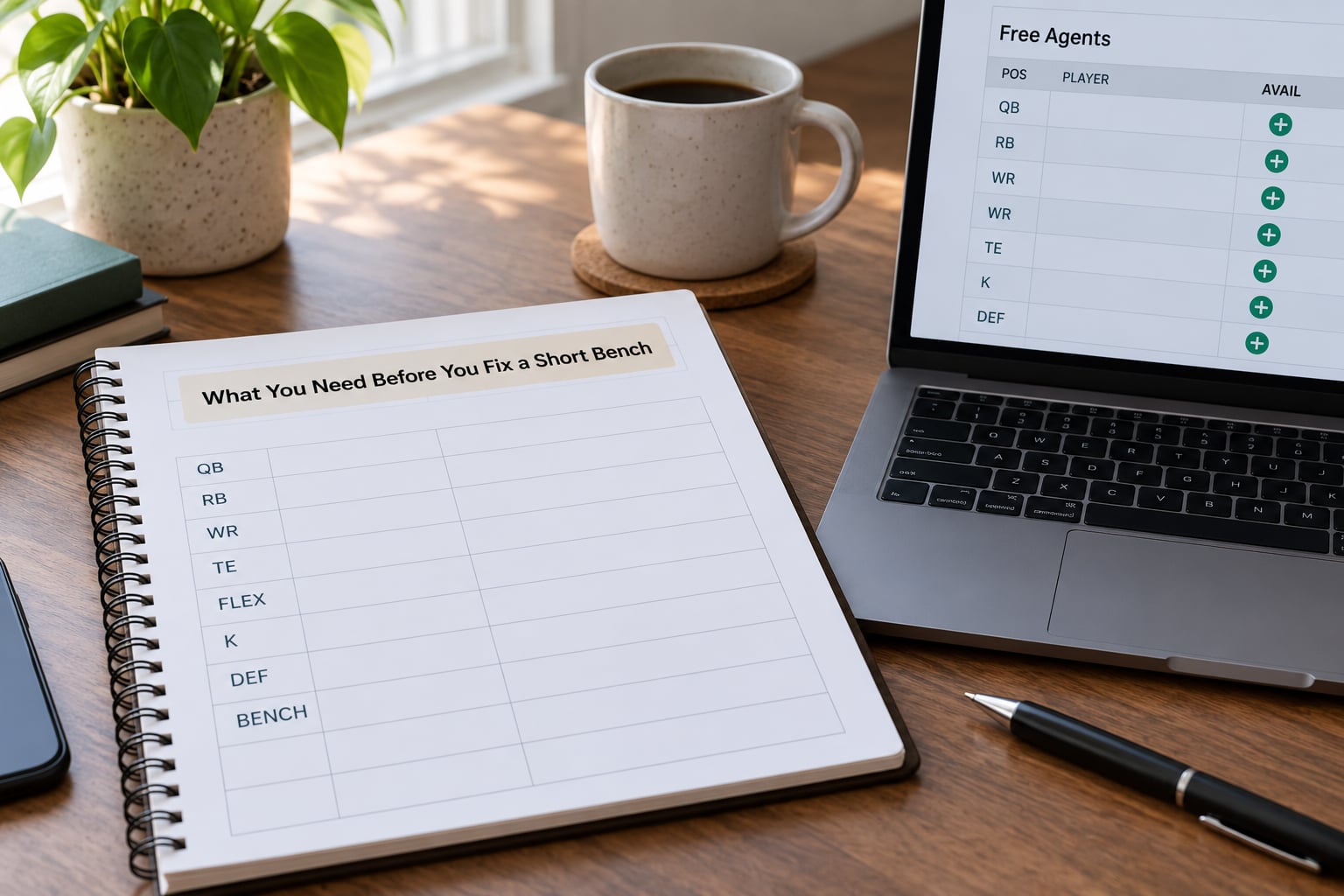
Before you add anyone, you need five things in front of you. First, your actual roster page, with the slot numbers visible, so you can count reserve spots rather than guess at them.
Second, your league settings. Roster limits, injured reserve rules, minimum position requirements and the auto-substitution order all change how many usable bench slots you actually have, and most short-bench managers have never checked the arithmetic.
Third, injury and practice reports for every starter you own, plus the bye schedule. Fourth, matchup data for the players you are considering, because role and opponent matter more than name value on a bench that small. Fifth, a written list of five to ten realistic replacements before you touch the free agent page, because open-market browsing is how managers end up with four kickers and no running back.
Do the bench budget math first
Your real bench budget is roster size, minus starters, minus injured reserve spots occupied, minus any players locked by minimum position requirements. That number is usually smaller than the league settings page makes it look.
| League type | Roster size | Typical bench spots | What to prioritize |
|---|---|---|---|
| 12-man PPR redraft | 16 | 9 | Depth across RB, WR and QB |
| 16-man PPR redraft | 16 | 5 | Handcuff plus one bye cover plus one upside |
| 16-man dynasty startup | 24 | 4 to 6 with a shared IR | Rookies and young upside over insurance |
| Guillotine playoff | 6 | 0 | High-floor players, punt anything with a bye |
A sixteen-player roster in a twelve-team league gives you nine reserve spots, which is forgiving. The same roster in a sixteen-team league gives you five, which is a completely different sport. Know which one you are playing before you decide anything.
How to Handle a Short Bench Step by Step
1. Audit Your Roster and Find the Real Problem
Most short-bench panic comes from mixing up two different problems. A temporary injury problem needs a one-week fix, and a structural depth problem needs a plan for the rest of the season. They get solved in opposite ways, so figure out which one you have first.
Go through your starters and sort them into three piles: healthy and producing, healthy and disappointing, and currently unavailable. For each of the unhealthy ones, ask what the replacement actually is. If the answer is a free agent you have never heard of, your problem is a depth problem, not an injury problem.
Then write down the real replacement need in one sentence per position, including which starter you own, who is likely to take over, and how many weeks of the season that player has left. If two of those sentences are identical, your roster is top-heavy at one position and thin everywhere else, and that is the audit finding that should drive every move you make next.
2. Separate This Week’s Need From the Long-Term Need
Every bench spot has to be assigned a tier before you fill it, so the decision stops being a judgement call about who you like more. Insurance and upside are different products with different costs, and on a five-spot bench you can rarely afford both at every position.
| Tier | What goes there | What it protects you from | When to upgrade or cut |
|---|---|---|---|
| Tier 1 | Handcuff or same-backfield backup | A season-ending injury to your highest-upside starter | Cut when the starter is dropped or the backup leaves that team |
| Tier 2 | Bye cover for one position | A projected zero that costs you a week | Cut after the bye week passes |
| Tier 3 | Low-owned upside or rookie flyer | A roster of safe players who never break out | Hold to the end of the season if the role keeps growing |
| Tier 4 | Generic replacement-level starter | One bad injury report on a fringe starter | Use for streaming, then drop the moment the role ends |
In redraft, insurance usually beats upside because your team is wiped every year and next season’s roster does not exist. In dynasty, rookies and young upside usually beat insurance, because a twenty-one-year-old running back who gets a full workload in year two is worth more than a thirty-year-old handcuff. Forum dynasty managers dealing with only three rookie draft rounds have said flatly that the right move is to load the bench with rookie running backs rather than short-term insurance, and that is exactly the tier logic above applied to a thin league.
Protect the players who would embarrass you to cut: a second-round pick still on a bad offense, a rookie with a growing role, or anyone a rival manager wants. Those players earn a bench spot on future value alone, which is why you should name them before you name anyone else.
3. Work the Waiver Wire by Opportunity, Not Desperation
Desperate waiver claims fail because they chase the biggest name rather than the best available role. Build a ranked list instead, in this order: the player’s actual role and expected workload, the matchup, the probability someone else claims him, and finally the acquisition cost.
Run the list after Thursday injury reports and again Sunday morning, because that is when role changes surface. A running back who took twenty carries on Sunday is worth more than a bigger name who did not touch the ball, and on a short bench role beats talent every time.
When a spot opens, claim the top name on your list rather than the first name you see. If nothing on your list fits the spot’s assigned tier, leave it open for a day and check the injury report again. An unfilled spot on Tuesday is recoverable; a wasted spot on Sunday is not.
4. Fix the Weakest Link Before Chasing More Talent
Before you add a body, look at the player already on your roster who is currently doing nothing. An unused bench running back playing behind a starter is often a better fix than a free agent with a similar projection, because you already own the opportunity.
When your bench is genuinely empty, the honest move is to start the lowest projected player on your roster rather than pretend a replacement will appear. That includes streaming a defense or kicker for a favorable matchup and running a low-scoring lineup when your running backs are on bye.
Another option most managers skip: move an expendable veteran to make room for a better prospect. If your fourth-string tight end has two games left on the schedule and a rookie behind him has a permanent role, the older player is the one who goes, even if you drafted him earlier.
5. Find Low-Cost Trade and Cut Options
Depth rarely has to cost a first-round pick. Trade for it, and offer something with broad appeal rather than something only your league’s owner wants: a reliable weekly starter at a position someone needs is usually worth a mediocre bench player to a manager chasing a playoff spot.
Cut low-upside insurance before you cut your only path to a breakout. A thirty-one-year-old running back with no offensive coordinator support has a ceiling of four points a week, which is not insurance, it is a placeholder.
Before you drop anyone, ask three questions: Is this player a starting-caliber asset at any position? Is there a clear path to touches or targets within four weeks? Does anyone in your league still want him? Two yes answers keep him. Fewer than two and he is the drop, no matter how much guilt the drop button produces.
If you are already out of spots in week seven, the recovery is unappealing but simple. Drop your two worst droppable players immediately, claim the two best available bodies at your positions of need, and stop looking for a perfect fix until the roster can actually absorb one.
6. Build a Weekly Short-Bench Plan
A short bench punishes improvisation, because you cannot afford a wasted mid-week decision. This six-step routine takes about thirty minutes and finishes before kickoff every week.
Monday: check the bye schedule and injury report, and confirm your bench order is set. Tuesday: run the waiver report at each of your positions of need and drop candidates. Wednesday: review practice reports and update your replacement list.
Thursday: place waiver claims in ranked order, then check for trade interest on your surplus players. Friday: fill any remaining spot from the free agent pool and confirm minimum position requirements are satisfied.
Sunday morning: re-check injury news, confirm your bench order one last time, and lock the lineup. The bench order matters more than most new managers realize, because it decides who gets subbed in automatically when a starter is scratched.
Common Mistakes That Burn a Short Bench
The first mistake is reactive adding. Claiming whoever is hottest the moment a starter goes down is how a five-spot bench becomes four kickers and no usable running back. Fix it by keeping the ranked list and claiming in order, even when the hot name is not on it.
The second is ignoring positional scarcity. On a short bench, one backup running back is worth more than two backup receivers, because the injury rate and the drop rate are both higher at that position. Fix it by weighting your waiver searches toward running back and quarterback when your bench is thin.
The third is stashing a player with no role. Depth requires a believable path to snaps, targets or goal-line work, and a player who is third in his position’s depth chart on a team that does not run has no path. Forum managers describe this as stashing a name instead of a role, and it burns a spot with nothing behind it.
The fourth is selling future value for a temporary fix. Trading a rookie or a second-round pick for a thirty-year-old with two good weeks left is how a short bench becomes a short bench permanently. Fix it by setting a personal rule that no asset drafted in the first eight rounds is traded before the halfway point of the season.
The fifth is making several moves without comparing the roster afterward. Two claims, a cut and a trade can each look reasonable in isolation and leave you weaker at three positions. Fix it by writing your roster out again after any multi-move week and checking your tier assignments still hold.
The sixth, and the most common one, is leaving bench order unset. Managers on guillotine and no-bench playoff formats who plan for byes in advance tend to do better than managers who react to them, and that planning starts with auto-substitution settings you configure in week one and never check again.
Frequently Asked Questions
Should I put a kicker or a defense on my fantasy bench?
Only when a spot is genuinely spare. Kicker and defense carry no season-long value, so on a short bench they are almost always better streamed weekly than stored. The exception is a keeper or dynasty league, where a defense you drafted as a starter is worth stashing to protect against injury, and a bye week with no replacement kicker is the one situation that justifies a permanent slot.
Is it better to hold a handcuff or an upside stash on a short bench?
In redraft, the handcuff, because your team disappears next year and immediate insurance has more value than a long shot. In dynasty, the upside stash wins, since a rookie with a growing role is an asset and a handcuff is a one-season placeholder. With one spot remaining, protect the starter who matters most to your ceiling and pick the insurance option for that player only.
When should I use Bench Boost if my bench is shallow?
Use it in a week when your bench player has a clearly better matchup than your starter and is a genuine starter-quality option, not a hopeful name. Shallow benches make the chip worse, not better, because you have fewer good candidates. Save it for the week your best bench player is favored against a poor opponent, and never use it on a player who is only a flex consideration.
How do I recover once I have run out of bench spots?
Accept that one of your starters is now unprotected, then protect the position where an absence hurts most. Drop your two worst players by the three-question test, claim the two best available bodies at your positions of need, and set your bench order correctly so auto-substitution covers what it can. Stop searching for the perfect fix until your roster has room to hold one.
Is bench strategy different in a dynasty league compared with redraft?
Yes, and it reverses the priority. Redraft treats the bench as insurance because nothing survives past the season, while dynasty treats it as trade stock and development runway. In dynasty, rookies and young upside should occupy spots ahead of handcuffs, and a bench spot you never use is still useful if it holds a player other managers want.
Why do I keep losing to players sitting on my bench?
Usually one of three reasons: your bench is full of kickers, defenses and low-upside insurance, your bench order is set to the wrong sequence, or you hold upside players you never start. Fix the first by streaming defenses and kickers, the second by ranking your bench from most to least likely to be inserted, and the third by starting your best projected player at every flex-eligible position.
Conclusion: Audit First, Then Work a Ranked Plan
The first thing to do is the audit, and it takes five minutes: count your real bench spots from your league settings, then write one sentence per position naming the replacement you would use if that starter missed a game. Wherever you cannot finish the sentence, that is your next move.
From there, fill spots by tier, claim waivers in ranked order rather than on panic, trade for depth before you pay a first-round price for it, and treat your bench order as a weekly setting rather than a one-time chore. Short-bench leagues are decided in October by managers who made fewer, better moves in August, not by the ones who added the most players.