
Fantasy football is a game where you act as the general manager of a virtual team made of real NFL players, drafting a roster before the season and scoring points from those players’ real statistics every week. That is the whole idea, and you can learn enough to play competently in an afternoon.
People ask two questions before joining. How long does it take, and do I need to love football? The honest answers: a first draft takes about 15 to 20 minutes of prep plus the clock itself, and weekly management runs 20 to 30 minutes once you settle into a routine. You do not need an encyclopedic memory of the league. Updated for the 2026 NFL season.
Table of Contents
What You Need
You need less than most beginners expect. Here is the full list of prerequisites before you can join a league and draft a team.
- A device and an app. A phone or laptop with the league’s app or site. Most managers check lineups on a phone in about two minutes.
- A league on a reputable platform. ESPN, Yahoo, NFL Fantasy, Sleeper, CBS and MyFantasyLeague all run standard rules. Pick whichever your friends are already on, because a league lives on one platform.
- The NFL schedule. You need to know when your players’ teams play and when they have a bye week. Every platform shows this inside the league.
- The league scoring rules. Read them once. Scoring decides which players are worth drafting.
- A place to track players. A notes app and a spreadsheet is plenty for year one.
- A source for player news. The platform’s own news feed works. Injury reports and practice reports live there too.
Paid memberships are optional. Every major platform gives you a functional free league, and that is enough to learn the whole game. Paid tiers mostly add deeper stats, custom projections and draft-kit tools.
A good way to test the water without committing is a free public league. You can create one in a few minutes, draft against strangers or a bot, play two or three weeks, then delete it and join the league you actually care about. Nothing carries over, and there is no fee to lose.
How to Play Fantasy Football Step by Step
Here is how to play fantasy football for beginners, in order: join a league, draft a roster, set a lineup each week, and manage that roster through claims and trades. Seven steps cover it, and the first four happen once.
Choose a League and Understand the Rules
Start with a redraft league, where you start fresh every season. That is the format to learn in, because nothing you learn carries a future consequence. Keeper leagues let you keep a few players between seasons. Dynasty leagues play across multiple seasons with a full roster of rookies to develop, which is a bigger commitment than most first-timers want. Guillotine leagues award a prize after a set week and eliminate the bottom team, so they reward short-term risk.
Scoring changes everything. Standard scoring counts yards and touchdowns. Half-point per reception gives half a point for each catch. Point per reception gives a full point per catch, which makes volume the deciding factor. Because a receiver who catches ten short passes can outscore a runner with 80 yards in one format and nowhere near it in another, your scoring setting decides your draft strategy.
To see the gap, take one game from a running back: 24 rushing yards, 60 receiving yards, 2 total touchdowns, 5 receptions. Under standard scoring that is 8.4 yards-to-points plus 12 for the touchdowns, or 20.4 points. Under half-PPR the five catches add 2.5, giving 22.9. Under full PPR they add 5, giving 25.4. Same player, same game, five points of swing. Some platforms round the final total, so check your league’s settings.
The rest of the rules are about roster size and who plays. A roster is everyone you own. Active slots are the starters who score; bench players do not score and can be swapped in. Flex slots accept more than one position. Trades swap players with a league mate, and waivers are how you pick up players other managers dropped.
Roster math matters more than beginners expect. In a four-team league with one starting wide receiver and four receivers on your roster, three of them produce nothing on any given week. You need bench depth because of exactly that arithmetic, scaled up to a twelve-team league where the same gap is worse.
Create a Simple League
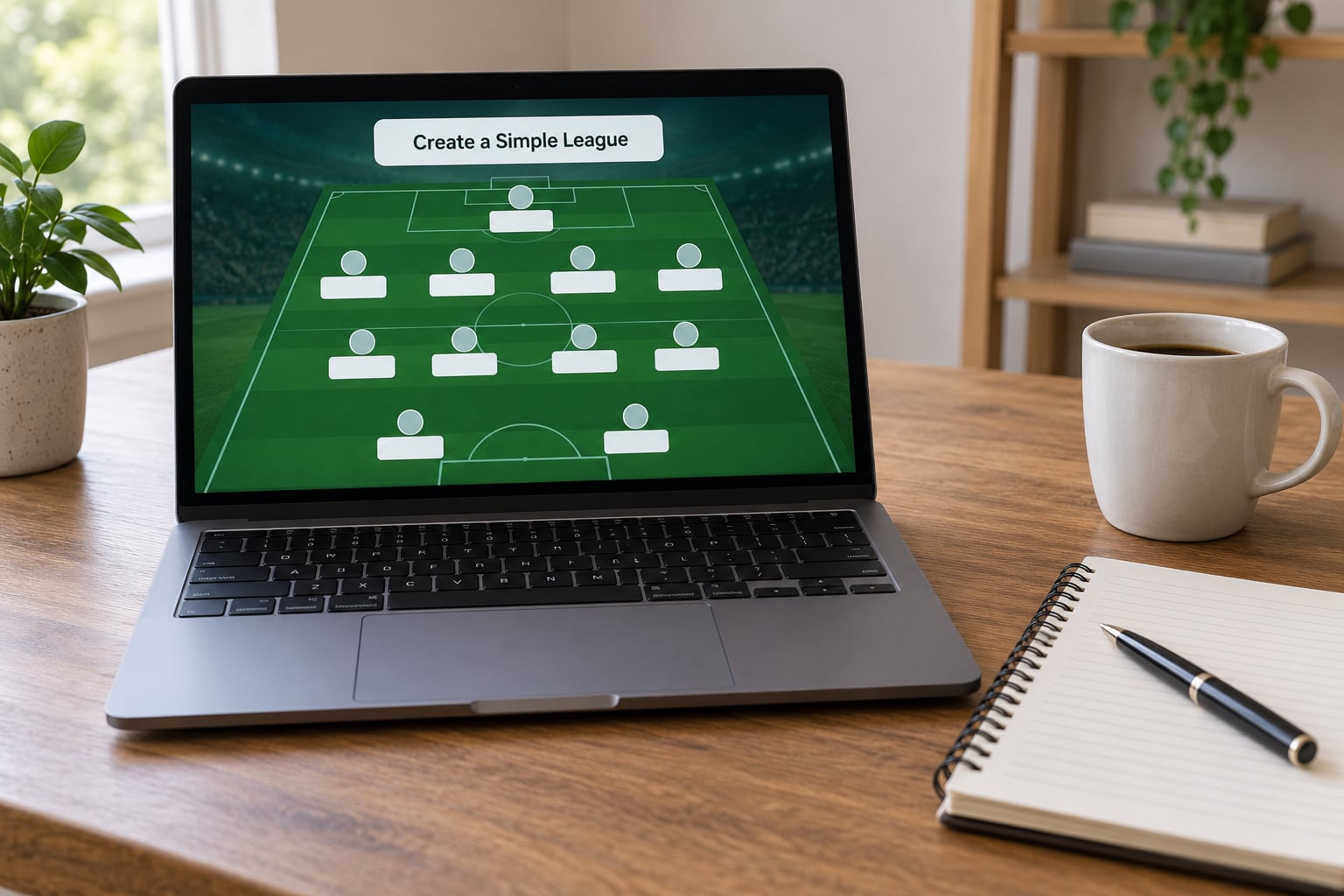
Creating a league takes about ten minutes on any of the platforms above. The sequence is the same everywhere, and the setting names differ slightly by app.
- Open the platform’s league creation page and pick a league type. Choose redraft for your first league.
- Name it something your league mates will recognise, then invite them by email or share code. Set the number of teams to the number of actual humans, not an aspirational number.
- Choose snake draft. It is the simplest format and the one every ranking is built for.
- Set the roster. Nine starters with a flex, plus five bench spots and one injured reserve slot is a workable default.
- Set the scoring. Full point per reception is the friendliest setting for a new manager because it rewards volume and does not require you to guess which runner will find the end zone.
- Confirm the schedule, set the draft date, and let the platform generate its own draft order.
These are starting suggestions for a first league, not universal rules. Every league can be configured differently, and a commissioner’s league may be locked before you see it.
Learn the Positions and Player Roles
Each position has a job, and the job determines how the player scores. This is the standard starting lineup most leagues use.
| Slot | How many | What the job is |
|---|---|---|
| Quarterback (QB) | 1 | Throws and runs a passing offense, scores on passing touchdowns |
| Running back (RB) | 2 | Carries the ball and catches passes out of the backfield |
| Wide receiver (WR) | 2 | Catches passes, the main target for quarterbacks |
| Tight end (TE) | 1 | Catches passes from the line, blocks on running plays |
| Flex (FLEX) | 1 | Takes one more player at a position your lineup is thin at |
| Kicker (K) | 1 | Kicks field goals and extra points |
| Defense (D/ST) | 1 | Scores on sacks, interceptions, fumble recoveries and defensive touchdowns |
| Bench | 5 (typical) | Does not score, fills in when a starter has a bye or injury |
| Injured reserve | 1 or more | Holds a player ruled out for a period, so the slot is not wasted |
The flex slot is the one beginners ask about most. On a standard league it accepts a running back, wide receiver or tight end, and you may start any eligible player there. A superflex slot is the same idea except it also accepts quarterbacks. Every player you own can be moved into the flex slot from another position, but only one flex slot exists, so the question each week is which position is short.
Then there is the vocabulary you will meet in rankings and news. Snaps are how many plays a player is on the field; a player with a small snap count is one injury away from nothing. Target share is the share of passes a receiver gets; a high share means lots of opportunity. Fantasy points are what a stat line is worth under your settings, not what a player is “worth.” Projections are estimates of future fantasy points built from those underlying numbers. ADP, average draft position, is where players are actually being taken across thousands of drafts, which makes it a crowd-sourced expectation. Player news is everything else: injuries, depth chart changes, contract situations.
Worked example: a receiver who gets nine targets and catches six for 60 yards is projecting to more catches and more points than a receiver who catches three for 40, regardless of which one has the bigger name. Target share explains the gap better than the depth chart does.
Build Your Strategy Before the Draft
Build a strategy for your league, not a generic one. The right approach depends on your scoring, roster size, number of teams and the size of your league mates’ rosters, and it changes when those change.
Start with ADP, because it is the cheapest information available. It tells you the market’s consensus and saves you from being the only person in the league reaching for a player two rounds early.
Then look for positional scarcity. In most seasons the drop-off from the first tier of a position to the second is where seasons get decided. Skipping the best available running back at pick 12 because you want a wide receiver with a nicer name is how rosters end up thin at one position and stacked at another.
Bye weeks belong in this conversation too. Every team sits one week between Weeks 4 and 12 depending on the division. If your four starters in one week all share a bye, you are running three players in a nine-slot lineup. Check the bye chart before the draft, not after.
Draft dependable weekly starters before you take upside players. A high-volume running back with four consecutive double-digit touch targets will give you a predictable floor. A fourth-round rookie wide receiver on a team with no clear starter ahead of him is a coin flip. Take the floors early, gamble late, and your lineup will not evaporate in week three.
How to Play Fantasy Football in Your First Draft
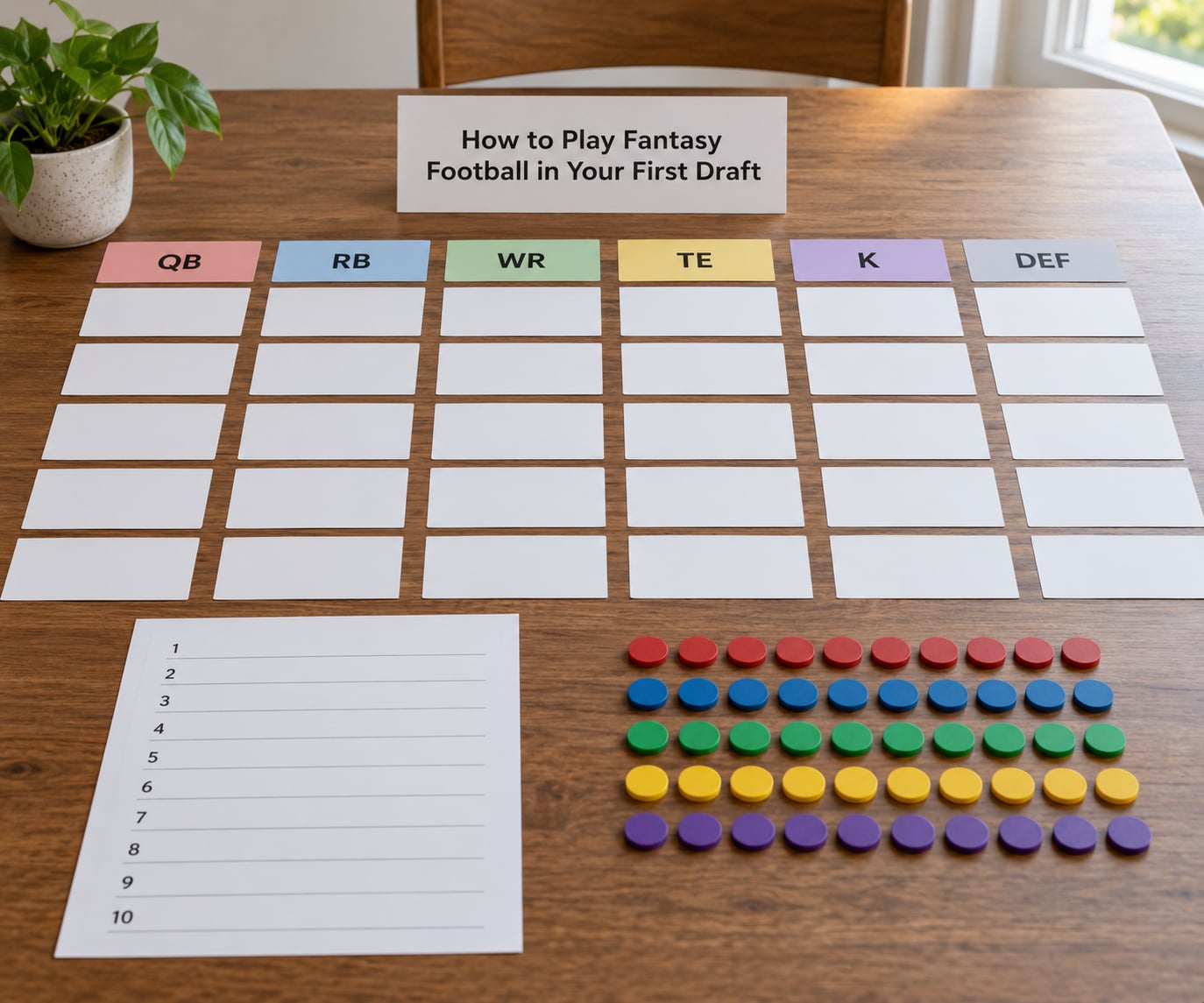
A first draft feels harder than it is. Everything below happens before the clock starts.
- Read the board first, before you commit to anything. In a live draft, the order reverses every round in a twelve-team league, so pick 13 belongs to the same manager as pick 12.
- Assign value to each player on your list. Sort the tier you trust, then mark the four players above each of your targets as gone.
- Set a personal player list of roughly 60 to 70 names, ranked by position. Anything outside it is a reach.
- Take the highest name on your list who is still available, unless the league needs a different position badly.
- Adjust when someone reaches. If two managers take your top two wide receivers before your second pick, the position is thin and the next receiver may be a stretch. Either commit to it or pivot to a position with depth.
- Use the late rounds on upside, after you have starters and depth at each position.
You can tell the draft worked even when your roster is not beautiful. If you ended up with one starter at every position, a handful of usable bench players and no glaring hole, you drafted fine. A clean roster with no value is a harder loss to recover from mid-season than a slightly worse draft that still holds up, and most of the season’s real decisions happen on the waiver wire after the draft is long over.
Set Your Weekly Lineup
Your lineup locks before kickoff, usually early in the week. Before you submit, check five things in this order.
- Injury news and practice reports for everyone in your lineup and your bench.
- Whether any of them are on a bye or have a favourable matchup.
- The platform’s projection for the player, and whether their projected role changed.
- Your flex decision, which comes down to which position you are short.
- Your kicker and defense, which are the two positions most managers stream week to week.
Streaming means picking up whoever plays against a weak opponent and dropping them next week. It works because defenses and kickers are shared across the league, and it is a legitimate strategy rather than a shortcut.
There is a scoring table behind every one of these decisions, so here are the default values most leagues start from.
| Action | Typical default points |
|---|---|
| Rushing or receiving touchdown | 6 |
| Passing touchdown | 4 |
| Every 10 rushing or receiving yards | 1 |
| Every 25 passing yards | 1 |
| Reception (PPR only) | 1 |
| Interception or fumble | -2 |
| Two-point conversion | 2 |
| Field goal | 3 to 5 depending on distance |
| Extra point | 1 |
| Defense: sack | 1 |
| Defense: interception | 2 |
| Defense: touchdown | 6 |
These are common defaults, not universal ones. Several platforms adjust them each season, and your commissioner may have changed them, so open the scoring settings and confirm.
The trap is reacting to a single headline. If a player sat out of practice on Wednesday, swapping him for a guy on your bench based on that report alone can cost you more than the injury does. Treat news as one input alongside the projection and the matchup, and change your lineup when several inputs point the same way.
Manage Waivers, Free Agents, and Trades
The waiver wire is where most of a season is actually won. When a manager drops a player, he becomes available, and your league’s settings decide how you get him.
On a priority system you get ranked claims: first priority goes to the lowest waiver number, successful claims reset you to the top, and unsuccessful ones push you down the list. On a bid system you spend from a free agent acquisition budget instead, bidding one to five dollars per week, and winning players are subtracted from your budget for the rest of the year. The weekly claim process clears the queue after games, and any player nobody claims goes to the free agent pool where you can bid for him.
Prioritise claims in this order: a position where you have no healthy starter, a replacement for an injured player, a player with more opportunity, then a player expected to play more games than the one he replaces. That last criterion handles bye weeks automatically, because a player who plays 15 games is worth more to your roster than one who plays 12 even if the other one has the nicer season ceiling.
On trades, do not aim to win the deal at the moment you make it. The right test is whether you are getting a player you would actually draft, and a replacement for the one you give up. New managers routinely accept bad offers because an experienced manager in the league frames them as favours, and the simplest defence is to say you do not make moves until your lineup is set for the week.
Check your league settings before every add, drop and trade. Some platforms limit how many players you can add per week, some penalise exceeding them, and some let you drop a player immediately while others make you wait.
Common Mistakes
These are the habits that show up in beginner leagues every season. Each one has a simple correction.
- Chasing last season’s totals. A player with 400 fantasy points last year is not automatically a value pick now. Draft on projections and role, then let the points come.
- Ignoring ADP. When your target goes one round earlier than planned, the market told you something. Take the next name on your list instead of reaching.
- Drafting by name recognition. You will hear about maybe 20 players all offseason and none of them are relevant. Rankings list 200, and the ones you have heard of are the ones who went in the first two rounds last year.
- Being a Homer. Stacking your roster with one team’s players because they are your favourite team is the most common self-inflicted wound in the game. Your team matters more in real life than it does here.
- Overvaluing bench players and rookie fliers. A fifth-round pick on the same team as your starter is not insurance, it is a second starter at one position with a real chance of a bye-week problem.
- Reacting to a bad week. Ignore results for the first three weeks of the season. One game is noise, and trading a good player after one quiet week is how good rosters get worse.
- Forgetting to set your lineup. If you do nothing, the platform starts your best previous lineup. That is a reasonable default, not a good one.
- Trading without replacement value. If you cannot name the player on your bench who replaces what you are giving away, you do not have a trade.
Four habits cover most of it: check the injury report once a week, look at the waiver wire every week even when you do not need anything, set a lineup before every game, and make no reactive move before week four.
Frequently Asked Questions
Can beginners play fantasy football for free?
Yes, and free leagues teach you everything the paid tiers do. ESPN, Yahoo, NFL Fantasy, Sleeper, CBS and MyFantasyLeague all let you create and join leagues at no cost, and most offer public leagues you can enter immediately. Paid memberships mainly add deeper statistics, custom projections and draft-kit tools. Start free, play a full season, and pay only if you decide you want better projections.
Should I choose standard scoring or point-per-reception scoring?
For a first league, choose point per reception. Catches are the most repeatable stat in football, so PPR rewards volume and rewards you for reading depth charts rather than guessing which runner reaches the end zone. Standard scoring is harder because a team’s scoring depends heavily on its running game. Standard is also still the setting in most long-running work and family leagues, so if you are joining rather than creating, you may not get a choice.
When should I make waiver claims in a beginner league?
Check the wire every week without fail, but only spend a priority or a bid when the player fills a real hole. The order that matters is: no healthy starter at a position, then replacing an injured player, then a player with clearly more opportunity, then more games played than the guy he replaces. Saving a claim for a player you do not need wastes the resource, and so does bidding on a name with no path to starts.
How do I know which players are safe to trade?
Do not judge a trade by who won it at the moment. Ask two questions: is this player someone you would draft today at his position, and can you name the replacement on your bench or on your waiver list for what you give up? If either answer is missing, the offer is not there. Beginners also get targeted by experienced managers, so the simplest protection is to set a rule that you make no trades before setting your weekly lineup.
Do I need to be an expert football fan to play fantasy football?
No. The platforms show you projections, injury reports, matchup data and player news, so a moderate knowledge of football carries you through year one. What matters most is accepting that results are noisy: ignore the first three weeks and avoid trading after a bad game. Plenty of managers who barely watch games on Sundays finish in the middle of their league, and plenty of very committed fans finish last.
Start With One Simple League
Do one thing today: join a free redraft league on the platform your friends use, with point-per-reception scoring and nine active slots. Before the draft, read the scoring settings and write down about 60 names from a ranking sheet.
That is the whole start. Draft the best available name on your list, take dependable starters before upside fliers, and check the bye chart so two starters never sit the same week. Then set a routine: injury report and waiver wire once a week, lineup before every game, no trades before week four.
Nobody’s first season goes perfectly. What separates a competitive beginner from a last-place one is boring and repeatable, and you now know what it is.