
Fantasy football scoring turns real game statistics into points. Your league assigns a value to every stat a player produces, the platform adds those values together for your whole roster, and the total is your team’s score for the week. Learn the rules and you stop guessing why a running back who carried the ball 22 times finished behind a receiver who caught six passes.
Table of Contents
- How Fantasy Football Scoring Works
- How Fantasy Football Scoring Works for Each Player Position
- What Are the Most Common Fantasy Football Scoring Formats?
- How Do Passing, Rushing and Receiving Points Affect Player Value?
- Why Do Fantasy Football Bonuses and Penalties Matter?
- How Do Tiers, Minimums and Maximums Change Scoring?
- How Can You Compare Two Fantasy Football Leagues?
- Frequently Asked Questions
- Where can I find my fantasy football league’s scoring rules?
- Does a standard scoring league favor running backs or wide receivers?
- How do 300-yard and multi-touchdown bonuses work?
- Are interceptions and fumbles always worth the same negative points?
- Can a fantasy football league change its scoring settings during the season?
- Conclusion
How Fantasy Football Scoring Works
Fantasy football scoring works by taking every stat a player records, multiplying it by the point value your league assigned to that stat, and adding the results for all of your starters. Yards earn a fraction of a point, touchdowns earn a flat amount, and turnovers subtract. Add any bonus, subtract any penalty, and that total is your score.
That is the whole system. Everything that feels complicated, like tiered scoring or points allowed thresholds, is just a variation on how one number converts to another.
The three-step formula
Step one is the stat. A quarterback throws for 281 yards, completes 21 passes and throws two touchdowns. Step two is the conversion, and this is where leagues differ: most award 1 point per 25 passing yards and 4 points per passing touchdown.
Step three is the adjustment. Turnovers usually cost points, and many leagues add a bonus for a 300-yard game. The platform applies the penalties and bonuses, sums all nine starters plus your bench if your league scores it, and posts the number on Tuesday morning.
Here are the offensive values most non-PPR leagues start from. Every one of these is adjustable, so treat the numbers as a baseline rather than a law.
| Statistic | Standard scoring | What it means |
|---|---|---|
| Passing yards | 1 point per 25 yards | 11 points for 281 yards |
| Passing touchdown | 4 points | Same for every league size |
| 2-point conversion | 2 points | Near the goal line |
| Rushing yards | 1 point per 10 yards | 18 points for 187 yards |
| Rushing touchdown | 6 points | Why goal-line backs still get drafted |
| Receiving yards | 1 point per 10 yards | Combined with rushing yards |
| Receiving touchdown | 6 points | Same value as a rushing score |
| Reception | 0 points | Adds 1 in PPR, 0.5 in half-PPR |
| Interception thrown | minus 2 points | Some leagues use minus 3 or minus 4 |
| Fumble lost | minus 1 to minus 2 points | Value varies by league |
A worked example: turning a box score into points
Take a running back with 24 carries, 118 rushing yards, one touchdown, three catches for 22 yards and no turnovers. Standard scoring gives 118 divided by 10 for 11.8 points, plus 6 for the touchdown, plus 2.2 points for the receiving yards, plus 0 for the catches. That is 20 points.
Under full PPR the same line is 20 points plus 3 for the receptions, so 23. Add a fumble lost and most leagues take 2 off that total. Now you know exactly why your two leagues disagreed about a player you thought had a big day.
How Fantasy Football Scoring Works for Each Player Position
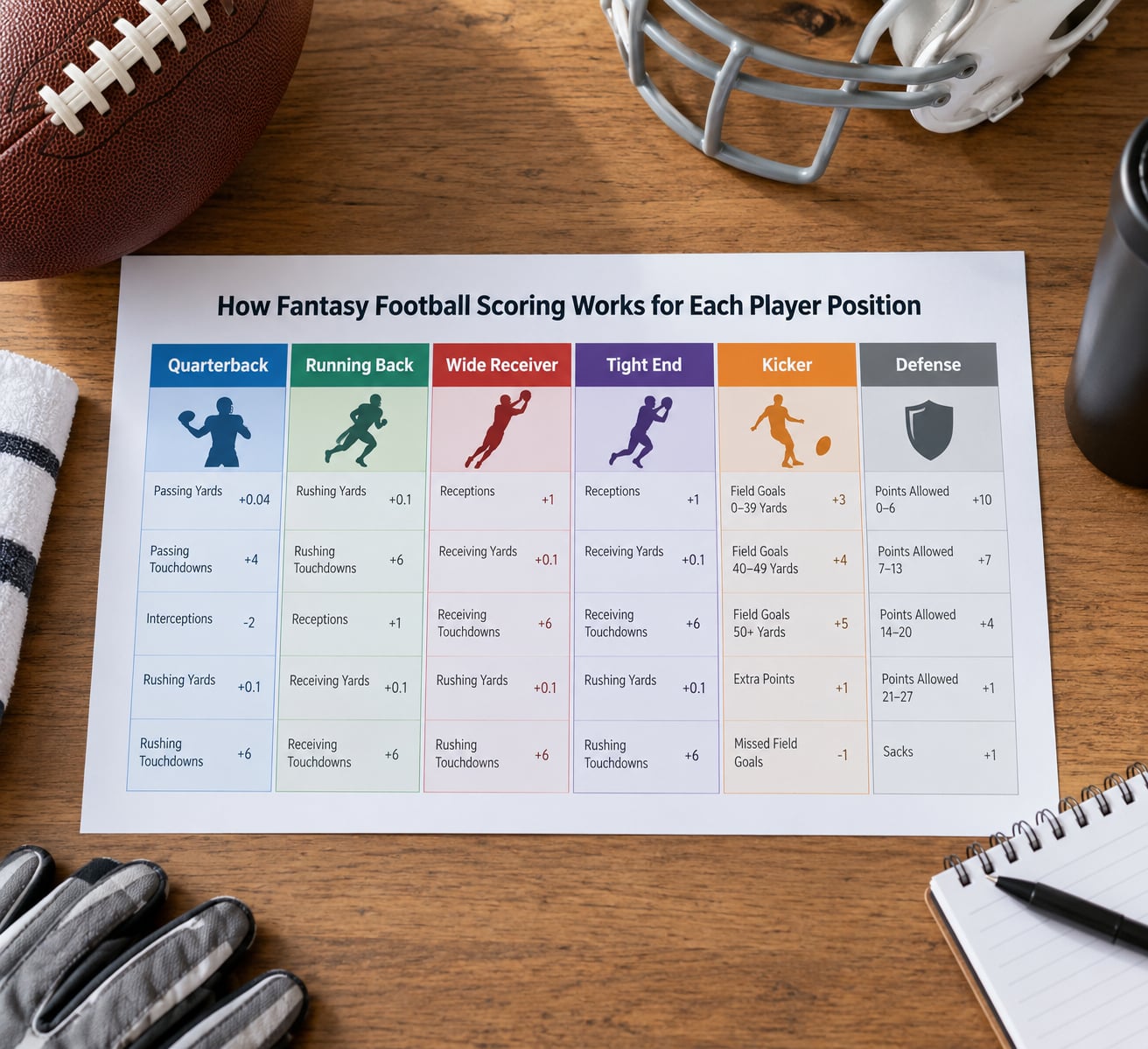
Each position group pulls from a different slice of the box score, so your league’s settings page usually splits into separate sections. Knowing which numbers feed which group is most of what you need.
| Position group | Statistics usually counted | Typical point values |
|---|---|---|
| Quarterback | Passing yards, passing TDs, interceptions, 2-point conversions, sometimes completions and rushing | 1 per 25 yards, 4 per TD, minus 2 per INT, 2 per conversion |
| Running back | Rushing yards, rushing TDs, receptions, fumbles lost | 1 per 10 yards, 6 per TD, 0 or 1 per reception |
| Wide receiver | Receiving yards, receiving TDs, receptions, interceptions | 1 per 10 yards, 6 per TD, 0.5 or 1 per reception |
| Tight end | Same as receiver, sometimes bonuses for 20-plus yards per catch | Identical base values to receivers |
| Kicker | Field goals by distance, extra points, missed field goals | XP 1 point, FG 3-5 by distance, minus 1 to minus 3 for a miss |
| Team defense | Sacks, interceptions, fumbles forced and recovered, safeties, blocked kicks, points allowed | Sack 2, INT 4, FF and FR 1, safety 4, points-allowed tiers |
| Individual defense | Tackles, sacks, interceptions, passes defended, fumbles | Solo tackle 1-2, assisted 0.5-1, sack 2-4, INT 2-4 |
How fantasy football scoring works for offensive players
Yards and touchdowns carry the value in every standard league. Receptions only matter once points per reception is switched on, which is why the same player can be a first-round pick in one league and a bench player in another.
Kickers, defenses and individual defensive players
Kickers are the clearest example of tiered scoring in the game. Most leagues give 3 points for a field goal inside the 50, 4 for one from the 50 to 59, and 5 for 60 or longer, with a small penalty for a miss. Some leagues invert it and reward distance more aggressively, so a kicker with a strong leg can be drafted higher than a more accurate one.
Individual defensive player leagues, often called IDP, score tackles separately. A common setup is 1 point for a solo tackle, half a point for an assist, 2 per sack and 4 per interception. Scoring is officially updated through the week, so a tackle recorded on Wednesday can show up on Saturday.
What Are the Most Common Fantasy Football Scoring Formats?
Nearly every league you will join is one of three formats. The difference is how much a reception is worth, and that single setting reshapes your draft board more than any other choice.
| Format | Points per reception | Who it favors | Trade-off |
|---|---|---|---|
| Standard (non-PPR) | 0 | Running backs, early-down receivers, kickers | Simple, but touchdowns decide too many weeks |
| Half-PPR | 0.5 | Volume players across the board | A middle ground most commissioners land on |
| Full PPR | 1 | Receivers, tight ends, pass-catching backs | More predictable week to week |
A few leagues go further. Points per game simply takes each player’s best single week of the season, which rewards one huge game over consistent production. Points against average credits a defense for how it performed compared with what its opponent usually allows. Fractional scoring, where every tenth of a yard counts, is mostly used to avoid ties in season-long leagues. Head-to-head category leagues are borrowed from baseball and rank each position separately, then add the ranks up.
Where each platform starts out
Default settings explain a lot of arguments. ESPN and Sleeper have defaulted to full PPR in recent seasons, Yahoo has defaulted to half-PPR, and NFL Fantasy has shipped with its own standard-leaning set that varies by year and scoring preset. The moment you create a league, read the settings before drafting, because you can change them later, but you cannot un-learn a draft board built on the wrong assumptions.
How Do Passing, Rushing and Receiving Points Affect Player Value?
Player value is production multiplied by the point values your league uses. Since most leagues use the same yardage and touchdown values, the places where players get re-ranked are receptions, turnovers and bonuses.
Use one box score to see it. A wide receiver with 6 catches for 74 yards and no touchdowns scores 7.4 in standard, 10.4 in half-PPR and 13.4 in full PPR. A running back with 18 carries for 71 yards, one touchdown and one reception scores 13.1, 13.6 and 14.1 across the same three formats.
In standard, that receiver finished less than half the running back’s 13.1, because 6 points for a touchdown outweighed 74 receiving yards. Add the receptions and the gap closes to 6.7 points by full PPR. That single comparison explains why a receiving back who catches four passes a game is a luxury in non-PPR leagues and a core player in PPR.
Where the formats disagree most
They disagree on volume, not talent. A quarterback throwing 40 passes in a low-scoring game may finish behind a kicker. A receiver with 12 short catches will beat a receiver with 5 catches for 120 yards in PPR and lose in standard. Turnovers swing harder than any other category, which is why ball-security players gain value in leagues that punish interceptions heavily.
Why Do Fantasy Football Bonuses and Penalties Matter?
Bonuses and penalties are small in most weeks and decisive in the ones that decide your playoff spot. A 300-yard bonus is worth more than a receiving touchdown in some leagues, and a points-allowed penalty can erase a defense’s entire week.
| Penalty | Common value | Aggressive leagues |
|---|---|---|
| Interception thrown | minus 2 | minus 4 |
| Fumble lost | minus 1 or minus 2 | minus 3 |
| Missed field goal | minus 1 | minus 3 |
| Incomplete pass | 0 | minus 1 in rare custom leagues |
| Points allowed over a tier cap | 0 to minus 4 | 0 for anything over 27 |
Bonus thresholds in practice
Common bonuses include 1 point for 100 rushing or receiving yards, 3 points for 300 passing yards, 1 to 3 points for a player scoring 4 or more touchdowns, and a defensive bonus for holding an opponent under a points ceiling. Thresholds usually pay in full rather than prorating, so crossing 300 by a single yard is worth the same 3 points as crossing it by 40.
Some platforms award bonuses at each tier instead, which rewards a 200-yard game twice as much as a 100-yard game. Check the wording, because the difference matters across a long season.
How Do Tiers, Minimums and Maximums Change Scoring?
Linear scoring gives every yard the same value. Tiered scoring breaks a range into steps, and it is where most of the strategy lives. Team defense is the standard example, with points allowed as a minimum and a maximum rather than a flat deduction.
| Points allowed | Fantasy points for DST |
|---|---|
| 0 | 10 (or 6 to 8) |
| 1 to 6 | 6 |
| 7 to 13 | 4 |
| 14 to 17 | 3 |
| 18 to 27 | 1 |
| 28 or more | 0 |
Two other formats fit here. Points per first down awards a point whenever a play crosses the marker to gain a new first down, which removes the yardage inflation of a run-heavy offense. Tiered PPR scales reception points by target share, paying 1 point per catch to a clear volume target and half a point to players who finish around 100 targets on the season.
The nine-yard problem
At 1 point per 10 yards, a player with 9 yards scores zero. Most platforms round down, so 9 stays 0 and 10 becomes 1. That is not a mistake, it is the cost of a threshold, and it is exactly why kickers use distance tiers instead of yardage. Two records also sit in no man’s land: a kicker with a stat corrected after Monday night can have a field goal moved across a distance tier, and a defensive statistic that is revised on Tuesday may lower a team’s points-allowed total and change the whole tier.
How Can You Compare Two Fantasy Football Leagues?
Comparing leagues is simple once you compare the same lines in the same order. Spend five minutes on it and you will never argue about a score again.
- Open the settings page in both leagues and export or screenshot the scoring tab.
- Check the reception value first, since it is the largest single difference.
- Compare yardage rates: passing yards per 20, 25 or 10, and rushing and receiving yards per 10.
- Compare touchdown values, which can differ between passing and rushing.
- Compare turnovers, including whether fumbles are counted as lost or as total fumbles.
- List every bonus and its threshold, then every penalty and its value.
- Pick one stat line, a real player, and convert it under both systems by hand.
- Note whether the league scores a week or a season total, and how ties are broken.
Step seven is the one people skip, and it settles most arguments. Take a receiver with 5 catches for 62 yards and a touchdown: 12.2 points in standard, 14.7 in half-PPR, 17.2 in full PPR. Add a 100-yard bonus in the league that awards it and that league moves ahead regardless of format. You now know which league the player is worth more in, and by how much.
One last thing to confirm: whether scoring is weekly head-to-head or season-long total. A player who scores 45 once and 8 for six weeks is worth more in a best-week league, and much less in a league where every week counts.
Frequently Asked Questions
Where can I find my fantasy football league’s scoring rules?
Open your league, select League Settings or Settings, then choose Scoring or Scoring Settings. Most platforms list every point value on one screen, including bonuses, penalties and points allowed tiers. If you created the league, that page is editable; if you joined one, it is read-only, so ask the commissioner to send you a screenshot or a link. Save the page before your draft so you can check values against any trade you are considering.
Does a standard scoring league favor running backs or wide receivers?
Standard scoring favors the players who score touchdowns, which historically means running backs and any red-zone target, because touchdowns carry 6 points while receiving yards are worth one tenth of a point each. In PPR the balance flips, since a receiver with six catches and no touchdowns outscores a back with 70 yards and one touchdown. Half-PPR sits between the two and rewards volume without ignoring scoring plays.
How do 300-yard and multi-touchdown bonuses work?
A bonus triggers when a player crosses a threshold and adds a flat number of points on top of his normal score. A quarterback with 312 passing yards and 3 touchdowns might finish with 21 points plus 3 bonus points for the yardage and another 1 for three touchdowns, or 25 total. Bonuses usually pay in full the moment you cross the line, so 301 yards and 400 yards earn the same bonus in most leagues.
Are interceptions and fumbles always worth the same negative points?
No. Most leagues use minus 2 for an interception and minus 1 or minus 2 for a fumble lost, but custom settings range from zero all the way to minus 4 for picks and minus 3 for fumbles. Some leagues also count total fumbles rather than fumbles lost. Check the penalty section of your own settings, because the difference across two teams in a close matchup is often two or three points.
Can a fantasy football league change its scoring settings during the season?
Yes, a commissioner can change most scoring settings at any point, though many platforms apply changes going forward only and keep prior weeks scored under the old rules. This is the part that catches people out, since a mid-season change to full PPR makes every earlier ranking wrong. If you notice your team scores jumped around for no football reason, read the league history or ask the commissioner what changed and when.
Conclusion
Open your league’s scoring settings and read the whole page before your next draft. Note the reception value, the yardage rates, the turnover penalties and every bonus threshold, because that single page decides which players are actually worth owning. Once the values are in front of you, convert one real box score by hand and you will never be surprised by a score again.