
Fantasy basketball scoring works by turning a real player’s box score into a fantasy number, then adding up the numbers from everyone in your lineup. On the standard setup, a point is worth 1 fantasy point, a rebound 1.2, an assist 1.5, a steal 3, a block 3 and a turnover minus 1. That is the whole engine. Everything else, category leagues, daily lineups, playoff seeds, is a variation on how those numbers get used.
If you’re new to this, the fastest way to get comfortable is to watch one box score get converted by hand. Once you’ve done that arithmetic once, the app’s numbers stop feeling arbitrary, and you can look at a league’s settings with actual judgment instead of just accepting them.
The catch is that there is no universal scoring system. Your league might use the standard table, a custom table, categories instead of a single total, or a daily format where a lineup has to be locked before tipoff. How fantasy basketball scoring works for beginners comes down to reading the specific settings your league runs on.
Table of Contents
- What Is Fantasy Basketball Scoring?
- How Do Points and Categories Affect Your Score?
- How Fantasy Basketball Scoring Works Step by Step
- What Are the Most Common Scoring Settings?
- How Do Scoring Stats and Rate Statistics Differ?
- How Do Daily and Weekly Scoring Affect Strategy?
- How Do Lineup and Roster Rules Change Your Score?
- How Are Ties and Head-to-Head League Results Decided?
- What Should Beginners Check Before Joining a League?
- Frequently Asked Questions
- Conclusion
What Is Fantasy Basketball Scoring?
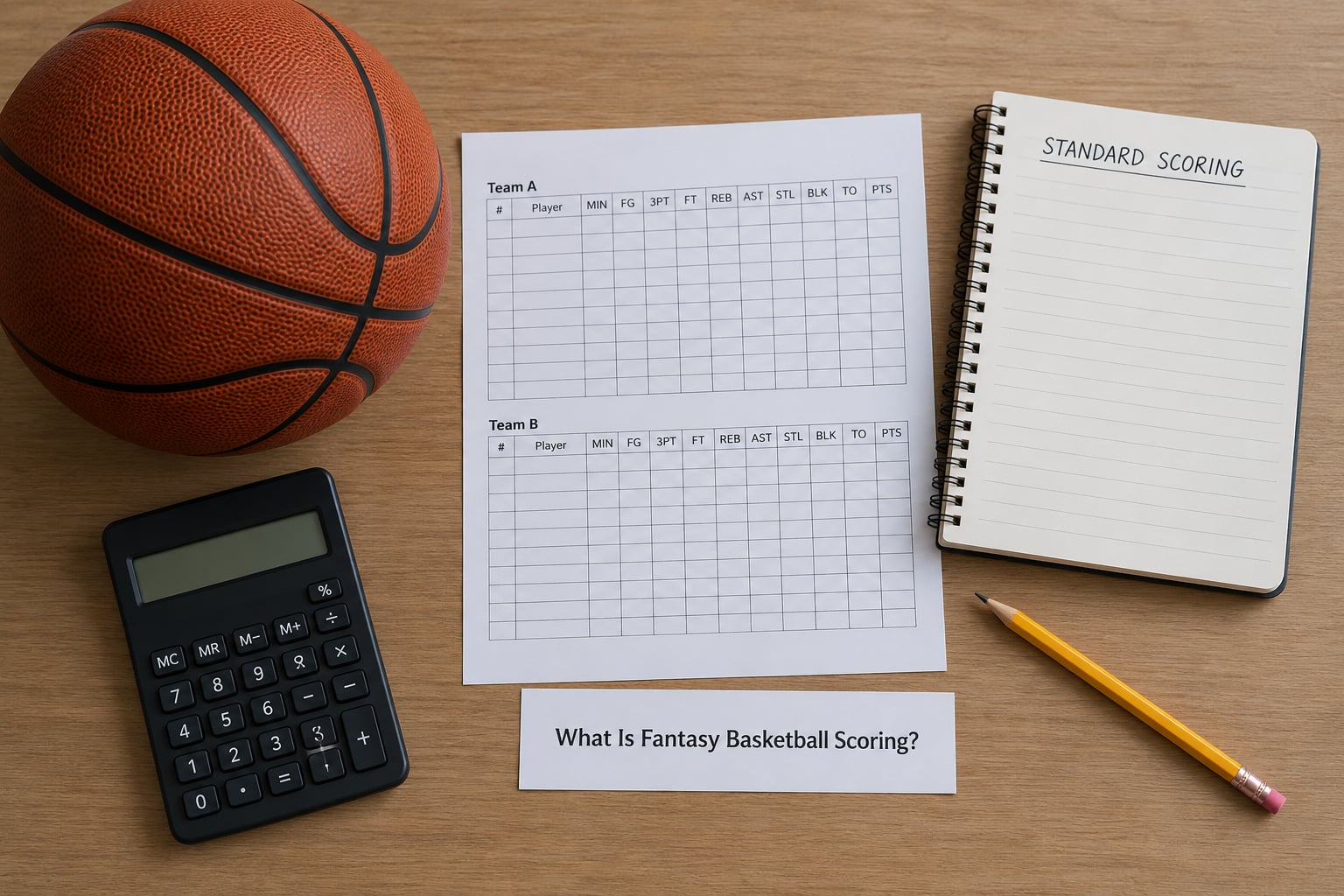
A fantasy point is a made-up currency. Your league assigns a value to each real stat, and when a player has a good night, those stats get converted and added to your team’s total. Nobody is inventing performance; the box score is real. The conversion is the part that varies from league to league.
This is the scoring table most leagues start with, and most never bother changing.
| Real stat | Standard fantasy value | What a single unit is worth |
|---|---|---|
| Points scored | 1.0 | 1 fantasy point per point |
| Rebounds | 1.2 | A board worth more than a point |
| Assists | 1.5 | Creating a score beats scoring it |
| Steals | 3 | Three times a point |
| Blocks | 3 | Three times a point |
| Turnovers | -1 | A lost possession costs you |
| Three-pointers made | 1 (many leagues) | Bonus for range |
| Double-double | Bonus (often 2) | Two categories in double figures |
| Triple-double | Bonus (often 5) | Rare enough to reshape a week |
Here is that conversion done end to end with a fictional stat line, so you can see the arithmetic rather than guess at it.
| Box score line | Math | Fantasy points |
|---|---|---|
| 28 points | 28 x 1.0 | 28.0 |
| 6 rebounds | 6 x 1.2 | 7.2 |
| 9 assists | 9 x 1.5 | 13.5 |
| 2 steals | 2 x 3 | 6.0 |
| 1 block | 1 x 3 | 3.0 |
| 4 turnovers | 4 x -1 | -4.0 |
| 3 made threes | 3 x 1 | +3.0 |
| Total | 28 + 7.2 + 13.5 + 6 + 3 – 4 + 3 | 56.7 |
Two details in that example catch beginners out. First, if the three-point bonus were switched off, the same night drops to 53.7, which is a meaningful swing on a tight week. Second, if the league uses a -1.5 turnover penalty, the four turnovers cost 6 instead of 4, and the total falls another 2 points. Small settings, real consequences.
Platforms also ship with different defaults, so the table in your league may not be the one above.
| Platform | Typical default | Watch out for |
|---|---|---|
| ESPN | Category league by default | Percentages and turnovers included or not depends on the league you create |
| Yahoo | Points or categories, with a scoring chart you can edit | Defaults have changed over time, so check rather than assume |
| CBS | Roto or H2H points with a full scoring chart | Ranking categories shift with league size |
| Sleeper | Points leagues with very customizable scoring | Lock-In mode punishes a bad lineup permanently |
| PrizePicks / DraftKings | Daily pick-based scoring | Three-pointers are not scored at all |
That last row surprises people who arrive from fantasy football and assume every rule carries over. On daily apps, you are not managing a roster; you are picking players to go over or under a stat line, and only a handful of stats count.
How Do Points and Categories Affect Your Score?
Points leagues collapse everything into one number, so more total fantasy points wins. Category leagues keep the stats separate, so you win by winning more category matchups than your opponent, even if you score fewer total points.
The category that gets a player’s value right depends entirely on what it rewards.
| Category | Type | What it rewards |
|---|---|---|
| Points | Counting | Volume scorers and anyone with a hot shooting week |
| Rebounds | Counting | Big men who stay on the glass |
| Assists | Counting | Ball-dominant guards who create |
| Steals | Counting | Defenders who gamble productively |
| Blocks | Counting | Rim protectors, though they can hurt FT percentage |
| Turnovers | Counting, negative | Careful ball handlers, punts volume |
| Field goal percentage | Rate | Efficiency over volume |
| Free throw percentage | Rate | Guards who get to the line |
| Three-pointers made | Counting | Shooters on high volume |
Winning six narrow categories by one rebound apiece beats winning one category by forty points, because a points league only cares about the total. That’s why a guard averaging 25 points and 8 assists can be excellent in a points league and merely average in a category league that also grades his three-point shooting.
Hybrid leagues split the difference. They score points and rank a few categories, so a huge scoring week still helps while a category win still counts for something.
How Fantasy Basketball Scoring Works Step by Step
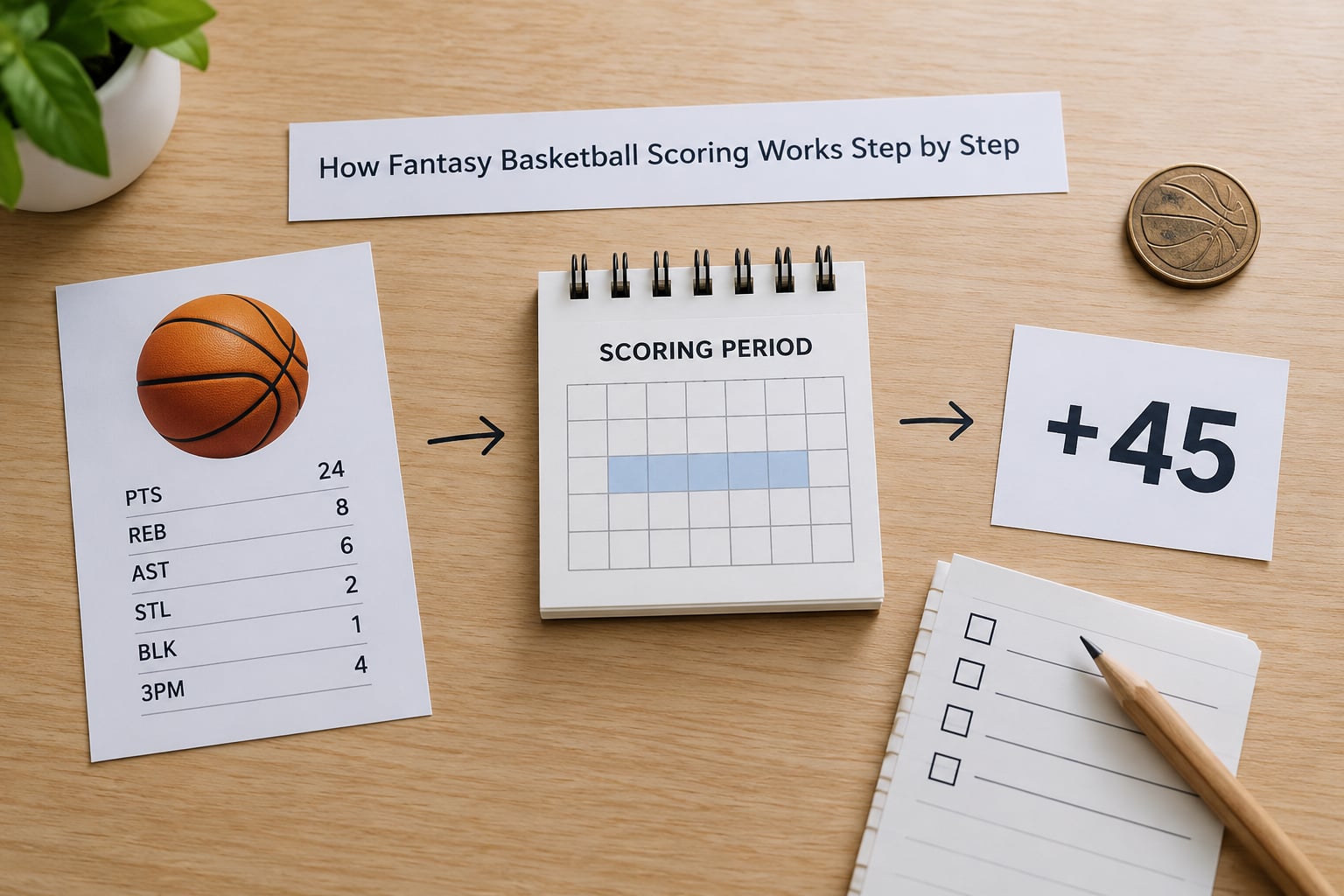
- A real game happens. The NBA plays, box scores get recorded, and the league’s data provider picks them up.
- Each stat gets a value. Your scoring table turns every point, rebound, assist, steal, block, turnover and made three into a fantasy number.
- Eligibility is checked. Only players who were in your lineup, or on your bench under a format that counts bench players, get converted.
- Lineup rules apply. Roster minimums, positional requirements and flex spots decide which players actually count toward the total.
- Totals are added. Your starters’ fantasy points sum into a single team total for the day or the week.
- The comparison happens. In head-to-head, your total goes against your opponent’s. In categories, every stat is compared category by category.
- Standings update. Wins, losses and category rankings shift once the scoring period closes, and ties get broken by whatever rules your league set.
The step beginners rush is step three. A brilliant performance by a player you benched before tipoff may not count at all, and in some weekly formats benching erases points that were already banked.
What Are the Most Common Scoring Settings?
Scoring settings fall into a handful of groups, and each one answers a question you should know the answer to before you commit to a league.
| Setting | Question it answers | Why it changes things |
|---|---|---|
| Daily vs weekly scoring | When does a game count? | One bad game is a small hit over a week and a disaster on a single day |
| Points vs categories | What wins the matchup? | Decides whether volume or balance is valuable |
| Roster size and starters | How many players are in, how many count? | A 9-man lineup scores far less than a 12-man one |
| Lineup changes | Can I swap players during the period? | Daily limits mean you cannot chase every hot hand |
| IR spot | Can I stash an injured player? | Without one, an injury can wreck a week |
| Games played minimums | Do I need availability to qualify? | Matters in season-long formats, rarely in short leagues |
| Tiebreakers | What happens on a tie? | Remaining games, win percentage or total points |
Rookie managers often accept whatever settings a league invite contains. That is fine for your first season, but know that a points league and a 9-category league with no turnovers are two completely different games, and the same player can be a cornerstone in one and a wasted pick in the other.
How Do Scoring Stats and Rate Statistics Differ?
Counting stats accumulate, so total production adds up as games pile up. Rate stats measure how well a player did per attempt, which makes them much harder to accumulate and far less forgiving of bad nights.
Consider three guards in one week. One scores 18 points a game on poor shooting, another scores 14 a game while shooting 62 percent from the field, and a third hits 6 three-pointers a night but lands only 3 of 11 from the line.
In a points league, the first two are close and the third is elite, because volume of made shots and threes is what the table pays for. In a category league with field goal percentage, the first player is a disaster, the second is a building block, and the third is a liability dragging a rate category down for everyone.
Here’s the trap in numbers. A player shooting 40 percent on 20 attempts a game would shoot 50 percent on 4 attempts. Rate categories reward the volume-efficient player, but only if he’s taking enough shots to hold the line, and low-volume specialists can swing a percentage category on almost no attempts at all.
Turnovers work the same way in reverse. At -1, a ball-dominant guard with nine turnovers loses 9 points a night, which most scoring tables can absorb. At -1.5, the same player loses 13.5, and a few of those nights quietly decide a weekly matchup.
How Do Daily and Weekly Scoring Affect Strategy?
Weekly scoring smooths out variance, so the better player usually wins over time. Daily scoring rewards avoiding a single disaster, because there is no next game to recover it.
In a weekly points league, you can start a player who has a tough schedule, stream someone off the bench for a favorable matchup, and let a cold stretch recover by Sunday. In a daily league, that same cold stretch is the whole game, and a player going into a bad defensive matchup with an unclear role is a coin flip.
Practical guidance for each. In daily scoring, start the players with the most predictable roles, because playing time matters more than ceiling. In weekly scoring, chase upside. Players coming off a bad week with a soft schedule are good stream candidates, and a player who has already had two big games is usually priced into your opponent’s thinking.
One more daily-only wrinkle: Sleeper’s Lock-In mode locks the lineup you submit and keeps that set for the rest of the week. A bad injury report before you submit can cost you the entire week, which is why daily managers should check lineups right before the deadline.
How Do Lineup and Roster Rules Change Your Score?
Roster rules decide how many of your players actually get converted, and that single decision can move a weekly total by a hundred points or more.
Some rules change how much opportunity a player has. Others change whether his production is counted at all.
| Rule | Type | Effect on your score |
|---|---|---|
| Starter limit | Opportunity | Only starters convert in most points leagues |
| Bench players | Opportunity | Some formats convert the whole roster, which inflates totals |
| Flex spot | Opportunity | One lineup slot that accepts any position |
| Daily lineup changes | Opportunity | Lets you swap in a better player later in the day |
| IR plus spot | Eligibility | Protects a roster slot when a starter is out |
| Minimum games played | Eligibility | A player below the threshold may not count in standings |
| Playoff eligibility | Eligibility | You may need a qualifying total to make your bracket |
A 12-player roster that converts everyone will beat a 9-player roster most weeks even when the managers have identical players. That is not a strategy insight, it’s math, and it’s why comparing your total to a friend’s without checking roster size is the most common beginner mistake.
How Are Ties and Head-to-Head League Results Decided?
Exact ties are decided by tiebreakers, and which tiebreaker applies depends on your league’s settings. In head-to-head daily leagues, a tied day splits into a win and a loss for most managers, or counts as a draw in leagues that allow one.
Weekly head-to-head ties get resolved by a chain of rules the commissioner picked. The common ones, roughly in order of how often they appear: remaining games on the schedule, then better overall win percentage, then more total fantasy points scored on the season, then fewer games played.
Category ties are different because you’re not comparing one number. If you tie your opponent in three categories and lose four, you lose the week. If you tie in every category, most leagues fall back to the same tiebreaker chain as points leagues.
Rotisserie leagues handle ties by category too, and season-long formats lean on remaining games late in the year, since there is no single scoring period to resolve.
What Should Beginners Check Before Joining a League?
Before you accept an invite or create a league, read these settings rather than skim them.
- Scoring format. Points or categories, and how many categories if it’s a category league.
- Whether turnovers count, and at what penalty.
- Roster size and starter count, plus whether bench players are converted.
- Daily or weekly scoring, and your lineup change limit.
- Percentage categories in play, which behave very differently from counting stats.
- Waiver type: free agent autobidders, FAAB bidding or a plain claim system.
- IR spots and how many you can use.
- Trade windows and the league’s length, including whether playoffs start in week 15 or later.
- Tiebreakers, which you’ll want to know about in week 20 rather than week 1.
If you’re the commissioner, the settings that cause the least regret later are a standard points table or a classic 8- or 9-category setup. Keep turnovers out of category setups if you want volume guards to hold their value, and skip bonus stats like double-doubles unless every manager in the league is comfortable with how they distort values.
Frequently Asked Questions
Is 200 fantasy points a lot?
It depends on how many players count and how long the period runs. In a standard weekly points league with nine starters, most team totals land between 250 and 350, so 200 for a full week sits below average. In a daily league with five or six players, 200 in one night is an excellent score. Check your own league’s average in the standings column before comparing your number to anyone else’s.
What is the default scoring system for fantasy basketball?
The most common starting point gives one fantasy point per point scored, 1.2 per rebound, 1.5 per assist, 3 per steal, 3 per block and minus 1 per turnover, with an extra point per three-pointer in many leagues. Defaults vary by platform and by league size, so open your league’s scoring settings and confirm the actual values rather than trusting a general guide.
Are points or categories better for fantasy basketball?
Points leagues are easier to understand and reward volume, since one total decides the matchup. Category leagues reward balance, because you can win by taking eight narrow categories even while scoring fewer total points. Categories suit managers who enjoy weekly research; points suit managers who want a fast weekly routine. Beginners usually find points leagues easier to pick up.
Does fantasy basketball count three-pointers?
In most season-long leagues, a made three is worth at least one fantasy point, sometimes more, and it’s a separate category in many setups. Daily fantasy apps work differently: PrizePicks and DraftKings do not score made threes at all. That gap surprises people moving from a season-long league, so check the stat list your platform actually pays for.
Is head-to-head points the same as PPR from fantasy football?
No. Points per reception has no direct basketball equivalent, because basketball rewards a fixed set of categories rather than opponent-dependent production. The closest ideas are category leagues, which reward winning stat matchups, and points leagues with bonus scoring for doubles and threes. Bring your instinct for research across, but expect the scoring math itself to be different.
Conclusion
Start by opening your league’s scoring settings and reading the table out loud, stat by stat. Then convert one real box score by hand so you know exactly where your numbers come from. After that, judge players using the categories your league actually pays for rather than a general consensus ranking.
Keep one idea in mind while you learn: there is no single correct scoring system in fantasy basketball. Every league’s settings change which players are worth owning, so your league’s rules, not a rulebook you read somewhere else, are the standard that matters.