
Learning how to draft starting pitchers in fantasy baseball comes down to three things: a secure rotation spot, a dependable workload, and a price that matches what the rest of your draft gives up to get it. Figure out how many starters your league actually needs, tier the pool by role rather than talent alone, and decide the round you want your first ace in before you sit down. The prep takes about an hour. The draft itself takes five minutes of thought per pick.
That prep matters more than it does for any other position. Starting pitchers are the least accurately projected group in the sport, they carry a large share of your weekly scoring, and the difference between a good staff and a bad one usually comes down to a handful of picks rather than the whole board. A single reach on a fragile arm in round three can undo a season of careful work in the ratio categories.
What follows is a repeatable process. It works in 10-team leagues and 15-team leagues, in points and rotisserie formats, and it does not assume you can read a sabermetric report. You need a projection source, a willingness to track innings, and the patience to write down a plan before the clock starts.
Table of Contents
- What You Need
- Step-by-Step: How to Draft Starting Pitchers in Fantasy Baseball
- 1. Set the Pitching Targets for Your League
- 2. Identify Starters with Secure Rotations
- 3. Favor Workload and Run Support
- 4. Build a Tiered Starting Pitcher List
- 5. Turn Projections and Role into Draft Value
- 6. Draft by Rotation Need and Draft Board Opportunity
- 7. Check the Finished Staff Before Your Last Pick
- Common Mistakes
- Frequently Asked Questions
- Conclusion
What You Need
Everything below is preparation. None of it requires advanced statistics, and none of it takes more than an evening if you are doing it properly.
League settings and scoring rules
Start here, because scoring decides what a pitcher is worth to you. A 9-game week with 8 pitching starts in the rotation rewards innings almost as much as strikeouts. A 7-game week with 6 pitching starts turns the same pitcher into a much worse pick. Categories change the shape of it too: if your league counts ERA and WHIP, a fly-ball-heavy park or a defense in shambles behind a pitcher is a real cost, not a rounding error.
Active roster and eligibility rules
Know how many pitchers you must keep active, how many can sit on your bench, and whether there is a pitcher slot alongside the closer slot. Some platforms let you start only the pitchers in your lineup, which changes everything about how many starters you need. Also check whether openers and bulk pitchers carry dual starter and reliever eligibility, because that flexibility is worth more than most people realise.
Probable rotations and role language
For each club you care about, find out who is actually slated to start, not who started last time. Depth charts published before spring training, and any rotation reshuffle after an injury, tell you which jobs are secure and which are being competed for. A five-man rotation with settled names is a locked job. A club that added two arms in the offseason and will fight it out in March is not.
Workload, skills and underlying numbers
You need projected innings, strikeout rate, walk rate, and one underlying number that strips out defense and luck, such as xFIP or SIERA. Managers building their own tier lists lean on WHIP and walk rate as the first filters, then break ties with strikeouts. You do not need all of it to be advanced, but you do need innings, because a pitcher with a great ratio profile and 150 innings is a different player than one with 200.
Context signals
Team context matters: run support, defense, ballpark, and bullpen quality behind him. So does injury history, particularly for young lefties with shoulder or elbow concerns. And you need a current average draft position for every pitcher on your board, because value is a relationship between what a pitcher is projected to do and what he costs on draft day.
Two community rules are worth adopting early. One user on r/FantasyBaseball pointed out that the best predictor of a second-year pitcher’s Year 2 innings is his Year 1 MLB innings, not his minor league innings, which is a genuinely useful line and one most guides skip. The other is that PitcherList is the resource other managers treat as the go-to for pitcher rankings; pair one set of rankings with your own context work and you have more than enough.
Step-by-Step: How to Draft Starting Pitchers in Fantasy Baseball
1. Set the Pitching Targets for Your League
Count how many starting pitchers you need before you look at a single name. The base number is your active pitching slots minus the closer or bullpen roles you will fill, minus one or two spots you plan to fill with hot waiver pickups. Then adjust for your schedule. A 12-team league with 8 games a week and 5 typical pitching starts per game gives you 40 potential starts across the board, so four solid starters and a fifth source covers most weeks.
A 15-team league with 7 games a week and 6 pitching starts per game gives you 42, which sounds similar until you account for the extra two or three teams you are competing against for the same arm. Deeper leagues need one more drafted starter than shallow ones, and none of them need more than five. Streaming is the pressure valve: probable pitchers are added and dropped weekly, so a draft that fills every slot with a fourth- and fifth-round starter usually leaves you worse off than one that stops at four and collects another late.
| League setup | Typical games per week | Starters worth drafting | Notes |
|---|---|---|---|
| 8-team mixed | 7 | 3-4 | One ace plus streaming does most of the work |
| 10-team mixed | 9 | 4 | Two anchors plus two budget arms is the standard build |
| 12-team mixed | 9 | 4-5 | Add a fifth if your schedule is thin |
| 12-team points | 7 | 4-5 | Two-start weeks are rare, so depth matters more |
| 15-team mixed | 7 | 5-6 | Rounds compress; take one extra starter |
How you can tell this worked: before the draft, you can state a round for your first starter and a round for your last one. If you cannot, the counting is not done.
2. Identify Starters with Secure Rotations
Separate probable starters from pitchers competing for a job. Signs of security are concrete: a settled five-man rotation, a front-end starter with a full-season innings projection, club language that names him a starter, and a rotation spot that has not changed hands in two seasons. Signs of competition are the opposite: a two-starter battle, a club that added two arms, a pitcher moved to the bullpen in the prior season, or a top prospect arriving in the same clubhouse.
A pitcher with a locked role deserves a bigger share of your risk budget than a prospect fighting for the fifth slot, even if the prospect’s ceiling is higher. Reason: a prospect who loses the job in April does not just produce less, he produces nothing, and you paid draft capital for a season-long zero. On a snake draft, this is the difference between a pitcher you drafted on round four and a pitcher you have to replace in mid-May.
How you can tell this worked: for every pitcher on your board, you can say in one sentence whether his job is settled. If you cannot, you are ranking talent instead of roles, and those are different things.
3. Favor Workload and Run Support

Workload is the quietest and most reliable of the pitching variables. Innings are the scorecard, and projected innings are the most stable input in pitcher projections, because they come from a rotation spot and a rotation spot changes slowly. A pitcher projected for 200 innings will be on your team every week whether or not his underlying numbers are loud. A pitcher projected for 165 needs you to stream around him, and streaming is a weekly tax on your attention.
Run support and environment decide how much of that workload actually scores. A strong offence, a defence that avoids errors behind him, and a bullpen that holds leads will all lift his weekly floor. A pitcher on a poor club with a leaky defence will eat runs no matter how well he strikes hitters out, and in a category format those runs hit two of your categories at once.
Compare two pitchers ranked next to each other on your board. The first has a settled rotation spot, 195 projected innings, a neutral park and adequate run support. The second has similar raw skills, an uncertain role, and 170 projected innings on a club with a poor defence. In most formats the first is the better fantasy pick even if his raw strikeout rate is lower, and the second is a good waiver-wire target rather than a draft pick.
How you can tell this worked: every pitcher in your top two tiers has an innings projection in the same range, and none of them depend on a bullpen move to keep their value.
4. Build a Tiered Starting Pitcher List
Tiers beat a flat ranking because a flat ranking hides the one thing that matters most: where value falls off. The drop between the fourth and fifth pitcher in a ranking might be nothing. The drop between the eighth and ninth might be a cliff, and if you reach across that cliff you pay for it. Managers in one popular r/FantasyBaseball cheat sheet break the top 150 into explicit buckets with targets, breakouts, stashes and fades, and the format works because it tells you what to do, not just who is better.
A workable set of tiers looks like this:
- Safe weekly producers. Settled roles, 190-plus innings, good ratio floor. Draft one, maybe two, early.
- Strong starters with some volatility. Slightly noisier underlying profile or thinner run support. Your second anchor.
- Favourable matchup weapons. Platoon or park-split upside. Best used as a roster flex or a late addition rather than an anchor.
- Streaming starters. Role is fine, innings are not. Draft one, plan to rotate it.
- Speculative upside. Young, volatile, high ceiling. Two at most, and only if your board stays intact.
Now change the tiers when the format changes. In a points league with 7-game weeks, two-start weeks are scarce, so the streaming tier gets smaller and the depth tier gets bigger. In a roto league, a fly-ball pitcher on a bad club belongs a tier lower than his raw numbers suggest, because the runs cost you in two categories. Do not reuse last year’s tiers without checking the format and the schedule.
How you can tell this worked: you can point to the exact pick where your tier drops and say what you get instead. If your list is one long block of names, it is not tiered.
5. Turn Projections and Role into Draft Value
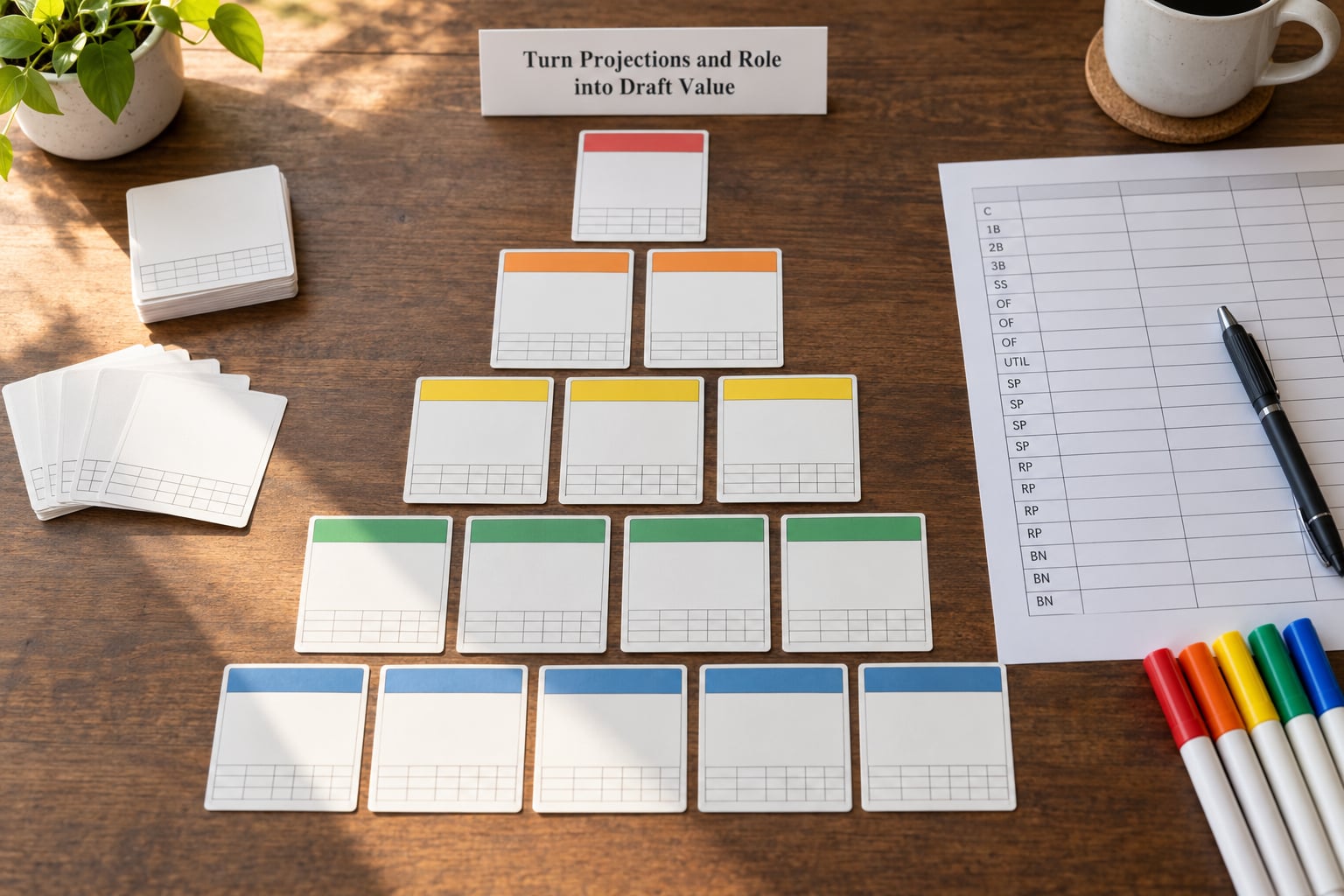
At each turn, compare five things: expected production, opportunity, volatility, injury risk, and scarcity. Production is the projection. Opportunity is the role and the innings. Volatility is how far the realistic range spreads. Injury risk is the history, with extra weight on young lefties. Scarcity is how many comparable pitchers remain after this pick.
Reaching for an ace is justified when three conditions hold at once: you are picking early enough that the tier will not survive the pick before you, the league format punishes bad ratios heavily, and the ace is not carrying an injury flag. Reaching is not justified simply because a pitcher is the best available on your board, which is the most common draft-day mistake in this position. An early run on starting pitchers also flattens the board: four managers in a row taking their rotation anchor removes the depth tier, and the tail of your staff becomes names you did not want.
Use average draft position as a live reference, not a command. If the pitcher you want is going at pick 25 and you are at 31, take the best player available rather than pretending his price is about to change. Panic about a target being taken one pick before you is the single most common way good drafts go wrong.
How you can tell this worked: at every pitcher selection, you can name what you gave up and why the trade was worth it. “He was the best player left” is not a reason.
6. Draft by Rotation Need and Draft Board Opportunity
Work from your slot, not from a round. On a snake draft, your picks are scattered, so what matters is the shape of your board at the moment you are on the clock, not a rigid round-by-round script.
- Pick 1 to 3. Take an ace if one is worth it, otherwise take the best player available and plan your first starter around picks 25 to 45. A first-round ace is a fine outcome, not a requirement.
- Pick 4 to 6. Your rotation anchor window in a 12-team league. Take the highest-upside pitcher in the top two tiers here and stop the early run.
- Pick 7 to 9. Second anchor, then a batting group. Do not take a third early starter here unless the board has forced your hand.
- Pick 10 and later. A streaming starter, two speculative arms, and closers with defined roles. This is where the tier drop usually does the work for you.
A concrete version: at pick 34 you have a stable, innings-eating starter sitting at the top of tier two and a hitter you like at the bottom of tier two. If your roster has a hole and the innings guy is projected to outlast the hitter’s plateau, take the starter. Then on pick 39, when four other managers have taken arms and the pitcher tier has thinned, take a hitter. The staff is built, the bat board is still good, and you did not spend a third of your first five rounds on pitchers.
How you can tell this worked: by the end of round five you hold two starters you would defend, and you still have a full round of batting depth ahead of you.
7. Check the Finished Staff Before Your Last Pick
Audit the staff about five picks from the end. Check for an ace, one or two anchors, a streaming slot, closers, and one depth arm. Then look for the four failure patterns: missing innings, because three 165-innings pitchers is not a staff; too much injury risk concentrated in one bullpen or one injury-prone history; redundancy, because two players with identical platoon profiles stack badly; and unused late-round value sitting there.
If one large gap remains, fill it now rather than hoping. A manager who ends the draft with a real hole at the end of round 15 is gambling on a waiver wire that already emptied. If your staff is complete, take one pitcher you like for the IL stash and one hitter, and stop.
How you can tell this worked: you can name the role each of your pitchers fills, and none of those names are “insurance for a season I have not thought about yet.”
Common Mistakes
Chasing raw strikeout totals without role security
A pitcher with 250 strikeouts in a bullpen role is not a starting pitcher. Check the innings projection before the strikeout number, every time. The fix is simple: sort your board by role first, then by talent within the role.
Drafting too many similar pitchers
Five pitchers from the same archetype means five bad weeks when the league trends against that archetype. Build for variety: one innings eater, one ratio-first arm, one speculative upside pick. The fix is to check each new selection against your existing staff before you click.
Ignoring replacement value
The pitcher available in round nine is not a worse version of your first-round ace, he is a different job. Judge him against the other pitchers on the board at that pick, not against your first selection. The fix is to re-rank your tiers as the draft moves, roughly every three rounds.
Overvaluing weak offence
A rotation with no run support is harder to own than its pitchers look. Check projected lineup quality, not just the club’s reputation. The fix: discount pitchers on clubs with rebuilding lineups by a tier in roto formats, less in points formats where a bad week does not compound.
Reaching for injured arms too early
Injured pitchers fall on draft boards, which makes them look cheap. They are not cheap, they are uncertain, and the price does not reflect the probability you never get a full season from them. The fix: draft them at their normal slot or later, never ahead of a healthy equivalent.
Overloading on young, unproven starters
Youth brings ceiling and volatility in equal measure. Rookie and second-year innings projections built on minor league workload are the most inflated numbers in the sport; the community view that Year 1 MLB innings, not minor league innings, is the best Year 2 predictor is the safer basis. The fix: cap speculative arms at two and let the projections be modest.
Leaving no depth at all
A staff of four starters with no fifth option is one bad week from a waiver-wire scramble that rarely goes well. The fix: draft one streaming arm you are willing to rotate, and one more you would actually start in a bad matchup.
Using the same strategy in points and category formats
Points scoring rewards consistency you can project, so secure workloads gain. Roto scoring punishes a single bad ratio week twice, so a volatile arm is more expensive than it looks. The fix: move a player one tier up in points formats and one tier down in roto when his volatility is high.
Draft-day tips that hold across formats: write your first-acet round and your last-starter round on the board before you start, track the number of pitchers taken in every round, and stop your early run on arms by pick 60 no matter how thin the tier looks. Managers who pre-commit to a round reach for far fewer arms than managers who improvise.
Frequently Asked Questions
How many starting pitchers should I draft in a 12-team league?
Most 12-team managers should draft four or five. Four covers a normal schedule when you add probable pitchers from the waiver wire in thin weeks, and five is safer if your league plays only seven games a week, plays at home one week and away the next, or counts ERA and WHIP. Going beyond five rarely helps, because the replacement arms get thin and you end up rostering two players with the same role.
When should I draft a starting pitcher instead of a batter?
Take a starter when you are inside the window where your top two tiers of pitchers will not survive to your next pick, and your roster does not yet have a rotation anchor. In most 12-team leagues that window opens between picks 25 and 45. Outside it, take the best available player, because a pitcher drafted in a thin tier is worth less than an equivalent bat.
Are probable pitchers worth drafting in fantasy baseball?
They are worth picking up during the season rather than spending a draft pick on. Probable pitchers from good rotations give you a week of streaming without a roster slot, and they are how you cover a thin stretch between two starts. A pitcher projected for fewer than 160 innings is usually better handled this way than burned on a fifth-round pick.
Should I draft a young starting pitcher for upside?
Sometimes, but never as an anchor. A young pitcher in a settled rotation spot is a reasonable second or third upside arm, because even a mediocre season returns innings and ratio stability. A prospect still competing for a job can lose the role in April and produce nothing all year, so cap speculative pitchers at two and weight their innings projections toward their first MLB season rather than their minor league workload.
Does starting-pitcher strategy differ in points and category leagues?
Yes. In points formats, consistency and innings are worth more, so secure workloads and high-volume arms move up a tier and volatile high-upside arms move down. In rotisserie formats, a single bad week can cost you two categories, so ratio floor and ballpark effects matter more and fly-ball pitchers on poor clubs deserve a discount. The tier list is the same; the ordering changes.
Conclusion
A strong pitching draft is not built on one universal ranking. It starts with what your league actually needs, then with pitchers who hold a secure rotation spot and a workload you can count on, and it prices all of that against the current board. Draft a dependable workload first, keep the number of volatile arms low, and hold back the late picks where the depth tier does the work for you.
Before your next draft, do one thing: write down the round you take your first starter and the round you take your last one. Everything else on the board gets easier once those two numbers are fixed.