
To set FAAB budget bids without torching your season, work from the player’s replacement value, not from his box score last week: price the player, price the competition, pick a maximum number, and submit it once. It takes about ten minutes per wire and it is the whole difference between managers who finish the year with budget and managers who spend 40 of it in September.
FAAB, short for Free Agent Acquisition Budget, is a pool of fake dollars — most commonly 100 — that every manager gets at draft time and then spends by placing blind bids on waiver-wire players. The highest bid on a free agent wins the claim, you are deducted exactly what you bid, and the pool never refills. No refunds for overshooting, no weekly reset, no second chances.
Table of Contents
What You Need

Most bad bids come from bidding with half the picture. Six things worth having open before you type a number:
- Your league settings. Starting budget, minimum bid, how many claims you’re allowed per week, the waiver deadline, and whether ties break by waiver priority or reverse standings. Yahoo, NFL.com, ESPN, Sleeper, Fleaflicker and MyFantasyLeague all handle these slightly differently.
- Your remaining budget and the date. Not the starting number. The remaining number, plus a rough count of how many claim cycles stand between you and your championship week.
- A replacement baseline for the position. The best player you could plausibly add for free at that spot, which is your actual price floor.
- Role news, not just injury news. Snap counts, target share, backfield splits, and whether a coach has described a change in the offensive scheme. Usage trends move waiver values more than box scores do.
- The current wire. What your league rivals are dropping tells you which positions are about to thin out.
- A written valuation scale. Some fixed anchors, in your own league’s scoring, so you are deciding from a scale instead of from whatever excitement a name generates on a Tuesday night.
Step-by-Step: How to Set FAAB Budget Bids
1. Check the league budget and bidding rules
Open your league settings and confirm the starting budget, the minimum bid, and how many players you can bid on in one window. Some platforms allow a queue of claims that fire in order until one lands, which changes your whole approach; others only score your first successful claim each week.
Write the reserve number here, too: the slice of budget you refuse to touch. Ten to fifteen percent is a reasonable starting point, and in a league with an IR slot it is closer to twenty. Whatever you choose, this is the number that stops a panic bid at 1:00 am.
2. Establish a replacement-value baseline
Before you decide what a player is worth, decide what he is worth relative to the next guy who will appear on your wire for free. That replacement-level player is your zero point. Anything above that is what you are actually bidding on.
Say your backup running back is a fourth-round regression candidate with a chance to start eight games. The best RB likely available for free next week is a low-end committee back. If your target only projects better than that replacement, the correct bid is small — and in a deep league, small. If he’s the only real upgrade available at running back, the bid climbs toward a fifth of what you have remaining.
3. Rate the player’s weekly and season-long value
Now move the target from a ranking to a range. Four inputs move a bid more than anything else:
- Expected playing time. A guaranteed three-down back is worth more than a guy competing for touches, even if the latter scored more last week.
- Role stability. Committee work caps the ceiling. A stated lead role does not.
- Schedule and matchup. Playoff schedules and soft weekly opponents justify paying up in September, not in week three.
- Age and format. In dynasty, a 23-year-old with a job is worth bidding on far past the point where a redraft manager would have moved on. In redraft, late-round fliers often are not.
Write the range down as a percentage of your remaining budget, not your starting budget. This is the single most misunderstood habit in the whole topic, and almost every piece of published bid advice assumes it: a “10 percent bid” with 60 remaining means 6, not 10.
4. Estimate the competition
Every platform shows you what your rivals have been claiming and how much budget each of them has burning. Use it. A league where two rivals have full budgets and empty benches is a league where a four-dollar bid on a hot backup will get contested to 20.
Then adjust for structural habits rather than guessing. Round numbers are magnets — plenty of managers type 20 or 25 without thinking, so odd numbers win ties for free. And in leagues where one manager reliably outbids everyone early and another hoards until Week 12, you can plan around both of them.
One practical habit: pool your failures with your league. The weekly bid threads on r/fantasyfootball work because managers report the number that lost. Ten data points tell you more than any tier chart.
5. Set a maximum bid and stop there
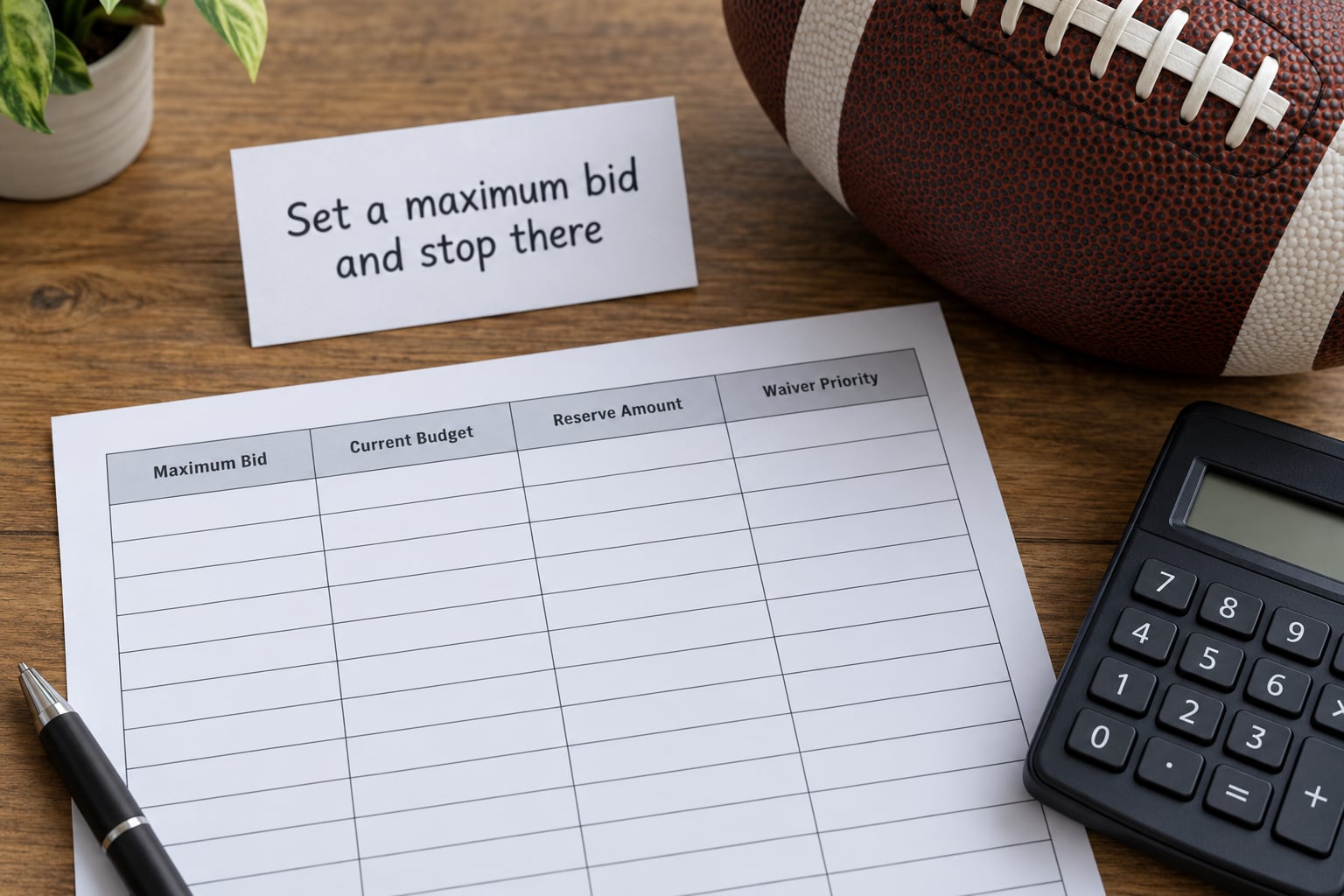
Take your midpoint from step 3, add a little for the competition you found in step 4, subtract the reserve from step 1, and that’s your maximum. Submit it, log it in a spreadsheet with the week, the player, and the outcome, and close the wire.
| Player tier | Share of remaining budget | With 100 remaining | With 60 remaining | With 30 remaining |
|---|---|---|---|---|
| League-changing starter | 35-50% | 35-50 | 21-30 | 11-15 |
| Clear starter upgrade | 15-30% | 15-30 | 9-18 | 5-9 |
| Handcuff or depth piece | 8-15% | 8-15 | 5-9 | 2-5 |
| Streaming defense or kicker | 1-3% | 1-3 | 1-2 | 1 |
| Dart throw or free agent pickup | 1-2% | 1-2 | 1 | 1 |
Read the last two rows again. Most of those bids should be 1, and a lot of them should be 0. Streaming is not an investment; it’s a placeholder you intend to upgrade. Bidding real money on a kicker in week four is how rosters end up with no budget in December.
Common Mistakes
Bidding in the first hour of the wire. Everyone else is awake and clicking. Wait until the last ninety minutes before the deadline, when most managers have given up and the quality names have thinned out.
Spending the whole budget. The budget is a season-long resource, not a monthly allowance. If you have nothing left in week 12, you cannot respond to a starting quarterback getting carted off in week 14 — and that is exactly when the league is decided.
Ignoring replacement value. The most common cause of overspending. If a waiver addition does not upgrade you over what you can get for free next week, you should be bidding the minimum, not the number that made you feel something.
Anchoring to a round number. Twenty-five is a psychological bid, not an analytical one. Bid 23 and you beat every manager who guessed 25 while also winning ties against the 20s. You give up almost nothing and you win a coin flip you were otherwise losing.
Chasing last week’s score. A 28-point fantasy performance from a player with a declining role is the single most expensive thing on the wire. Bid on the job, not the box score.
Spending early because the wire looks thin. Some weeks are genuinely barren, and then saving is correct. The test is whether the players available were players you already wanted. A slow wire is not a reason to bid; it is a reason to hold.
A few habits that pay off:
- Submit a queue of claims with descending amounts rather than one bid. Many platforms process them in order, so your lower bid only fires if the higher one loses. Sleeper managers get this most often wrong, then bid a second player out of panic and lose twice.
- Reconcile with your league rivals. Tell people your budget philosophy early; it makes everyone calmer and it makes your bids easier to read.
- Log every bid that loses, including the number. Your losing bids are the only honest market data available to you.
- Bid odd numbers. Every time.
Frequently Asked Questions
How much should I bid on the waiver wire?
Most of the time, a fraction of what you have left. A clear starter upgrade is usually 15 to 30 percent of your remaining budget, a committee-back or depth piece lands around 5 to 10 percent, and streaming pieces should be 1 or 0. Reserve at least 10 percent of your starting budget for late-season needs, and remember those percentages apply to what remains, not what you started with.
Should I bid 0 or $1 on a waiver wire player?
For defenses, kickers and pure streamers, yes — a 0 bid claims the player if nobody outbids you, and costs you nothing when someone does. Check your platform’s setting first, because some leagues treat a 0 bid as a claim and others require at least 1. On ESPN, zero-dollar claims can count as real bids, which changes late-season math entirely.
How do FAAB tiebreakers work?
When two managers bid the same amount, the league’s tiebreaker decides it: usually the manager with higher waiver priority wins, and in reverse standings leagues the lowest-ranked manager wins. Because of that, bid one dollar above any number you think is popular rather than matching it. Rounding up by a single odd dollar turns a coin flip into a win.
Does the FAAB budget reset every week?
No. A FAAB pool is season-long. Whatever you spend is gone, and once it reaches zero you can still bid 0 for free players, but you are finished acquiring talent. Some dynasty leagues add an annual budget at the start of each season, which is a different thing from a weekly reset. Read your league settings to be certain what yours does.
How do I decide whether to save or spend my FAAB budget?
Count the claim cycles remaining before your championship week and divide what you hold by that number. Spending everything in October leaves you with nothing when a starter gets hurt in December. Spend aggressively only when a target would meaningfully change your playoff ceiling — a workhorse running back in a good offense, for instance — and hold on everything else.
How many players can I bid on at once?
Most platforms let you queue several claims, ordered by the priority you set, and they process until one succeeds or the window closes. Sleeper and Yahoo both support this behaviour; NFL.com and ESPN vary by league settings and season. The mistake is assuming the queue fires all at once — enter your backup bid below your primary, not at the same level.
Start tonight by writing your reserve number on paper before you open the waiver page. Everything else in this guide is arithmetic on top of that one decision, and a manager with a firm floor rarely ends up broke in November.