
To manage a fantasy baseball bench during the season, give every roster spot one job, decide in advance what fills it and what it costs to hold it, and re-run that decision once a week instead of reacting to yesterday’s box score. In practice that means writing down your league settings, labelling each bench player as a streamer, injury replacement, platoon bat, prospect or insurance, and setting a drop threshold before you get emotionally attached to anyone.
It sounds simpler than it is. Most bench problems are not bad luck; they are undecided owners sitting on lottery tickets and calling it a strategy. This guide is the system I use: about ten minutes a week, a spreadsheet with three columns, and a rule for every spot you own.
Updated for October 2026. Settings and roster sizes vary by league, so adjust the numbers to your own commissioner.
Table of Contents
- What You Need to Manage a Fantasy Baseball Bench During the Season
- Step-by-Step
- How to manage a fantasy baseball bench during the season: start with your league rules
- Separate bench players by the job they perform
- Use matchups, role changes, and expected playing time
- Set weekly streaming rules for temporary value
- Plan for injuries and uncertain lineups
- Make final bench calls before lineup locks
- Review bench performance without second-guessing every move
- Common Mistakes
- Frequently Asked Questions
- Conclusion
What You Need to Manage a Fantasy Baseball Bench During the Season
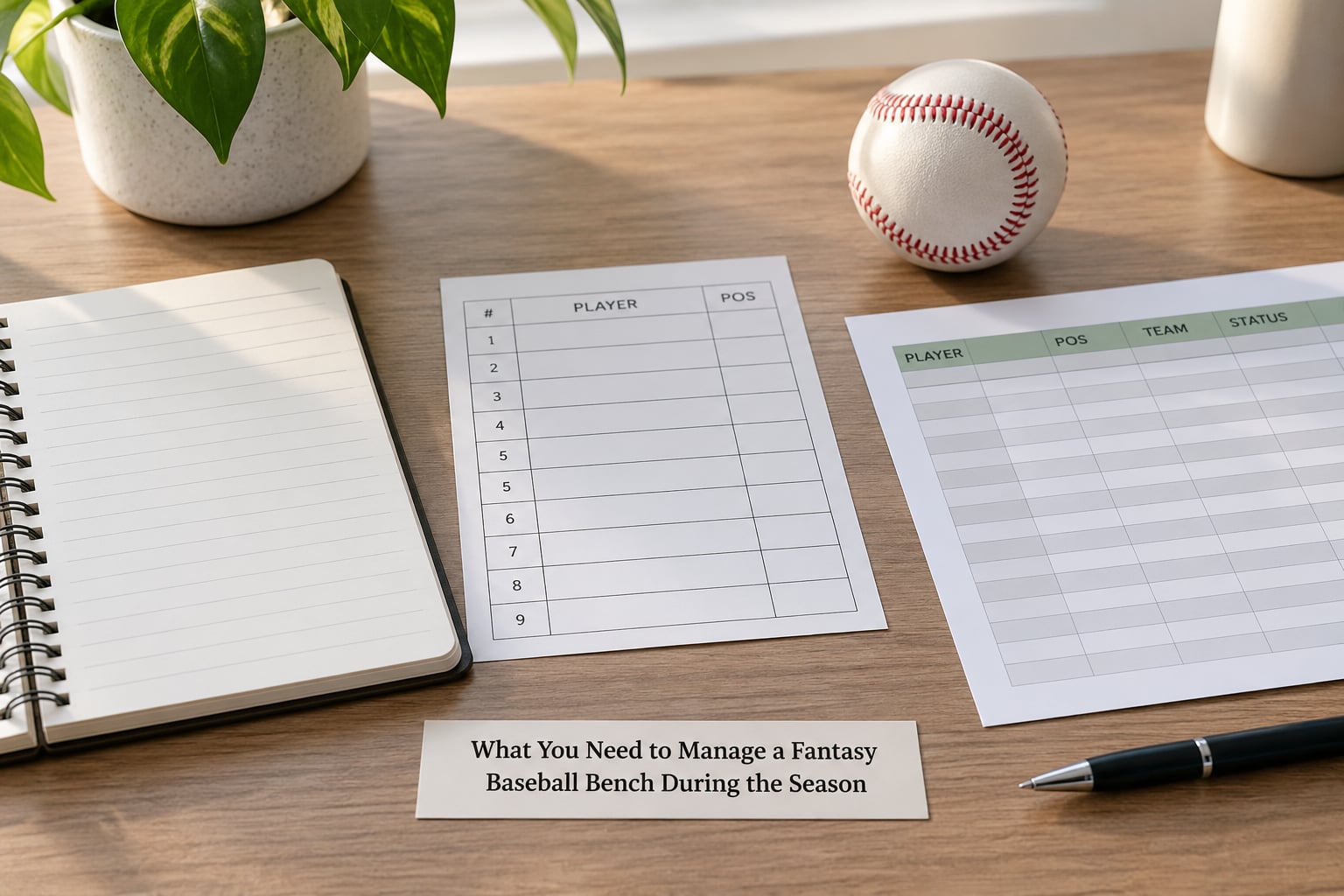
You need four things before you touch a bench spot: your league settings, a reliable player-news source, a place to record decisions, and enough time each week to actually run the process.
- Your league settings printout. Roster limits, active positions, utility and MI/CI slots, injured list spots, transaction caps, daily versus weekly games, scoring format, and playoff dates.
- A starting-pitcher reference with probable pitchers. Most platforms show projected starts a week out, and that projection is the single most useful input for streaming.
- One reliable injury and lineup source. Official club transaction reports beat rumor accounts, and posted lineups beat projections once they are out.
- A roster sheet with a job column. Every bench player gets a label: streamer, injury replacement, platoon bat, prospect, insurance. No label means you do not know why he is there.
- A drop threshold, written down. Decide in advance what evidence makes you cut someone, so a bad week does not make the call for you.
Benches work differently by format, so the first real question is not which player to add. It is how many spots you have and what your league allows you to do with them.
| League type | Typical roster spots | Usable bench spots | What the bench is for |
|---|---|---|---|
| 10-team mixed, standard | 16 | 3 to 4 | Streaming arms and one injury replacement. Thin on flexibility, so hoard nothing. |
| 12-team mixed, 5×5 roto | 23 | 5 or more | Category help, platoon bats, hot waiver pickups, surplus pitchers. |
| 12-team mixed, points | 23 | 5 or more | Injured returns and hot hands. Roster is wide enough to run two plans. |
| AL-only or NL-only | 23 | 5 or more | Narrow player pools mean fewer streamers and more value in a second baseman. |
| Keeper league | 23 | 5 or more | One spot is permanently reserved for the prospect you are building toward. |
| Dynasty | Varies widely | Varies widely | Bench spots are development slots. Young upside outranks weekly production. |
Managers on the r/fantasybaseball forums regularly post the size of their bench as the first detail of a league question, usually because they have run out of it. Three bench spots in a 12-team league is the constraint most people are actually fighting.
Step-by-Step
How to manage a fantasy baseball bench during the season: start with your league rules
Start with your league rules because they decide everything else. Active roster limits, reserve slots, whether you play daily or weekly, tiebreakers, scoring categories and playoff dates all change what a bench spot is worth.
Daily games give you the most flexibility: a pitcher who starts Tuesday can sit Wednesday and nobody blinks. Weekly locks do the opposite, which is why managers complain that mid-week injury news is unmanageable when they locked a lineup on Sunday. Categories reward a bench player who adds a category you need; points punishes a player who only produces in weeks you do not have. Know which game you are playing before you decide who sits.
Separate bench players by the job they perform
Label every bench player with the single reason you own him. Managers who skip this step end up with three pitchers, two low-owned outfielders and no idea which one to cut first.
| Role | Best player type | Upgrade when | Cut when |
|---|---|---|---|
| Streamer | Low-owned pitcher with two good starts this week | The projected matchups improve next week | His starts slip or the opponent bullpen improves |
| Injury replacement | Player with a firm return timeline | His replacement on your active roster is dropped | No timeline after two weeks, or he lands on the IL again |
| Platoon bat | Right-handed hitter you start only versus lefties | The split holds at a meaningful margin and the player stays in the lineup | He loses his regular role or the split disappears |
| Prospect hold | Young player with a path to a call-up | He gets a regular role at his position | No playing time through a full month |
| Insurance | Cheap catcher or shortstop eligible at a second position | A starter goes on the IL | You get two full weeks without needing him |
The two-man bench from forum threads usually means a player on the IL plus one add, which leaves nothing for anything else. That is a roster construction problem at the draft, not a mid-season one, and the honest fix is a trade.
Use matchups, role changes, and expected playing time
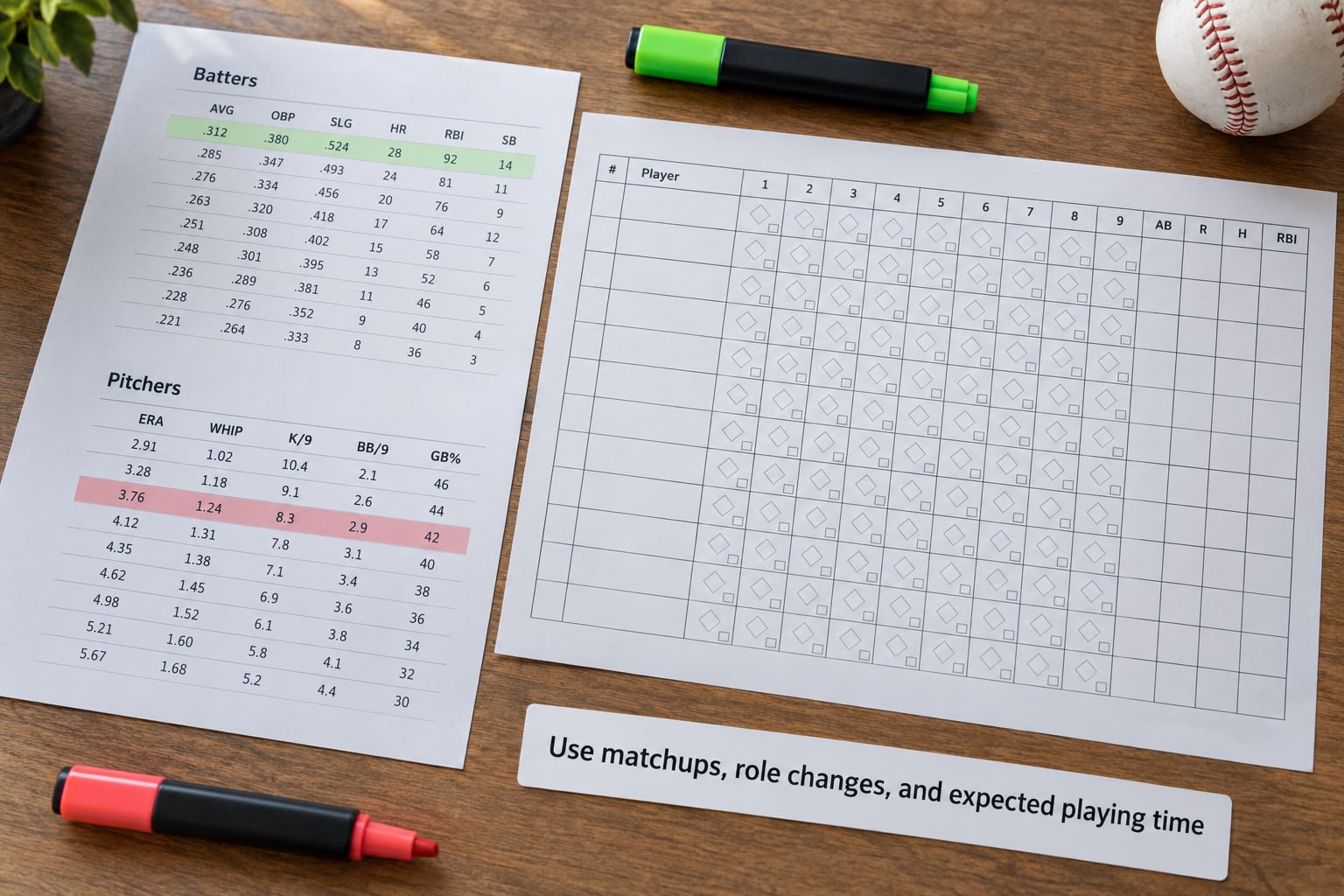
Judge bench players by expected playing time and matchup, not by season averages. A shortstop batting eighth with a .230 average is a different player from the same shortstop batting third, and only one of them belongs in your lineup against a lefty.
Check four things: his spot in the batting order, his split versus the handedness of the opposing starter, the pitcher’s stuff and the bullpen behind him, and whether his role changed recently. A player who used to lead off and now bats seventh is not the same asset he was three weeks ago. Playing-time projections catch that shift before it shows up in the box score.
Platoon splits only matter when the gap is real. A 100-point wRC-plus differential between sides of the plate is a decision; a 30-point gap is noise you will chase for a week and lose on.
Set weekly streaming rules for temporary value
Streaming works when you commit to a short window and write down when you are done. Pick a candidate with two favorable projected starts inside a seven-day span, set the drop date for the Monday after, and do not extend it because he homered once.
Two rules keep streaming from eating your roster. First, never stream for more than two consecutive weeks, because the pitcher you added will be someone else’s steal target and the next start gets harder. Second, pay a modest FAAB for the first claim of the season and save the aggressive bids for August and September, when every owner is chasing a playoff push and the free agents who matter are gone.
In a daily lineup with a games-start cap, the Ottoneu community’s rule is straightforward: keep the pitcher on your roster but slot him in only on days he pitches. In a weekly league, the same pitcher is a one-week rental.
Plan for injuries and uncertain lineups
Decide where an injured player lives before it happens. An injured list slot protects the player and keeps him out of your lineup math; a bench spot protects him and costs you flexibility. If your league has two IL spots and a three-man bench, you have room for exactly one injured player without hurting.
When news breaks, work in this order: check the official club report for a timeline, decide whether the absence is days or weeks, and only then decide whether to use an IL spot, a bench spot or the wire. Prepare two contingencies, not one, because posted lineups at an hour before first pitch often differ from projections.
Temporary absence and long-term role change need opposite responses. A day off for rest is a streaming opportunity. A dropped batting-order slot or a move to the bench for a week is a demotion, and you revalue the player accordingly rather than waiting for the batting average to come back.
Make final bench calls before lineup locks
Run this checklist in the last hour before lock, not the night before:
- Confirm the probable pitchers for both teams today.
- Compare your bench candidates on expected playing time first, stats second.
- Check the injury report and any late lineup notes from the teams in your matchup.
- Confirm your IL slots are not full when a new report lands.
- Write one sentence per call: who starts, who sits, and why. You will reuse that sentence in your weekly review.
If two players are close, start the one with the better schedule this week and decide again next week. Consistency in the process matters more than getting each individual call right.
Review bench performance without second-guessing every move
Separate process from results once a month. Did you follow the rules you set? Was the drop threshold applied on schedule, or did you hang on because you liked the player? A rule you follow and lose on is fine; a rule you break and win on teaches you nothing.
Keep a simple log with three columns: player, reason added, date dropped. After a full month you will see patterns, such as streamers who never got their second start because their rotation slipped, or prospects who sat untouched for five weeks in a redraft league where nobody else will value them.
Common Mistakes
Most losing bench strategies share the same handful of errors.
Chasing yesterday’s results. Adding a hitter because he went 4-for-4 has no connection to his next ten games. Fix: make streaming decisions on schedule and matchup, and never on a single performance.
Hoarding replacement players. Holding four players below 20 percent ownership in the hope one becomes a star means four empty spots. Fix: every non-core player gets a date, and if the date passes without a role, he goes.
Ignoring playing time. A bat averaging .280 with two at-bats a week produces less than a bat averaging .240 with full at-bats. Fix: check the batting-order spot before the average.
Streaming without an exit plan. You add a pitcher for one start, he pitches well, and suddenly he is a roster member. Fix: write the drop date when you make the claim, not after.
Spending the FAAB budget in April. Bidding aggressively early leaves nothing for a mid-season injury replacement. Fix: small bids for streamers, real bids only when a top player hits the wire.
Making every move off one matchup. A lefty starter does not make a right-handed hitter drop to the bottom of your lineup every time. Fix: require a meaningful split margin before you platoon.
Running the same bench strategy in a keeper or dynasty league. Weekly optimization does not belong in a league where you are building a 25-player roster. Fix: in dynasty, one or two bench spots stay developmental all season.
One habit that quietly fixes several of these: post your weekly bench somewhere other managers can see. Forum threads show that owners with a written, repeatable policy get taken more seriously in trade talks, because their roster math explains itself.
Frequently Asked Questions
How many bench players should I roster?
Match your bench to your league, not to a target number. A 10-team league leaves you about three or four usable bench spots, so fill them with streaming arms and one injury replacement. A 12-team league with five or more spots can also carry a platoon bat and a hot waiver pickup. Never leave a bench spot empty, and never fill one with a player you cannot explain.
Should I bench my injured player or drop him?
Put him on an injured list slot if you have one and the report gives a timeline you trust within two weeks. If your IL spots are full, use a bench spot for the same reason. Drop him when there is no timeline after two weeks, when he is expected back after your playoff week, or when the replacement at his position is already performing.
When should I drop a player in fantasy baseball?
Drop on evidence, not on mood: no playing-time news after two weeks of benching, a role change to a worse spot, a demotion to the bench, or a drop date you wrote down at the time of the claim. In a points league, also drop a starter-quality bat who is not in the lineup on his scheduled start. Cold batting averages alone are not a reason.
Is platooning a good strategy in fantasy baseball?
Yes, when the split is real and the player stays in the lineup. Sit a right-handed hitter against a good left-handed starter if the gap is around 100 wRC-plus or more, and start him otherwise. Do not platoon in a weekly points league if the cost is benching your best available substitute every week for a marginal edge.
Should I stream starting pitchers every week?
In a daily league with a games-start cap, yes. Keep the pitcher on your roster and slot him in only on the days he starts. In a weekly league, stream selectively: pick arms with two favorable starts in the window, set a drop date for the following Monday, and never extend a rental because of one strong outing.
How do I use bench spots in a dynasty league?
Treat bench spots as development slots rather than weekly score boosters. Keep one or two prospects with a clear path to regular playing time, and value youth upside over current production. Drop a prospect who gets no at-bats in a full month, and check your league’s minor-league roster limits before stashing someone who will not be rostered.
Conclusion
Managing a fantasy baseball bench during the season comes down to three habits: name the job each spot does, give every temporary player an end date, and re-run the whole thing on a schedule instead of on emotion.
Start with the least glamorous step. Write down your league settings and count what you actually have, then label each bench player as a streamer, injury replacement, platoon bat, prospect or insurance. After that, map the next two weeks of probable pitchers so the streaming decisions are already made before you need them. Ten minutes now saves you three rushed lineup locks later in the season.