A fantasy football tier is a group of players you would genuinely draft in any order, because the gap between them and the next group down is wide enough that reaching past it costs you real value. Tiers are a decision bucket, not a prediction that everyone inside it scores the same. Learning how to tier players for a fantasy draft takes about an hour of setup and a few edits per week, and it is the difference between drafting from a plan and panicking into a reach.
Most managers already have rankings. What they lack is any way of knowing which gaps in that list are real and which are an artifact of one analyst’s ordering. Tiering is the filter that answers that question, and once your tiers are built the draft itself gets much simpler.
This guide teaches the method, not a player list. Every example below uses a hypothetical league so the article does not go stale in September, and you should always reconcile any tier board against your own league settings before you sit down.
Table of Contents
- What You Need
- Step-by-Step: How to Tier Players for a Fantasy Draft
- Common Mistakes
- Frequently Asked Questions
- How many player tiers should I use in a fantasy draft?
- Should I make my fantasy football tiers before or after knowing the ADP?
- How do I tier players at positions like quarterback and tight end?
- How often should I update my fantasy player tier list?
- What is the difference between a player tier list and a draft board?
- How do injury concerns change a player’s tier?
- Conclusion
What You Need
You need five things, and four of them are free. None of this requires a paid subscription.
- Your league settings. Scoring format, roster construction, bench size, number of teams and whether it is a superflex or best-ball league. Tiers built for one format do not transfer cleanly to another, so write these down before you look at a single player.
- A consensus baseline. A standard expert consensus ranking (ECR) sheet, or a projection set, sorted by position. FantasyPros is what most managers open first, and that is a reasonable starting point. You are going to edit it anyway.
- Player notes and injury information. Depth charts, target share and carry splits from the beat writers, plus a reliable injury source. A tier break sits where the opportunity changes, and opportunity is exactly what a depth chart describes.
- A place to build. A spreadsheet works fine and costs nothing. If you would rather not build one, the free cheat sheet creators inside FantasyPros Draft Wizard and RotoWire let you group players into labelled rows and edit the order directly, then pull the same board up on a phone during the live draft.
- A mock draft tool and your draft slot. Simulators exist at both FantasyPros and RotoWire. Your slot number matters, because a tier is only worth what it costs you to wait for it.
Step-by-Step: How to Tier Players for a Fantasy Draft
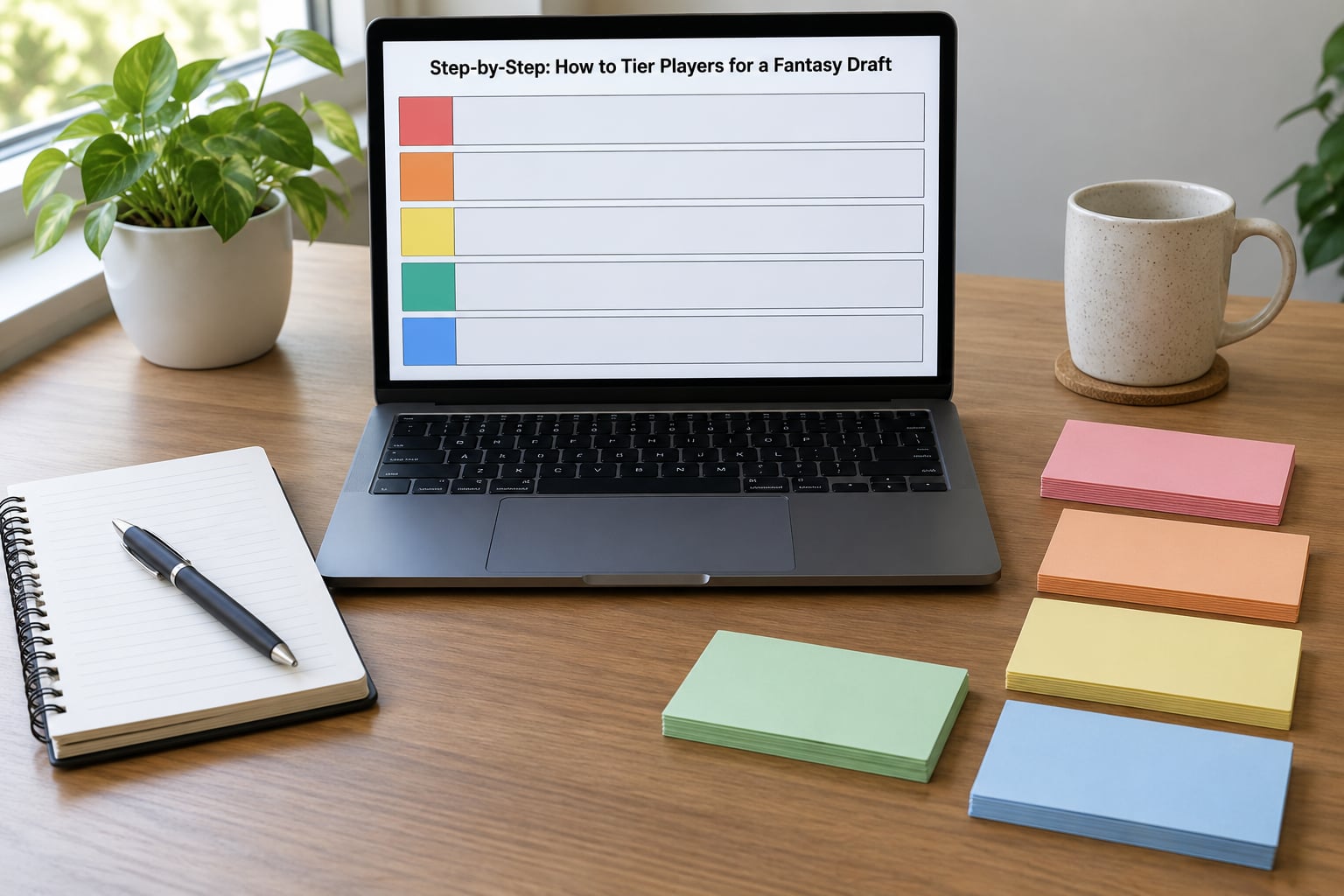
The process below is six steps. Steps one and two set the frame, steps three and four give you a consistent comparison, and steps five and six turn a sorted list into a usable board. Do them in order the first time; after that you will mostly re-run steps five and six as news moves players around.
Define Your Fantasy Football Player Tiers
Step 1: Pull your position lists. Get your ECR or projection data into a spreadsheet with one column per position, sorted best to worst. Do not tier across positions. Quarterback 1 and wide receiver 1 are not comparable units, and a board that mixes them will lie to you in the draft.
Step 2: Set the framework, not the boundaries. A tier break goes where a meaningful drop in expected fantasy value occurs, judged by role, opportunity, floor and positional scarcity. Round boundaries are a separate thing: a tier can easily span three rounds, and forcing a break at round three tells you nothing about value.
Two sanity checks keep you honest. If a tier holds one player, you have rebuilt a ranking. If a tier holds eighteen players with wildly different roles, you have hidden the very drop-off you were looking for. Useful tiers at running back and wide receiver usually run somewhere between three and eight players; tiers at quarterback are naturally wider because the position has a shallower ceiling.
Positional scarcity is the other half of the framework. It describes how many acceptable players remain at a position relative to how many teams need one. When scarcity is high, the tier above a break is expensive and the tier below it arrives late, which is exactly the situation tiers are built to exploit.
Set Consistent Evaluation Criteria
Step 3: Fix your five criteria. Use the same five for every player in a position group: projected role, weekly volume opportunity, floor, ceiling, and durability. Write them at the top of the sheet so you apply them the same way at quarterback 22 as you did at quarterback 2.
Step 4: Apply them position by position. Quarterbacks get judged on rushing involvement, their offensive line and target volume. Running backs get judged on carry share inside the red zone and whether they are a genuine committee member. Wide receivers get judged on target share and route tree, not raw yards. Tight ends get judged on whether the offense actually throws to them, which is a completely separate question from whether they are good.
That last point is why a tight end tier list built on talent rather than usage will embarrass you in a standard league. Six similarly talented tight ends can produce a fantasy spread of almost nothing if only one of them is a real target.
At running back and wide receiver, split your list into two columns before you tier: a floor column for the players whose role is locked, and a ceiling column for the players whose range runs from starter to bust. Most managers should read the floor column, and the ceiling column is where the value lives late.
Group Players by Expected Draft Value
Step 5: Draw the break where the gap is real. Sort each position by projection, then walk down the list comparing neighbours. Two practical tests help when the gap looks small.
The first is the projection gap test. If the player at the bottom of a group projects only marginally better than the first player of the next group, the break is not there. If the step down is meaningful relative to the weekly output of the position, the break is real. At running back, a drop from a workhorse to a committee back is a break. Between two similar committee backs, it is not.
The second is the replacement-level delta. Ask what the next real option down the board is worth to you, and compare that to the player in your hand. The gap between those two numbers is the value of the pick, and when the gap is thin the pick is not worth reaching for.
On the ECR side, the same idea appears as the standard deviation across analysts. When a large group of experts ranks a player in a narrow band, that band is a tier. When his ranking swings wildly from analyst to analyst, the uncertainty is a warning, not a tier.
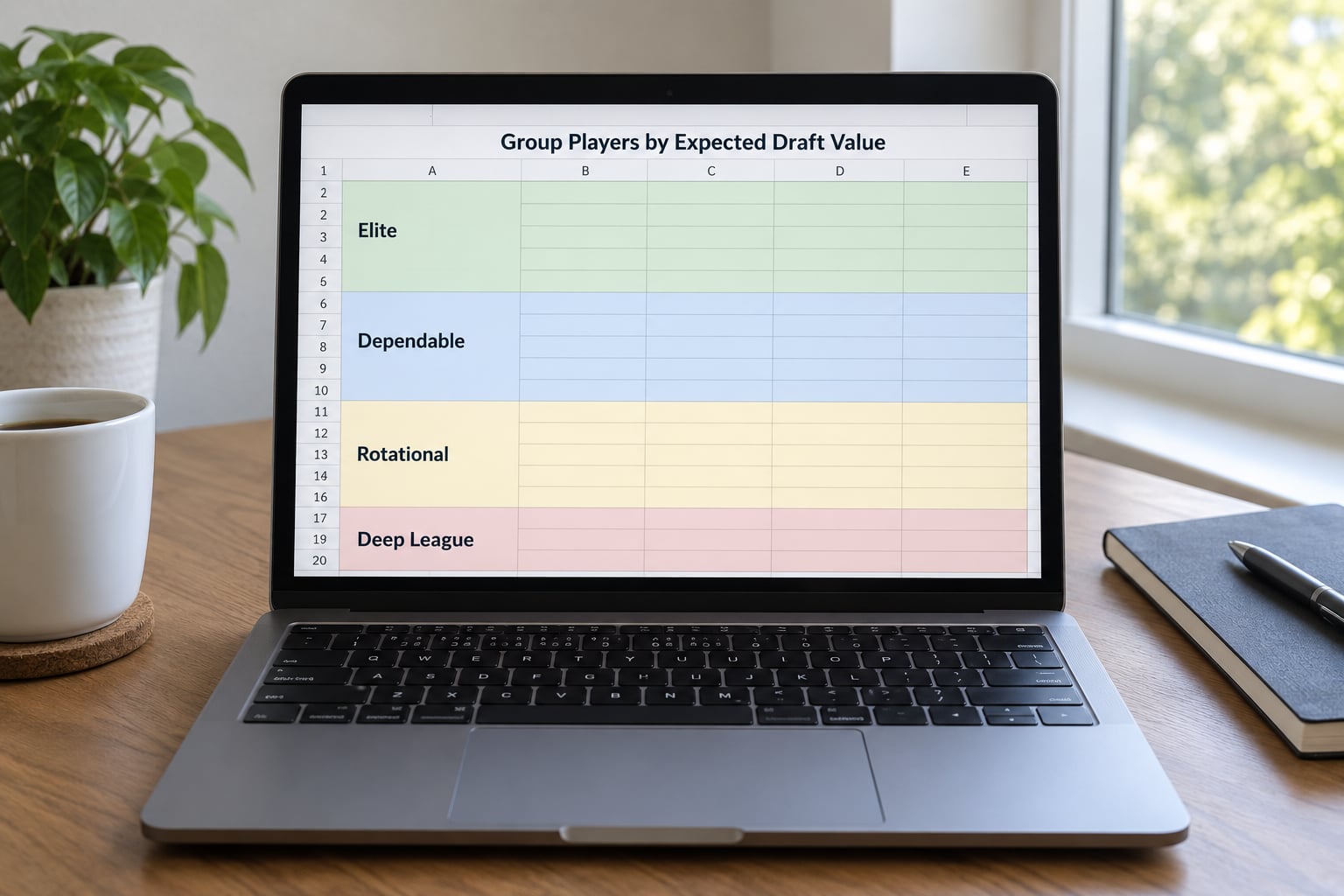
Give the tiers plain labels: Elite, Dependable, Rotational, Deep League. Narrative labels are fun but they anchor you, and a tier called “if things break right” will keep pulling you toward the player inside it no matter what the numbers say.
Test the Tiers Against Your League
Step 6: Stress-test before draft day. Run two mock drafts and see whether your board held up. If you panic at a spot your tiers called routine, the board is wrong, not you.
Adjust for the variables that actually change tier construction:
| League setting | How it changes your tiers |
|---|---|
| PPR scoring | Widens the spread between receivers, so WR tiers are sharper and target share matters more |
| Standard scoring | Compresses the receiver spread, so more receivers fall into one big tier |
| Superflex | Turns quarterbacks into a two-per-round requirement, which shifts every QB tier down the board |
| Tight end premium | Makes the top tight end tier enormous and the second tier nearly empty |
| Best ball | Ceiling matters far more than floor, so read upside columns instead |
| Dynasty rookie draft | The pool is prospects, not NFL players, so tier on draft capital and role path |
| Keeper league | Count picks until your next keeper year, not to your next turn in the draft |
| Auction | Value means a budget number, so sort by projection per dollar instead of by drop-off |
Now decide what to do when tiers and average draft position (ADP) disagree. They are answering different questions. ADP estimates when a player will still be available; the tier tells you whether the pick is worth taking at all. A player going two rounds earlier than his tier suggests is a reach, and a player falling two rounds past it means the board is mispriced in your favour. The tier is worth; the ADP is only timing.
Here is the moment-by-moment version in a 12-team PPR league, picking at 12. The numbers are hypothetical, the method is not.
| Your pick | What is available | What has changed | Action |
|---|---|---|---|
| 12 | Second RB tier intact, top WR tier already picked over | Two WRs from the same tier gone | Take from the RB tier, which will not come back |
| 31 | Third RB tier nearly gone, WR2 tier still deep | One of your positional rivals went early | Draft the last RB in the tier rather than reaching for a WR |
| 54 | WR2 tier half gone, QB tier wide open | Quarterback prices fell after a run | Take the best remaining WR in the tier; do not reach for WR1 |
| 78 | Tight end tier you dislike, but three of them remain | Nobody has taken a tight end in three rounds | Value pick: take one of three, you need one eventually |
On draft day the routine is four moves: cross players off in real time, count how many remain in the tier you are targeting, count how many picks until your next turn, then take from the scarcer tier when two are available. If a run is about to wipe out two tiers from one position, plan a contingency position before the run starts rather than after.
When you are stuck between two or three players inside a single tier, matchup quality and league need break the tie. A player facing a soft weekly schedule or a needed position at a thin roster spot is worth more than the one who does not.
Common Mistakes
Copying a published tier list wholesale. Consensus is an input, not an answer, and almost every public list was built for a specific league size and scoring format. Use one as a starting draft of your own, then rewrite the breaks that do not match your league.
Building tiers of one. That is a ranking wearing a costume. If every group holds a single player, you have gained nothing over sorting by ECR.
Building tiers of eighteen. A group that wide hides the drop-off. Look for a break you have walked past twice and ask whether the role genuinely changes there.
Tier-hopping on single news items. One practice report or one depth chart reshuffle is not a role change. A tier should move when the opportunity changes, not when the news cycle gets loud. A full re-tier takes twenty minutes, so batch your updates rather than reacting to every headline.
Using ADP as the reason to draft. Drafting because a player is going 11% more often than you think is following the market rather than your research. The market is a decent prior and a poor reason.
Ignoring positional context. A running back is not a worse version of a wide receiver, and the tier that looks thin at one position may be endless at another. Tier within positions, then let scarcity decide the order between them.
Never revisiting the board. A tier list built in early August is wrong by September. Plan one update in late training camp, one after the final preseason games, and one the night before your draft.
Frequently Asked Questions
How many player tiers should I use in a fantasy draft?
Aim for tiers that group genuinely interchangeable players, not a fixed number of tiers. At running back and wide receiver, most useful tiers hold three to eight names. Quarterback tiers are naturally wider, sometimes ten or more, because the position has a shallower ceiling. Sanity check both ends: a tier of one is just a ranking, and a tier of eighteen has buried a real drop-off.
Should I make my fantasy football tiers before or after knowing the ADP?
Build the tiers first, then read the ADP. Tiers are your read on value and should be written before consensus polling starts shaping your thinking. Average draft position answers a different question, namely when a player will still be there. If the two disagree, trust your tier for whether the pick is worth it and use the ADP only as a timing signal.
How do I tier players at positions like quarterback and tight end?
Quarterback tiers spread on rushing involvement and offensive line quality rather than raw passing stats, because that is where the fantasy gap opens. Tight ends tier on usage, not talent: a blocker on a run-heavy team belongs in a low tier even if he is a better real player than a high-volume receiving tight end. Standard scoring compresses both positions, so expect fewer breaks.
How often should I update my fantasy player tier list?
Three times is enough for most redraft leagues: once when training camp depth charts settle, once after the final preseason games, and once the night before your draft. Make small edits in between for major injury news rather than re-running the whole board. If you find yourself moving players several times a week, you are reacting to headlines instead of to opportunity.
What is the difference between a player tier list and a draft board?
A draft board is a live list of every player still available, which makes it a tool for tracking. A tier list groups comparable players together, which makes it a tool for deciding. Managers often use both, exporting tiers onto a board at the start of the draft and crossing names off as they go. The tiers do the thinking; the board does the bookkeeping.
How do injury concerns change a player’s tier?
Judge injuries by the change in opportunity, not by the headline. If a player loses his job entirely, he drops a tier or two. If he is out for one game but the backup is a downgrade of half a point per week, the tier barely moves. The most disruptive injuries are the ones that change a committee, because they shift several players at once.
Conclusion
Start with your settings, because a tier list built for the wrong league is wasted work. Then fix five evaluation criteria, pull a consensus baseline into a spreadsheet, and draw breaks only where role or opportunity genuinely changes.
The method is the part that stays valuable, since the same framework works for a keeper league, a dynasty rookie draft and an auction board. Build the first version before draft day, when you still have time to be wrong, then run two mocks against it. The managers who reach well are rarely the ones with better information. They are the ones who knew in advance which gaps mattered.