To prepare for a fantasy football auction draft, you need three finished documents before you sit down: a tiered player ranking, a budget split by position, and a bid sheet with a maximum price attached to every player you would actually buy. Add a tested draft interface, an opponent note sheet, and a plan for your first three nominations, and you have done the work. Most managers can get there in three to four weeks of light prep plus one long session the weekend before.
That prep matters more in an auction than in a snake draft. In a snake draft you get a pick and take what is on the board. In an auction you get seconds to make maybe 40 spending decisions while nine other people try to outbid you, and a single impulse bid on a running back can wreck the rest of your roster. Preparation is the whole edge.
The framework below runs in the order you should actually work: rules, research, budgets, tiers, practice, final check. Each step has an output you can point at, so you know when it is finished.
Table of Contents
- What You Need
- Step-by-Step: How to Prepare for a Fantasy Football Auction Draft
- How to Prepare for a Fantasy Football Auction Draft: Confirm the Rules and Rosters
- Build Your Player Research From More Than One Source
- How to Prepare for a Fantasy Football Auction Draft: Set Auction Budgets
- Create Tiers and Target Players
- Practice Auction-Day Decisions
- How to Prepare for a Fantasy Football Auction Draft: Review the Final Checklist
- Common Mistakes
- Frequently Asked Questions
- How much time should I spend preparing for a fantasy football auction draft?
- Do I need fantasy football auction rankings if I prepare my own budgets?
- What is the best way to handle a positional run in an auction draft?
- How should I bid when my target player is selected by another manager?
- Should I draft a running back early in a fantasy football auction?
- What should I bring or open before the auction draft starts?
- Conclusion
What You Need
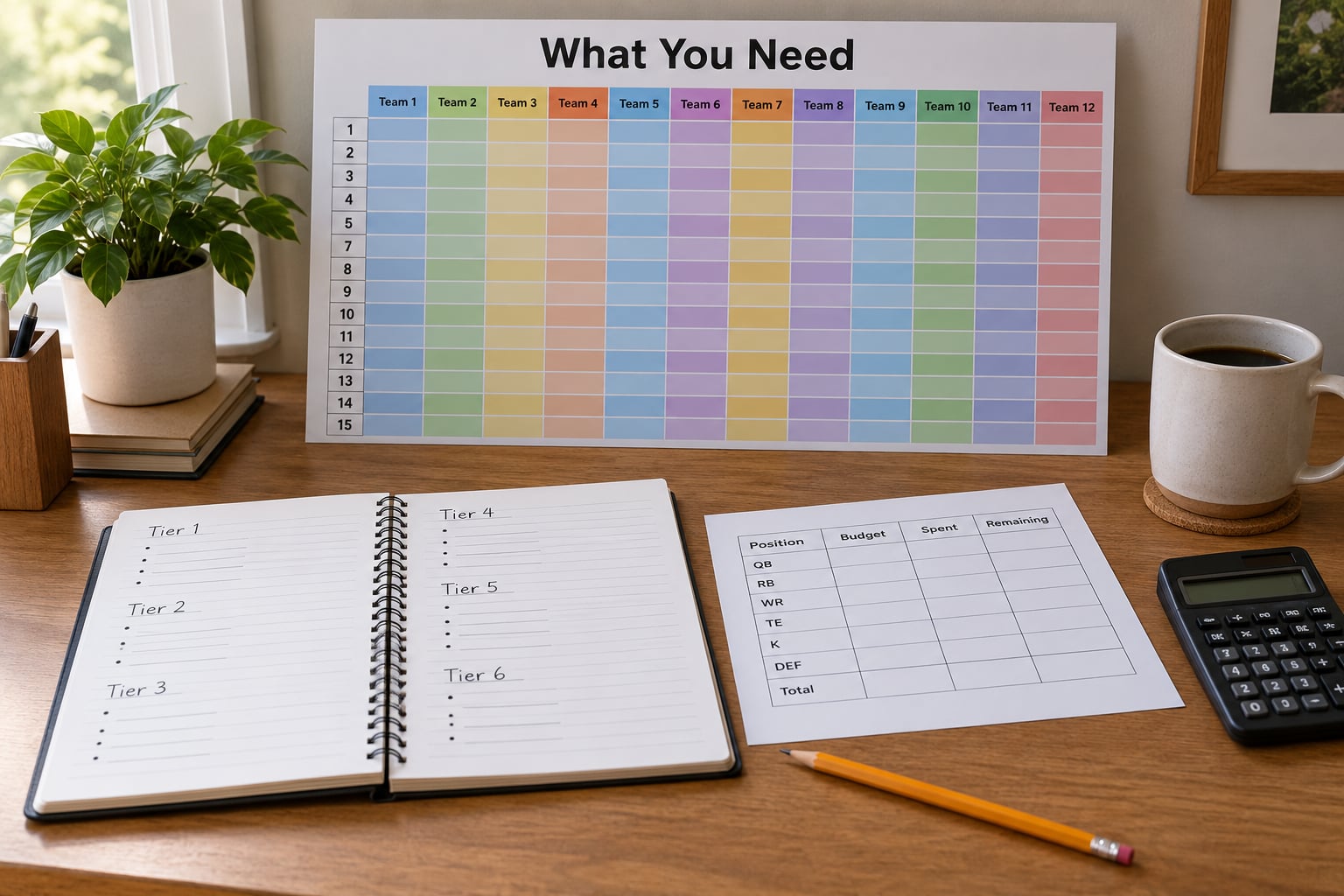
Here is the prep kit, in the order you will use it.
- League settings sheet. Roster size, starting lineup requirements, flex and superflex spots, scoring format, budget amount, and any house rules on nomination order or ties.
- Projection set plus a second opinion. One site’s projections for expected points, a second source so you can spot where the consensus is thin.
- News and injury tracker. A feed you check twice a week in the last month. Depth chart changes matter more than box scores.
- Budget worksheet. A column per position with a target dollar amount, a max, and a running total. Spreadsheet or paper, whatever you will actually look at during the draft.
- Tiered ranking with auction values. Players grouped by the price you expect to pay, not just by overall rank.
- Bid sheet. One line per player: tier, your ceiling, and a fallback you would take instead.
- Draft interface and a backup. The live draft room, logged in, tested, with a phone or second device as a fallback. Confirm your league’s bid clock length before you start.
- Opponent notes. Who in your league runs an anchor-heavy roster, who chases every tight end, and what they paid for the same players last season.
Keep it all in one place. A shared spreadsheet with the two players you draft against beats a private one, because budget transparency is the only real information you get during an auction.
On opponent research, keep it light. You are looking for tendencies, not dossiers. Note who took a tight end above 30 dollars last year, who built an elite-anchor roster, and who had money left at the end. Two or three lines per manager is plenty, and the fastest way to gather them is to ask the two managers who drafted against you what everything went for.
Step-by-Step: How to Prepare for a Fantasy Football Auction Draft
How to Prepare for a Fantasy Football Auction Draft: Confirm the Rules and Rosters
Start by writing down every setting that changes what a player is worth. League size and budget decide the total money supply, and that number drives every price you will see on draft night.
Specifically, you need to know:
- How many teams and how much budget each manager has.
- How many roster spots, and which positions start versus which sit on the bench.
- Whether you run a flex spot, superflex, IDP, or a 2-QB build. Each one changes scarcity dramatically.
- Scoring. PPR scoring raises wide receiver and running back values, and standard scoring flattens the gap between them.
- Keeper rules, if it is a keeper league, since keepers remove players from the board before anyone bids.
- Bid clock length, nomination order, and whether you can pass on a nomination or must take someone.
How to prepare for a fantasy football auction draft is decided here. A superflex league doubles the quarterback supply problem, so the money you park at QB has to roughly double too, and a 16-team league prints more money than a 10-team league, which means the same player costs more.
You know this step worked when you can answer the question “what would I have to give up to own this player” for any position without guessing.
Build Your Player Research From More Than One Source
Collect projections, but never from a single site. The consensus is worth more than any individual ranking, and where two sources disagree is exactly where the auction value sits.
Work in this order:
- Projected points from a source you trust, which gives you a baseline price expectation.
- Role confirmation, by reading the depth chart and the beat writer, not by guessing from last season’s total.
- Injury and offseason news, including camp reports, contract status, and any position change.
- Auction value data from a couple of different advisors, because the same player gets a different price in every league. Treat published values as a starting point, not a truth.
- Comparable players, the guys with the same role, same snap share, and similar projection. If two players are close, you should be able to describe why one costs more.
What separates a useful note from clutter is context. A line like “24.5 points, target share rising after the depth chart reshuffle” tells you something at the table. A bare ADP number does not.
Read the data you gathered and delete anything that does not change your price. Most of it will not.
A preparation timeline keeps this from taking over your month. Four to six weeks out, confirm the settings and set the construction philosophy. Two to three weeks out, build the tiered ranking and the per-position budgets. The final week is for news only, since projections at that point are mostly churn. The weekend before, fill in every ceiling and run the mock. Draft day itself is for checking, not learning.
Do the research in one sitting rather than nibbling at it. Reading about a position for ten minutes a day across three weeks produces a player list. Two focused hours produces a bid sheet, and only the second one helps.
How to Prepare for a Fantasy Football Auction Draft: Set Auction Budgets
Divide your total budget across positions before you research prices, not after. Once you are locked into a number, your bid sheet gets much easier to build because you are looking for players who fit a slot instead of falling in love with a name.
In a 12-team, 200-dollar PPR auction with a 16-spot roster, a workable split looks like this.
| Roster group | Target spend | Share of budget | Rule of thumb |
|---|---|---|---|
| Running backs | 62 dollars | 31 percent | One true stud, one solid starter, one cheap depth piece |
| Wide receivers | 68 dollars | 34 percent | Your biggest share; PPR separates the top from the rest |
| Quarterbacks | 14 dollars | 7 percent | Pay down at one starter unless the board says otherwise |
| Tight ends | 7 dollars | 4 percent | One streaming option, no premium unless scoring rewards it |
| Flex spot | 8 dollars | 4 percent | Fill with the best available RB or WR in the position |
| Kicker and defense | 4 dollars | 2 percent | Stream both, spend almost nothing |
| Bench and lottery tickets | 22 dollars | 11 percent | Include one or two handcuffs and some late fliers |
| Buffer you do not plan to spend | 15 dollars | 8 percent | Only used if the draft runs long or prices collapse |
Running back and wide receiver together should take 60 to 70 percent of the budget in most leagues, which is the number a lot of experienced auction managers land on in r/Fantasy_Football and r/fantasyfootball threads. The reason is simple: those are the positions where replacement is expensive and where a starter’s weekly floor comes from volume rather than one big game.
Quarterback and tight end are where you pay down. The opportunity cost of a 60-dollar quarterback is a second wide receiver who scores every week, and in a one-QB league that trade is almost always worth making. Hold at quarterback only when the board proves the supply is thin, because several teams take one early and push everyone else down to the mid-teens.
Scale the percentages rather than the dollars. In a 100-dollar league, take the same share and let the numbers be small. In a 250-dollar league, keep the same share but expect the top two tiers to price higher, since more money is chasing the same players.
Then reserve something. A common recommendation in auction forums is to hold back 10 to 15 dollars for the final picks, because that is where cheap players appear and where managers who spent early start panicking.
Create Tiers and Target Players
A tier is simply a group of players who should all cost about the same. When you build tiers before the draft, you can bid late in a tier and still feel good, which is the opposite of how a snake draft works, where the best player in a tier is gone first.
Build the sheet this way: for each player you would actually own, write the tier, the auction value you expect, your maximum bid, and the player you would take instead if that price passes your ceiling. Then mark each one as a target, a want, or a flier.
Targets are the players you are buying on purpose, and they are where your plan has flexibility. Wants are fine at the right price. Fliers are lottery tickets you take only with money you have already decided is expendable.
Two rules make the sheet work. First, every player on it has a ceiling, written down before the draft, so you never negotiate with yourself at the table. Second, the middle of your ranking matters more than the top. The first two players at each position get bid up while the room is still flush. Managers report consistently that the middle tier is where a draft is actually won.
Choose a construction philosophy and write it at the top of the sheet. Anchor plus value, meaning two or three genuine stars and a cheap roster everywhere else, is the more common winning shape. A flat, value-heavy roster is cheaper and more fun, and it needs every pick to hit.
Practice Auction-Day Decisions
Run at least one mock auction, two if you have never done one. Simulating a snake draft tells you little, because the decisions you want to rehearse are money decisions made in seconds.
Use your real bid sheet and a real budget in the mock. The point is to practice three specific things:
- Your nomination script. Nominate a mid-tier player at a position you have already filled early. You are buying information, not a player.
- Bidding up players you do not want. Drive a rival’s budget down so their late picks are worthless. Do it early, when it is cheap to do and nobody can tell your motive.
- Walking away. Have a practice rule for the moment a price passes your ceiling. Say it out loud during the mock so the phrase exists before you need it.
My rule on draft night is simple: if the price passes my written ceiling, I stop immediately and move to the fallback on the same line. No deliberation, no hoping the room cools off.
Also plan for the strange parts. Near the end, if you are the only manager with money, do not start bidding up every unwanted player to 8 or 9 dollars. Find the ones nobody else wants and pay 1 or 2, because the value of money late is a full roster of lottery tickets.
Time is the part people forget. An online auction of 12 managers at 16 spots usually runs somewhere between 90 minutes and three hours, and a slow bid clock or a couple of auto-pick delays can stretch it further. Eat before, keep your phone silent, and never let a nomination pass without a decision, because a no-response usually gets resolved by the platform and you lose the negotiation.
Draft-night setup in one place, so you are not searching for it:
- Live draft room open and tested on the device you will use, logged in ahead of time.
- Shared budget spreadsheet with one column per manager, already open in a second window.
- Your bid sheet, sorted by position, ceilings visible.
- Backup device charged, with the draft room reachable on it.
- Bid clock length and nomination timer confirmed, so you know how long you really have.
- Your three planned nominations written down, with the reason for each.
- Fifteen minutes of buffer before the scheduled start.
How to Prepare for a Fantasy Football Auction Draft: Review the Final Checklist
The weekend before, run this list top to bottom. It takes twenty minutes and catches nearly everything that goes wrong.
- Settings verified against the actual league page, not a screenshot from last year.
- News checked in the last 48 hours for injuries, trades, and depth chart news at your target positions.
- Budget totals still add up, and the buffer is still intact.
- Every target has a written ceiling and a fallback.
- First three nominations decided, with a reason for each.
- Draft room loaded and tested on the device you will actually use.
- Backup device charged, second connection working, spreadsheet shared.
- Bid clock length and nomination timer rules confirmed.
- Opponent notes open in a second window, with last season’s prices for your top targets.
- League chat etiquette settled. Nominations belong in the draft room, not in a side message.
One more thing belongs on the sheet before you sit down: what you are willing to do on waivers. In an auction, the roster you finish with is not the roster you play in September. Decide now which bench spots you will actually add to, so a breakout wide receiver on the wire does not tempt you into a fourth bench player you never intended to own.
You are done when you can name your budget for running back, your quarterback ceiling, and the player you will nominate first without checking anything.
Common Mistakes
Overvaluing stars early. The most common auction mistake is winning the first bid war out of instinct. If you spend heavily on the top two players at a position and the board is still full of money, you will finish with a 1-dollar bench. Fix: cap your top two per position at roughly half of that position’s budget before the draft, and only cross the cap when the board forces it.
Nominating a player you want. You hand every rival a price anchor on the exact player you were saving. Fix: your first nominations are almost always mid-tier players at positions you have already covered.
Bidding up a player you do not want. Useful, but only early and only cheap. Push someone to 6 dollars on a tight end you will never roster in the opening hour, and stop. The same trick at pick 90 mostly wastes your own money.
Ignoring the money supply. You are not tracking every other manager’s remaining budget, so you do not know when the room gets broke and value appears. Fix: a shared spreadsheet with a column per manager, updated after every purchase.
Researching instead of deciding. Reading rankings for a sixth week does not move you forward. Every hour of research should end with a number on the bid sheet. Fix: set a ceiling for every player you would actually own, and stop researching at that point.
Treating projections as guarantees. Someone drafted second overall last year finishes 15th all the time. Write your ceilings expecting a miss, and never let one player’s projection justify a price that breaks your structure.
No plan for a positional run. Four running backs go in the first 30 seconds and suddenly your 40 percent running back budget is gone. Fix: pre-decide what the position looks like at three different prices, so a run triggers a switch rather than panic.
Two tips that hold up most often. Spend your whole budget, because unused money does not score points, and end up as a wasted asset. And keep your plan flexible on who you buy, strict on what you pay, since the auction punishes improvisation on price far more than it punishes improvisation on target.
Frequently Asked Questions
How much time should I spend preparing for a fantasy football auction draft?
Three to four weeks of light work is plenty. Spend a couple of hours a week confirming settings, tracking depth chart news, and building tiers, then give yourself one long three-hour session the weekend before to set budgets and fill in bid ceilings. The final hour should be a checklist review, not new research.
Do I need fantasy football auction rankings if I prepare my own budgets?
Use them as input, not as a decision. Published auction values assume a particular league size, scoring format, and number of bidders, so they will be off in yours. The step most managers skip is converting those values into their own ceilings per tier, which is the only version that matters at the table.
What is the best way to handle a positional run in an auction draft?
Pre-decide three versions of the position before the draft: what it looks like if you win one stud, if you win none, and if the run starts early. When a run happens, switch to the version that matches the new reality instead of raising your budget at the same price everyone else just paid.
How should I bid when my target player is selected by another manager?
Do not chase. Check the fallback you wrote on that line and bid on it immediately, while the room is still reacting. Then update your spreadsheet, because another manager spending that much means your read on the position was off and the remaining prices there just moved.
Should I draft a running back early in a fantasy football auction?
Usually yes, one of them, and rarely two. Running back scarcity hits hardest early in a typical auction, and the first one usually sets the price for the rest. Cap that position at roughly a third of your budget so the second pick there does not eat your wide receiver money.
What should I bring or open before the auction draft starts?
Open the live draft room and confirm it works, load a shared budget spreadsheet with a column for every manager, and have your bid sheet beside it. Keep a second device charged as a backup, note your bid clock length, and start fifteen minutes early so you are not reading settings while the first nomination is called.
Conclusion
To prepare for a fantasy football auction draft, do these five things in order. Confirm the league settings and roster construction, refresh the research on your top targets, split the budget by position with a written buffer, build tiers with a ceiling and a fallback on every line, and run the final checklist the night before.
Nothing else adds much. The managers who win auctions are not the ones who know more player names. They are the ones who knew what they would pay before the clock started, and who had already decided what to do next when the room surprised them.