
An auction draft sells one player at a time to the highest bidder, and every manager starts with the same fixed budget instead of a fixed pick number. Nobody gets a turn at a set slot in round three, so the player you want is always available as long as you can pay for him. That is the whole idea, and the rest is just mechanics and budgeting.
I break the format into eight moving parts below, plus what to prepare, what to avoid, and how long a league of your size will actually run. Updated for the 2026 season.
Table of Contents
- What Is an Auction Draft in Fantasy Football?
- How Auction Drafts Work in Fantasy Football
- 1. The commissioner sets the rules
- 2. Managers take turns in a fixed nomination order
- 3. The nominator puts a player on the board
- 4. Bidding opens at the league minimum
- 5. Managers raise until nobody will
- 6. If nobody bids, the player passes on
- 7. The winning bid is deducted from the budget
- 8. What happens to the players nobody drafted
- How Do You Bid and Win a Player?
- What Determines a Player’s Auction Value?
- What Is a Good Auction Draft Strategy?
- How Do You Prepare Before an Auction Draft?
- What Are the Most Common Auction Draft Mistakes?
- Frequently Asked Questions
- Start With a Budget, Not a Star Player
What Is an Auction Draft in Fantasy Football?
In a snake draft, your name on a list decides who you take. In an auction draft, your money does.
Every manager receives the same salary cap, commonly 100 to 200 dollars in most leagues, and a roster of a set number of slots. On your turn you nominate any player who has not been drafted yet. Every manager then bids against each other, the highest bid wins, and that bid comes straight out of the winner’s remaining budget.
Players are sold one at a time rather than in a fixed sequence because the draft order is decided by price, not by position in a queue. It removes the luck of an unlucky draft slot entirely, and that is the main argument people make for the format.
Two mechanics create most of the strategy. Price enforcement means a rival can push a player’s price up by bidding on someone you don’t own, which makes everyone else pay their own true value rather than a rank-based guess. Scarcity works the same way: if there are only a handful of usable quarterbacks on the board, the ones still available cost more than their rankings suggest.
How Auction Drafts Work in Fantasy Football
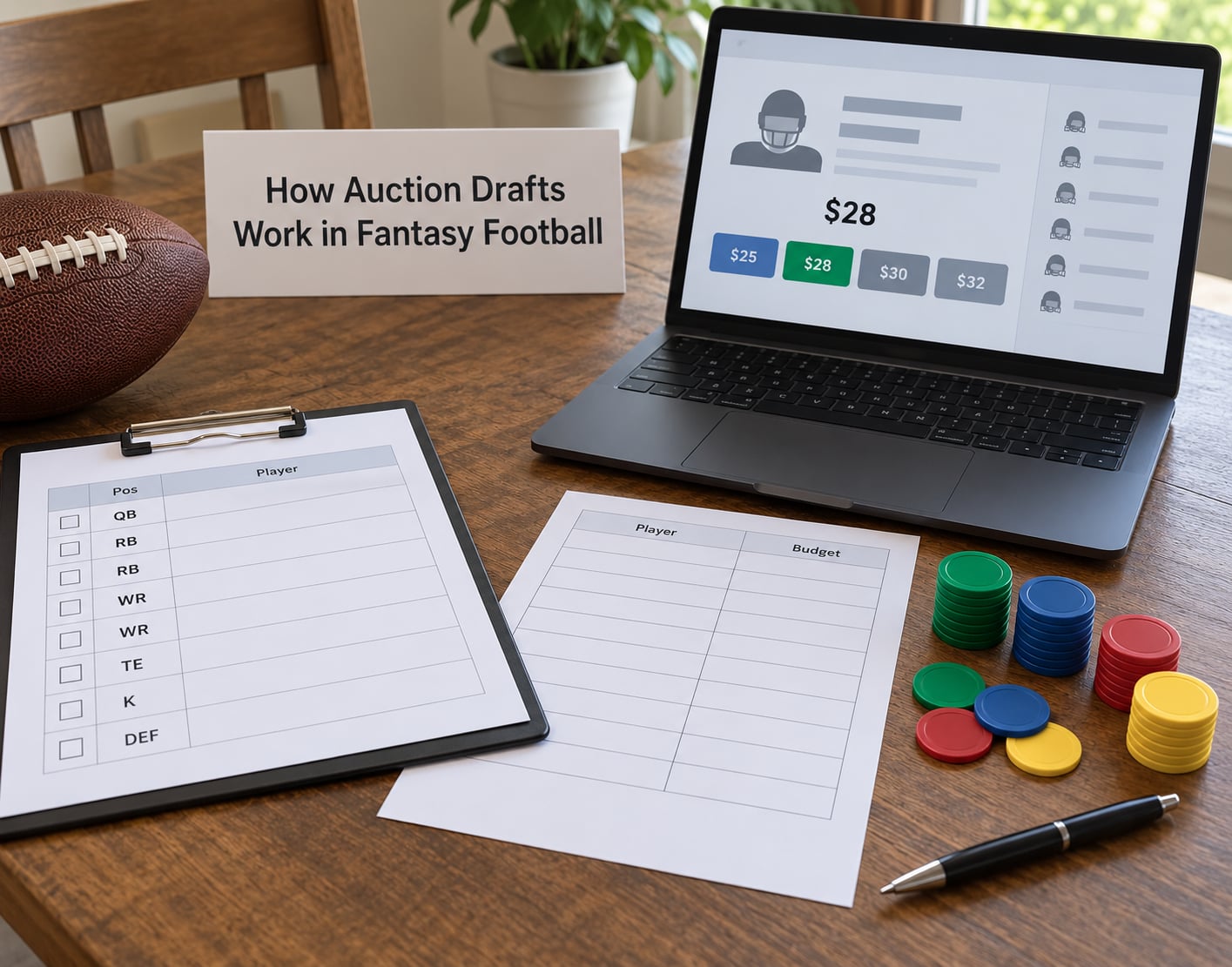
Here is the full sequence, from league setup to the end of the auction.
1. The commissioner sets the rules
Budget, roster size, number of bench slots, flex eligibility, scoring, nomination order, tiebreakers, minimum bid, bid increment, and the seconds allowed on the clock. Different platforms default these differently, so check yours before draft day.
2. Managers take turns in a fixed nomination order
The order is usually random or seeded by last year’s finish. Once it wraps around, the cycle repeats for every nomination until rosters are full.
3. The nominator puts a player on the board
Any undrafted player will do, at any ranking. You can nominate a player you want, or one you would rather your league mates overpay for.
4. Bidding opens at the league minimum
Usually a single dollar, sometimes two. Every manager has a short window to type a bid, and the auction advances when the clock runs out or everyone passes.
5. Managers raise until nobody will
Increments are small by design, often a dollar at a time. The auction ends when no one bids higher, and one manager passes, or the clock expires.
6. If nobody bids, the player passes on
An unbid player goes to the next nominator in the order, who may nominate the same player again or take a different one.
7. The winning bid is deducted from the budget
Roster space is filled, the money is gone, and the next manager in the rotation nominates. Repeat until every roster is full.
8. What happens to the players nobody drafted
Once the auction ends, undrafted players sit in a waiver pool at the league minimum. Managers claim them through the waiver wire after the draft, and a player you drop during the season keeps the auction price he carried on your roster, which is how inflation creeps in over the years.
How Do You Bid and Win a Player?
Picture a 12-team league with a 200-dollar cap, standard roster, and a one-dollar minimum. You are third in the order and you want a particular wide receiver ranked in the top ten at his position.
You nominate him. Bidding opens at one dollar. A manager at the table with him raises to six. Another goes to nine. You decide eight is your ceiling, you type eight, and the bidding ends. The nine wins him and now has 191 dollars left.
Why the clock changes how auction drafts work
Platforms set a per-bid window, often ten to thirty seconds. Short windows force fast decisions and stop a slow manager from freezing a league, but they also cut off the long haggling some auction people enjoy. If your group likes to talk out bids, set a longer window or run the draft in a live voice room alongside the platform.
Two things can stop a bid outright. A manager cannot go over their remaining budget, and most platforms block a bid that would exceed it. Some leagues also cap a single bid at a percentage of the total budget, which exists specifically to slow down the early spending that ruins a lot of first-time auctions.
Running a silent auction instead
A silent or sealed-bid auction collects every manager’s maximum price at once, then awards the player to the highest bidder at the second-highest bid plus one increment. Nobody sees anyone else’s number, the whole draft can finish in a day, and prep matters more than timing. Larger leagues like the 16-team format often prefer it, but first-timers should know the rules before they sign up for one.
What Determines a Player’s Auction Value?
Price is what the market in your specific league will bear, and several things move it.
Positional scarcity. Twelve teams need two quarterbacks, but only a handful are attractive. Late in the auction, the surviving quarterbacks carry a price that reflects the shortage rather than the ranking.
Role and opportunity. A receiver on a team that throws a lot is worth more than a same-ranking receiver on a run-heavy roster. In a points-scoring league the difference is small; in a dynasty startup it is the whole argument.
Projected production. Most auction values are just projection formulas that spread a fixed budget across the eligible player pool. Your source of projections matters less than staying consistent with it.
League size and settings. Sixteen teams buying from the same pool means less money per roster spot and shallower talent. Two flex slots change which players are useful enough to keep.
How many managers still care. A player about to go at a premium with three managers out of budget loses value quickly. That is when the good buys happen.
Keepers already banked. In a keeper league, keepers were paid for at the last auction and that money is gone. A thinner pool of available players means the rest cost more.
What Is a Good Auction Draft Strategy?
Set a maximum price for every player before you sit down, and never bid past it. An auction punishes indecision more than a snake draft does, because an overbid permanently damages your roster instead of costing you one pick.
Budget by position before draft day rather than reacting in the moment. A common starting split for a 200-dollar budget puts roughly 10 to 15 percent on quarterbacks, 35 to 45 percent on running backs, 25 to 30 percent on wide receivers, and 8 to 12 percent on tight ends, with the rest on your flex spot and a handful of dollars held back for noise players at the minimum bid.
How to handle your nominations
Early on, a nominee who spends has set the price for everyone else, so the first few picks tend to go fast. You can nominate a cheap player nobody wants and let the auction settle, or nominate a rival’s favorite to make him pay for it.
Later, nominate a name you would happily own at a fair price. Holding sleepers back while the auction burns other people’s money is the standard move, and managers in r/Fantasy_Football describe exactly this pattern: rivals blow their budgets early, then a run of insane value opens up in the middle of the draft.
Stars and scrubs versus a balanced build
Spending most of your cap on a few dependable players and filling the rest with the league minimum is aggressive and volatile. Building a balanced roster spreads money across positions and needs fewer things to go right. Whichever you pick, decide before the auction, because switching mid-draft is how budgets break.
Budget for keepers if your league has them
Keeper prices in an auction league are set by the manager who kept the player, and the league usually approves the number in advance. Those dollars are already spent, so subtract them from your plan for this year and treat the players themselves as unavailable. Some leagues let you set the price yourself right up until the draft, which makes it a weapon for people who know the market.
How Do You Prepare Before an Auction Draft?
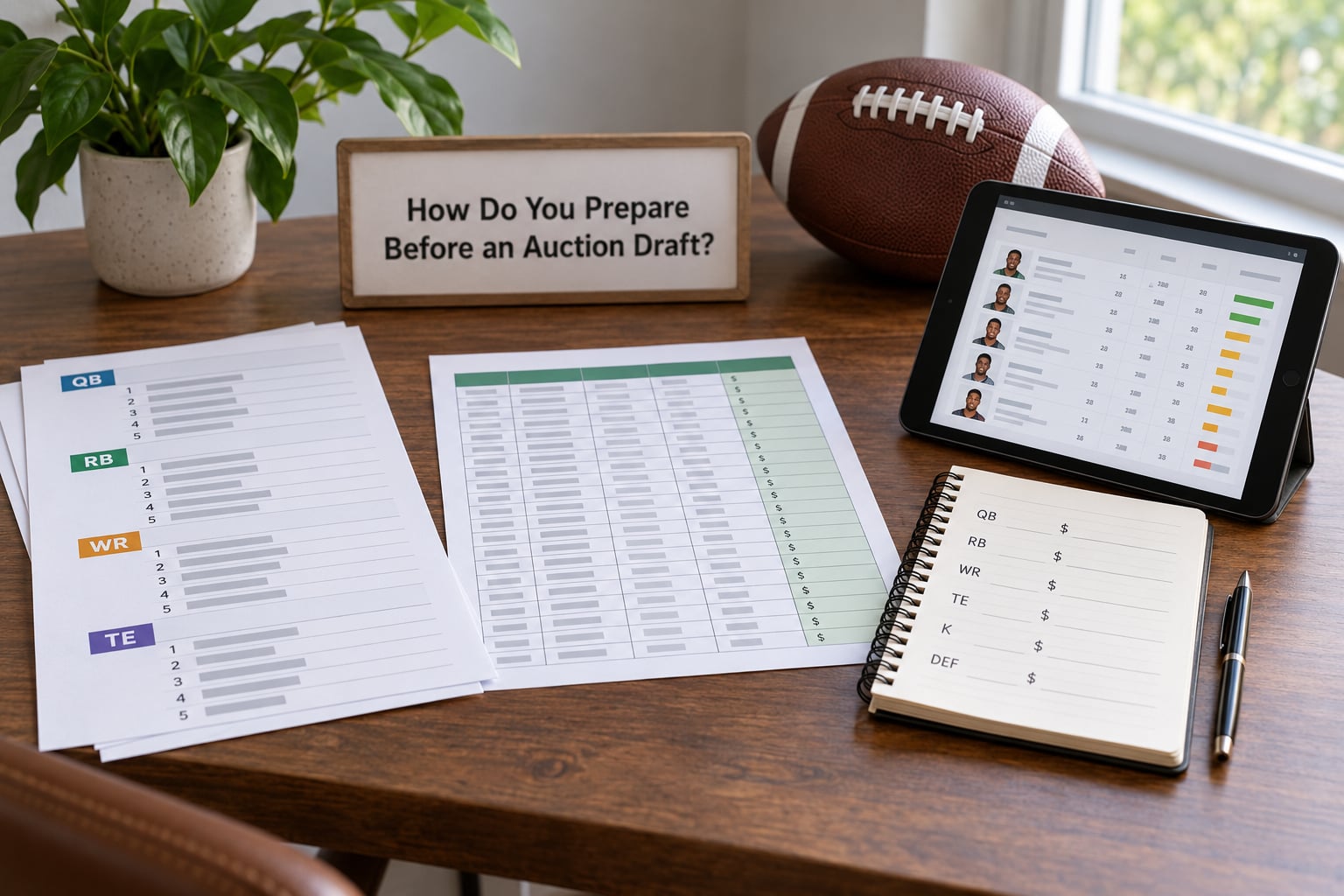
Preparation matters more in an auction than in a snake draft, because the field is usually better prepared too. Here is the checklist.
- Confirm your league settings. Budget, roster size, flex spots, minimum bid, bid increment, clock length, keeper rules.
- Build auction values, not just rankings. Average auction value from a projection source gives you a dollar next to every player, which is the number that matters.
- Set a maximum bid per player. Usually 70 to 90 percent of your projected auction value, adjusted for scarcity.
- Write your position budgets down. Total and per-slot, so you know when to stop bidding on a running back.
- Group players into tiers. Within a tier, players are worth about the same. That is where price enforcement pays off.
- Check injury news and depth charts the morning of, then adjust anything that moved.
- Know your league mates. The same auction is a different market when someone refuses to spend.
A sample 200-dollar budget
| Position | Roster slots | Budget range | Working plan |
|---|---|---|---|
| Quarterback | 2 plus flex eligibility | 20 to 28 dollars | One mid-tier starter, one streamer |
| Running back | 2 plus flex eligibility | 70 to 85 dollars | One workhorse, one or two cheap depth pieces |
| Wide receiver | 3 plus flex eligibility | 55 to 65 dollars | Two reliable hands, one flyer |
| Tight end | 1 plus flex eligibility | 10 to 18 dollars | One mid-tier, rest of the value at the minimum |
| Noise players | Bench and IR | 15 to 20 dollars | Minimum bids all the way through |
How to practice without a mock lobby
Managers on r/Fantasy_Football complain that mocks play out the same way every time, which is a fair criticism of a snake mock and not really true of an auction. Pick a league size, run one auction against bots if your platform allows it, and pay attention to where your budget ran out rather than to a final roster. Watch two real auctions on video and just track how long the money stayed in the price.
What Are the Most Common Auction Draft Mistakes?
Overvaluing your own studs. You love the player, so you pay above market. Set your maximum in advance and let the spreadsheet decide.
Bidding too early. The first twenty dollars is the most expensive money in the draft because every manager still has a full budget. Make your early bids on cheap players and let rivals spend.
Ignoring depth. Losing your first and second running backs to injury in week six is a roster problem, not a draft problem. Cheaper players at the minimum bid are insurance, and insurance is worth more than it looks on draft day.
Breaking your position budgets. Four running backs at 35 dollars each is a plan, not an accident. Decide the shape first.
Chasing at the end. Once rosters fill up, players get expensive fast because nobody wants an empty slot. If you are still shopping late, you already spent badly.
Not learning what the market told you. If three managers refuse to pay 30 for a receiver you rated 32, your projections are wrong in a way you should fix before next year.
Frequently Asked Questions
Are auction drafts better than snake drafts?
It depends on what you want out of your league. Auctions reward preparation and budget discipline, give everyone the same chance at the same players, and let you build a roster shape a snake draft would never allow. Snakes are faster, easier to run, and fine for casual leagues. Managers who like strategy generally prefer auctions once they get used to the budget work.
How much should I bid for a player in an auction draft?
Start at roughly 70 to 90 percent of that player’s projected auction value, then adjust for scarcity and league settings. Budget by position before you bid so you know the ceiling for the whole group, not just one player. The other half of the rule is harder: if you reach your maximum, you walk away even when the player is still available later.
How do you win a player in an auction draft?
You win a player by having the highest bid when the bidding closes, and the winning amount is deducted from your remaining budget immediately. In most platforms the auction advances when the clock runs out with no new bid. Some leagues use a sealed-bid format instead, where you submit a maximum price in advance and win at the second-highest bid plus one increment.
How do auction draft budgets work?
Every manager starts with the same budget, usually 100 to 200 dollars, and a roster with a set number of slots. A winning bid is subtracted from your total, so your money equals the sum of your current roster. If you go over budget in a live auction, some platforms reject the bid while others allow the overage and flag your team for the rest of the draft.
Should I draft a running back early in an auction league?
Position scarcity pushes running back prices up early, so the big-money options usually go in the first fifteen or twenty picks. That does not mean you have to spend heavily there, only that you will not find top prospects in the middle rounds. Drafting one workhorse early and filling the rest with cheap depth is a common plan in large leagues.
Can you use keeper or dynasty strategies in an auction draft?
Yes, and auctions suit both well. Keepers are purchased in advance by each manager, and that money is already gone when the auction starts, so subtract it from your plan. Dynasty startup drafts get one pass at the whole player pool with no waiver wire, which makes budget control more important, since there is no easy way to replace a mistake you paid too much for.
Start With a Budget, Not a Star Player
New managers try to win a bidding war in the first ten picks and spend half their cap before the roster takes shape. Do the opposite: read your league settings, split the budget by position, write a maximum bid next to every player on your sheet, and let the auction come to you.
The format rewards the manager who knows what a player is worth, which is the whole answer to how auction drafts work in fantasy football. Take cheap players early, spend real money only where scarcity forces you to, and keep enough budget to fill every roster spot at the minimum bid.