
FAAB stands for Free Agent Acquisition Budget, and it is the auction-style waiver system most serious fantasy football leagues use instead of a priority list. Every manager gets a fixed pot of fake money for the season and submits a sealed blind bid on players they want from the waiver wire. The highest bid wins the player, and that amount leaves the winner’s budget for good.
In a twelve-team league with a 100-dollar budget, that pot is roughly eight dollars of spending per week if you spread it evenly, which is why one impulsive Week 1 bid can reshape your entire season. Here is how the budget actually works, how to pick an amount, and where managers keep wasting money.
Table of Contents
- What Does FAAB Stand for in Fantasy Football?
- How Does the FAAB Budget System Work?
- Is 100 Dollars the Standard FAAB Budget?
- How Do You Make a FAAB Bid?
- When Should You Use FAAB in a Fantasy Football League?
- FAAB Bidding Examples for Common League Formats
- What Happens If No One Outbids You?
- Common FAAB Mistakes to Avoid
- Frequently Asked Questions
- Conclusion
What Does FAAB Stand for in Fantasy Football?
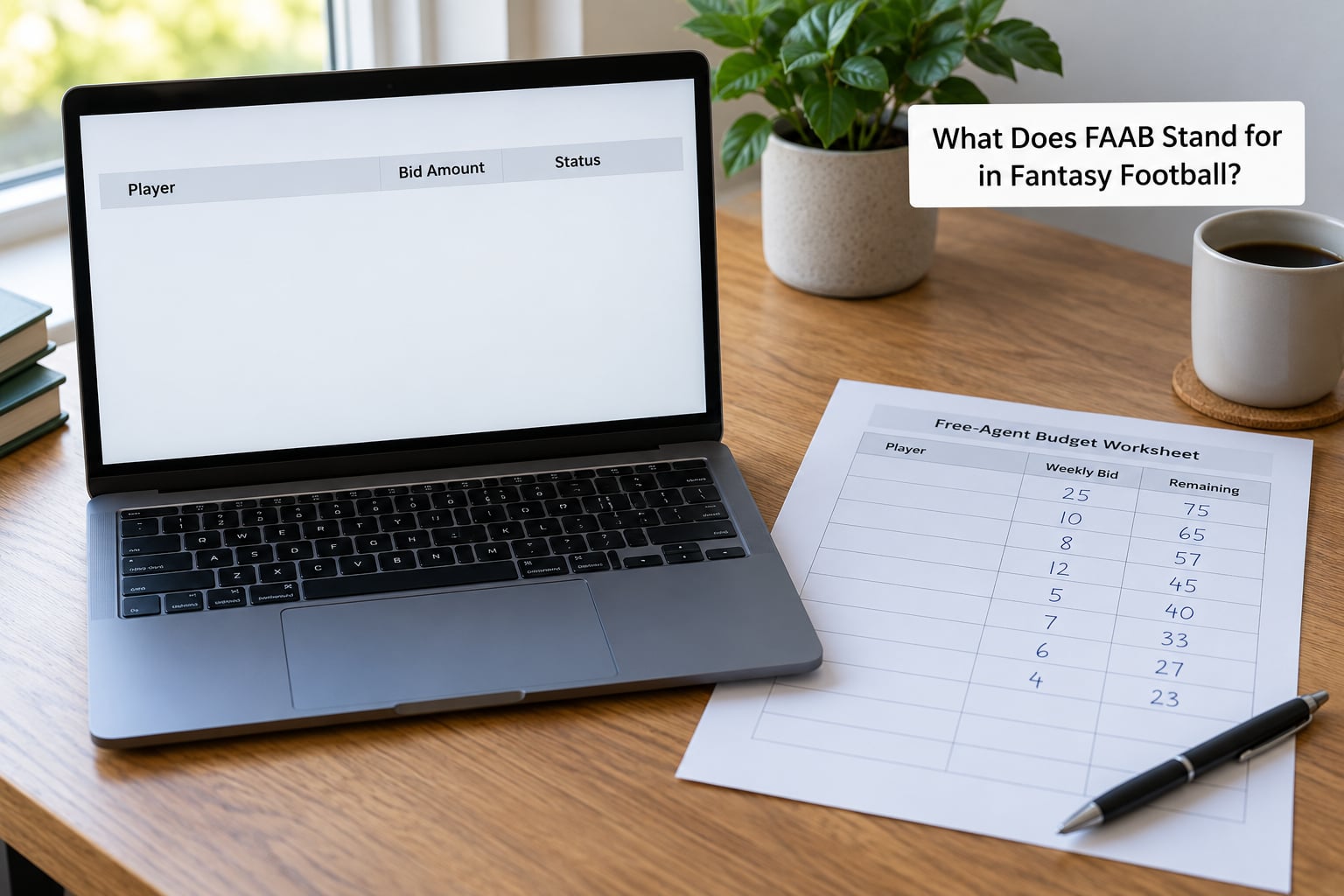
Three words: Free Agent Acquisition Budget. Each manager receives the same allowance at the start of the season and uses it to acquire players who become free agents during the year.
The money has no value outside your league. Nobody cashes out 40 dollars of FAAB, and no league takes real currency to run the system. It is a scoring device that forces every acquisition to have a price.
Take a typical redraft league. You start the year with 100 dollars of FAAB, an injured quarterback goes on the wire in Week 4, and you bid 18 dollars for his backup. You win, 18 dollars comes out, and you have 82 dollars left for the remaining nine weeks.
How Does the FAAB Budget System Work?
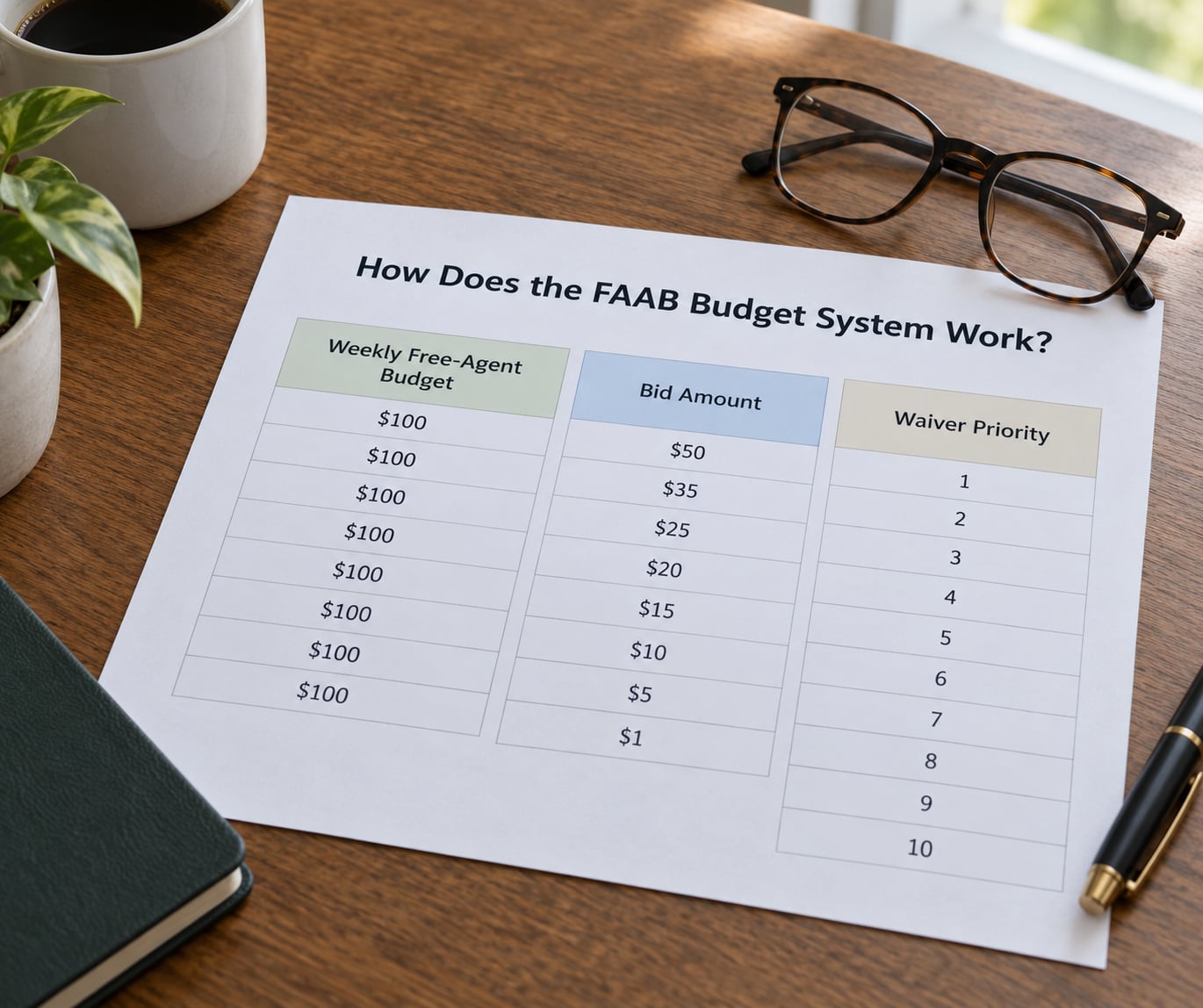
The mechanics are short enough to memorize in a minute. Most confusion comes from mixing up blind bidding with priority, so it is worth walking through each rule separately.
- The budget is fixed for the season. Most leagues use 100 or 200 dollars. Some larger money leagues use 1000, and the percentage of budget matters more than the raw number.
- Bids are blind. You cannot see what anyone else submitted before the waiver period closes, which is exactly why your budget is the only signal of your interest.
- The highest bid wins the player. Depending on your league setting, you either pay your full bid or the second-highest bid plus one dollar. Check this setting carefully.
- Losers pay nothing. A bid you lose only costs you if your league is set to deduct losers’ bids, which most are not. Losing a bid normally has zero financial effect.
- Zero-dollar bids are usually legal. Most platforms accept a bid of 0 dollars, and once the waivers clear, anyone can add an unclaimed player from the free agent pool for nothing.
- Ties resolve by a league rule, not by guesswork. Common tiebreakers include remaining budget, last season’s standings, or the manager who submitted the bid first.
Two more settings decide whether budget carries over. Some leagues reset the full amount each week, which makes bidding a per-week decision with no long-term consequence. Others pool the money for the whole season, which turns it into a genuine allocation problem. Almost every competitive league runs the season-long version.
Is 100 Dollars the Standard FAAB Budget?
100 dollars is the most common default, but it is not a rule. A 200-dollar budget is standard in many keeper and dynasty leagues, and 1000-dollar budgets show up in large money leagues. What matters is how the number divides across the season.
- 100 dollars, season-long, twelve teams: about 8 dollars a week if spread evenly. A single 20-dollar claim eats two weeks of planned spending, and three or four such claims end your flexibility by October.
- 200 dollars, season-long: roughly 16 dollars a week. This is the most forgiving setup because a mid-tier upgrade no longer forces you to skip the next two waiver periods.
- 1000 dollars, season-long: about 80 dollars a week. Bid amounts scale up, but the percentage of budget you commit to a given player should stay roughly the same, which is the only way advice transfers between formats.
- Weekly reset budgets: the full amount returns every week. Bidding becomes far more aggressive because there is no season-long scarcity, and streamers get bid on like starters.
League size changes the math too. In an eight-team league, the waiver wire is thin and any decent pickup draws three or four bids. In a sixteen-team league the wire is crowded with usable players, so the same percentage of budget buys you less.
How Do You Make a FAAB Bid?
Bidding well is mostly process discipline rather than knowledge. Rushing the step where you check the competition is how managers end up paying double what they planned.
- Check the injury report and the news first. Confirm the player is actually available and not out for the season. Spending budget on a player who then lands on the practice report is pure waste.
- Value the upgrade, not the player. The relevant number is the gap between this guy and what he is replacing. A 15-point-per-game upgrade over your current flex is worth far more than a 15-point-per-game player who would slot in as your third backup.
- Project how many weeks of value you are buying. Multiply the weekly gap in points by the realistic number of games left. That product gives you a ceiling for the bid.
- Look at the competition. Check the league chat, any weekly consensus thread, and your own history of winning bids for that player. Bid trackers built by the community show what percentage of budget managers typically commit.
- Bid one dollar above the obvious number. Most bids cluster on round figures like 10, 15, or 20 dollars. Bidding 16 instead of 15 wins the same player for less, and the same logic applies at every rung of the ladder.
- Submit before the waiver deadline and confirm the result. Most platforms run waivers overnight, commonly early Wednesday morning. Players left unclaimed drop to the free agent pool, where you can add them for nothing.
How Much Should You Bid? A Simple FAAB Ladder
A bid is a claim on the future, not a payment. The amount you submit only matters if you win, and only the amount you win by gets charged under the common second-plus-one setting.
- Streaming a bye-week or replacing a dud at 0 percent of budget: bid 0 dollars. You lose nothing and may still add them later.
- A modest upgrade worth a few points a week for a month: 2 to 5 percent of budget, so 2 to 5 dollars in a 100-dollar league.
- A reliable starter upgrade with multi-week value: 5 to 15 percent, so 5 to 15 dollars.
- A season-defining player such as a young breakout or a workhorse back: 20 to 40 percent, so 20 to 40 dollars.
- A league-winner type of player: be prepared to go to half the budget or more, and only when your roster has a real hole that player fills.
Ties are where money leaks. If two managers submit the same number and the tiebreaker is remaining budget, you want the higher number. If the tiebreaker is submission time, you want to submit early but not so early that you miss a late-breaking injury report.
When Should You Use FAAB in a Fantasy Football League?
Spending pays when the player fixes a specific weakness for a known number of weeks. It wastes budget when you are reacting to the latest stat line instead of addressing a roster gap.
- Injury replacements. The clearest case. A backup who inherits a full workload is worth a real bid immediately.
- Handcuff additions. In leagues that award points to backups who get carries, insurance on your starter is cheap relative to a season-ending absence.
- Breakout rookie receivers. Early production on limited volume is a signal, and the managers who win are usually the ones who acted on it in the first two weeks.
- Roster fill-ins and bench depth. Replacement-level players go unclaimed in larger leagues, and a bid of 0 often gets them for nothing.
- Keeper and dynasty replacement. A long-term asset is worth more budget than a one-week streamer, so the percentage you commit should be higher.
- End-of-season stockpiling. In dynasty, unspent budget simply disappears. Storing cheap young talent in the final weeks is usually the best available use of leftovers.
Where aggressive spending backfires: bidding your whole budget on a player who is merely interesting, chasing a hot stat line after a big game, and spending in August to look active. There is no award for spending money.
FAAB Bidding Examples for Common League Formats
Abstract percentages only go so far. Here is how the same thinking looks in three leagues a manager would actually play in.
Redraft league, 100-dollar budget, twelve teams
It is Week 4 and you have 100 dollars left. A starting running back leaves the game with a hamstring issue, and his handcuff has 20 carries waiting for him. You bid 23 dollars and win against a manager who bid 20 and another who bid 18. You pay 23 dollars under the full-bid setting, or 21 dollars if your league uses second-plus-one. Seven dollars saved on a season-long upgrade is a good trade.
Keeper league, 200-dollar budget, ten teams
You have 96 dollars left in Week 9 with a need at tight end. Two managers are known to be aggressive this season, so you bid 34 dollars on a rookie tight end with a target share, expecting competition. You win at 41 dollars and are left with 55 dollars for ten weeks. At roughly 5 dollars a week after that, you can still make cheap streaming moves, which is why spending a third of the budget mid-season is still safe here.
Dynasty league, 1000-dollar budget, 16 teams
You have 620 dollars left in Week 12 and an aging tight end on your roster. A 22-year-old with a top-15 target share hits the wire after a rough rookie year. You bid 180 dollars and win for 180. In a 1000-dollar league that is 18 percent of budget spent for a multi-year asset, and the remaining 440 dollars is still enough to keep bidding on prospects all season. The same percentage spent in a 100-dollar league would have been reckless.
What Happens If No One Outbids You?
If nobody outbids you, you win the player and you are charged your bid. The bid is a ceiling on what you pay, not a fixed purchase price, and under the common second-plus-one setting you usually pay one dollar more than the second-highest bid, or nothing at all if you were the only bidder.
Here is the part that surprises new managers: a bid that loses does not subtract money from your budget. You can bid aggressively on six players in one week, win one, and be down only what you actually won.
If an expected claim does not process, work through this list. Check whether you had a full roster spot or an IR slot available at the time you submitted. Confirm the bid was submitted before the deadline rather than created as a draft. Verify the league is set to blind bidding at all, since some leagues run priority even after you see a budget column. If you were on a partial roster, most platforms remove your bid automatically. And check whether the player was dropped by another manager after your bid, which sometimes triggers a re-processing delay.
Common FAAB Mistakes to Avoid
- Overbidding because others bid high. Bidding against an imagined competitor is how a 12-dollar player costs 40 dollars. Price the player’s value first, then adjust only for known competition.
- Bidding too early. The first bid of the week is made on incomplete information. Hold until you know the full injury picture and the player is confirmed available.
- Hoarding budget into December. Unspent FAAB expires worthless. A manager sitting on 60 dollars while their bench is empty has already lost the season.
- Spending on replaceable players. Extra tight ends and backup running backs are usually free after the waivers clear. Bid 0 dollars on those and spend real money only where you have a gap.
- Ignoring your league’s settings. Pay-full-bid versus second-plus-one, season-long versus weekly reset, and the tiebreaker rule all change the right number. Read the settings page once, carefully.
- Bidding on clean round numbers. Everyone clusters at 20 and 25. Bidding 21 or 26 costs you a single dollar and takes the same player off the board.
Frequently Asked Questions
Does a FAAB bid cost anything if no one outbids you?
Yes, you pay your bid when you win a player, and nothing extra when you lose. Under the common second-highest-bid-plus-one setting, you pay one dollar more than the runner-up bid rather than your full number. If you bid alone, you usually pay nothing at all. Losing a bid never deducts money from your budget, so submitting several bids in one week is safe.
Does everyone in FAAB get the same budget each week?
It depends on your league setting. Most competitive leagues give every manager one budget for the entire season, usually 100 or 200 dollars, and it never refills. Some leagues reset the full amount each week, which makes bidding much more aggressive because nothing is lost by spending. A few leagues set a fixed amount per manager rather than per week, so check your league settings before bidding.
What happens if two managers submit the same FAAB bid?
The league applies its tiebreaker setting. The common options are the manager with more remaining budget, the better standing from last season, or whoever submitted the bid first. Ties are one of the most common reasons managers lose a dollar for nothing, which is why bidding one dollar above an obvious round number is standard advice. Know your league’s rule so you know when a tie hurts you.
Can you bid zero dollars in FAAB?
Almost always, yes. Most platforms accept a bid of 0 dollars, and if nobody else bids, you win the player for nothing. Zero-dollar bids are the workhorse move of competitive FAAB leagues, especially for streamers and bench filler. If nobody claims the player during waivers, the player drops to the free agent pool and anyone can add him for free after the waiver period clears.
Should I use all my FAAB budget during the season?
In a season-long league, yes in practice, because unspent budget disappears at the end of the year and earns you nothing. Try to have most of it gone by mid-December so you can still make cheap late pickups. Spread it out rather than dumping it in Week 1, since early spending with nothing left leaves you stuck. A rough pacing target is to have about half your budget remaining by Week 6.
Is FAAB better than using a waiver priority?
For most competitive redraft leagues, FAAB is better because it rewards preparation rather than luck. Under a rolling priority, your position on the list depends on how many claims you lost, so one bad week can freeze your roster for weeks. FAAB lets a manager who spots a value player early lock him in. Priority formats still make sense in dynasty leagues where you add players far less often.
Conclusion
FAAB, short for Free Agent Acquisition Budget, replaces a waiver priority list with a fixed pot of fake money and a sealed bid. The highest bid wins, the losing bids cost nothing, and the money never comes back, so the whole system runs on honest valuation.
Before your first bid this season, check three things: the total budget, whether your league uses pay-full-bid or second-plus-one, and what happens to leftover money. Then bid 0 dollars on streamers, one dollar above round numbers on anyone real, and keep enough budget in reserve for the December stretch run.