
Half PPR awards 0.5 fantasy points per reception. Full PPR awards 1.0 point per reception. Everything else — passing, rushing, receiving yards, touchdowns, fumbles — is usually identical, so the two formats differ by exactly half a point on every single catch. That one coefficient changes who you draft, who you trade for, and why your weekly score looks nothing like the league chat.
Most managers pick a league without reading that setting. They join something called PPR, assume every catch is worth a full point, and then spend September wondering why their running back outscored a 100-catch receiver. Check the reception value in your league settings before anything else.
This guide scores identical stat lines under both settings, shows which positions gain and lose value, and gives you a straight answer on which format to pick for your league.
Table of Contents
- Half PPR vs Full PPR Scoring at a Glance
- What Is the Difference Between Half PPR and Full PPR?
- How Does Half PPR vs Full PPR Scoring Change Player Value?
- Which Players Gain the Most From Full PPR?
- Why Half PPR Still Rewards Production
- How Do These Settings Change Draft Strategy?
- Which Scoring Format Is Better for Your League?
- Frequently Asked Questions
- Is half point or full point PPR better?
- How does half PPR scoring work?
- Does half PPR favor running backs or wide receivers?
- What is the best PPR scoring format for fantasy football?
- Which fantasy football scoring system is the most fun?
- Why are my half PPR league scores lower than my friends’ full PPR league?
- Conclusion
Half PPR vs Full PPR Scoring at a Glance
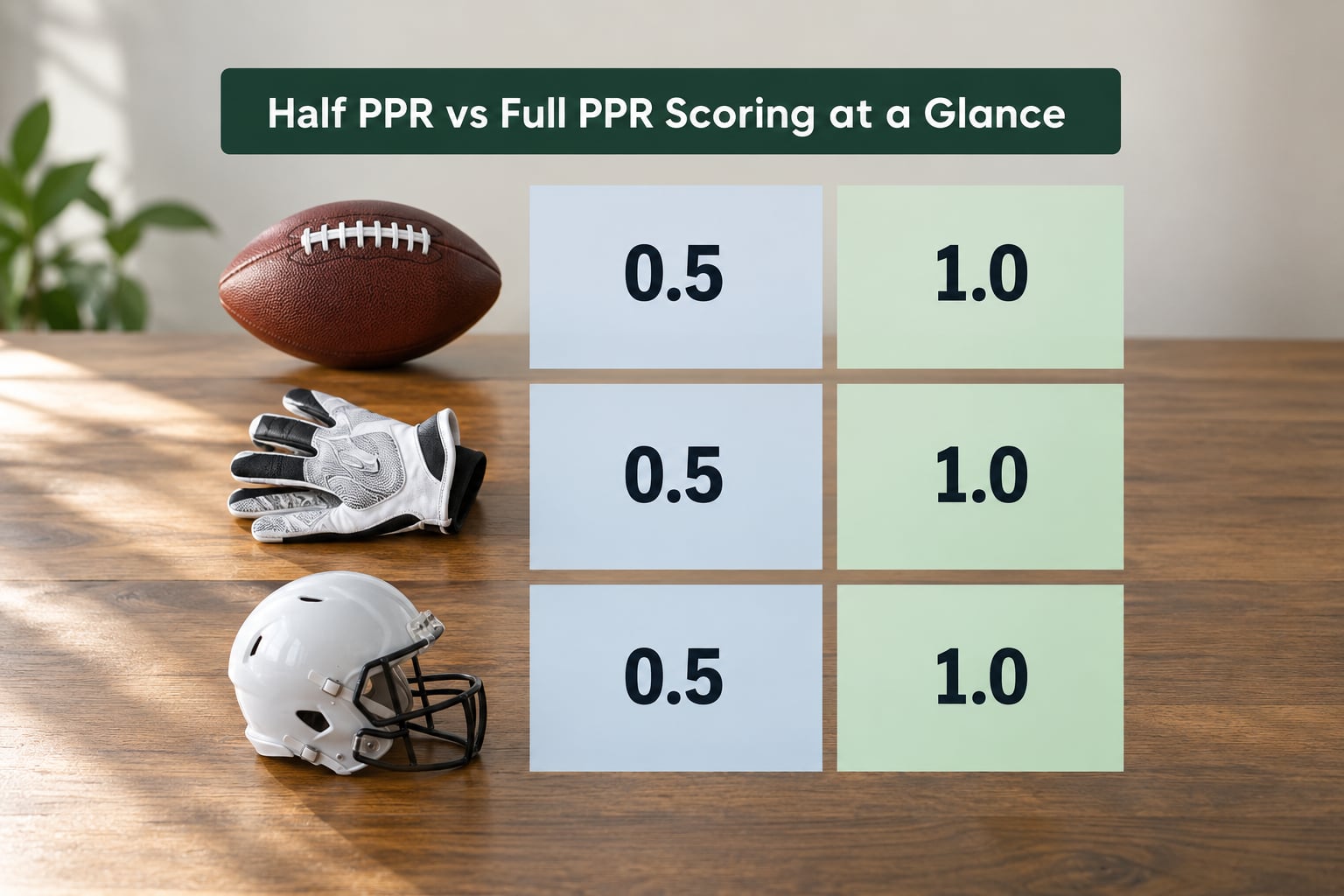
| Criterion | Half PPR | Full PPR |
|---|---|---|
| Points per reception | 0.5 | 1.0 |
| Points for a 6-catch, 60-yard, 1-TD week | 15.0 | 18.0 |
| Bonus for an 84-catch season | 42.0 | 84.0 |
| Positions that gain most from volume | WR and pass-catchers, moderately | WR and pass-catchers, heavily |
| Positions least affected | Workhorse rushers, blocking tight ends | Workhorse rushers, blocking tight ends |
| Draft emphasis | Efficiency plus role security | Target share and volume |
| Touchdown variance per season | Damped by the smaller reception base | Full effect on the scoreboard |
| Best fit | Casual and keeper leagues, dynasty steadiness | Competitive redraft leagues, best ball drafts |
The gap is not subtle once you look at a season rather than a week. It is also not evenly distributed, which is the part most explanations skip.
What Is the Difference Between Half PPR and Full PPR?
Half PPR means a player earns half a fantasy point for each reception. Full PPR means one full point. Standard, or non-PPR, means zero points for the catch itself, so only yards and touchdowns move the needle.
Standard yardage rates usually sit at 0.1 points per rushing or receiving yard, 1 point per passing yard, 6 points per passing touchdown and 6 per rushing or receiving touchdown, with turnovers subtracted. A full-PPR reception is therefore worth about 10 receiving yards at those rates, while a half-PPR reception is worth about 5. That single conversion is the fastest way to feel the difference: a short completion that gains two yards adds 2.0 points in full PPR and 1.0 in half PPR.
Settings vary by platform, so never assume. Yahoo’s default public leagues are half PPR, while ESPN and Sleeper have defaulted to full PPR. Fantrax and most dynasty platforms let a commissioner pick the reception value from a menu that ranges from zero up to 2.0 and beyond. Custom leagues add their own layers, such as bonus points per catch, points per first down or a tight end premium.
Finding your own value takes about thirty seconds: open your league, go to settings, look for the scoring tab, and read the number beside receptions. If it says 0.5, you are in half PPR. If it reads 1, you are in full PPR. If the league uses a reception bonus instead, such as 1 point per catch with an extra point for 5 or more, the format is a custom hybrid rather than either version.
How Does Half PPR vs Full PPR Scoring Change Player Value?
It changes value in proportion to a player’s target volume, and barely at all for everyone else. A workhorse running back with 18 rushing attempts and 1 catch scores within a few tenths of a point either way. A receiver with 100 catches moves 50 points between formats, which is roughly a full extra fantasy week.
Half PPR vs full PPR scoring example
Take one realistic week from a 12-team league. Every other setting is identical: 0.1 per yard, 1 per passing yard, 6 per touchdown, minus 2 for an interception.
| Player | Weekly line | Half PPR | Full PPR | Difference |
|---|---|---|---|---|
| Receiver A | 9 catches, 96 yards, 1 TD | 20.1 | 24.6 | 4.5 |
| Running back A | 21 carries, 78 yards, 1 TD, 2 catches | 14.8 | 15.8 | 1.0 |
| Tight end A | 7 catches, 61 yards, 0 TD | 9.6 | 13.1 | 3.5 |
| Quarterback A | 24 completions on 36 attempts, 251 yards, 2 TD, 1 INT | 32.1 | 32.1 | 0.0 |
The quarterback line is the useful control: quarterbacks do not get reception points in most leagues, so the two formats score them identically. Everything else scales with catches, and the running back barely moves because two receptions is not a volume game.
Stretch that single week across a season and the pattern holds. A receiver with 84 catches gains 42 more points in full PPR than in half PPR, and one with 110 catches gains 55. A running back with 40 catches gains 20. A quarterback gains nothing at all.
Position by position, the direction is consistent. Receivers rise the most in full PPR, then tight ends, then pass-catchers at running back, while pure rushers and quarterbacks stay put. Half PPR narrows that spread without reversing it — it does not make running backs better, it just makes the reception penalty for a low-catch player slightly smaller.
Which Players Gain the Most From Full PPR?
High-volume receivers gain the most, and the qualifier that matters is targets rather than catches. Two receivers can both post 70 catches, but one achieved them on 100 targets and the other on 130. Full PPR pays both 70-catch seasons identically, while in half PPR the catch is such a large share of the score that the underlying target volume still drives the gap between them.
Running backs in pass-heavy offenses are the second group. A back who catches 4 to 6 passes a game adds 2 to 3 extra points a week in full PPR, and those are points a power rushing week cannot generate. Goal-line backs with heavy receiving involvement in the fourth quarter benefit from the same thing.
Tight ends get a bigger relative boost than almost anyone. A blocking tight end catching three balls a game gains 1.5 points a week in half PPR and 3.0 in full PPR. That is the entire argument behind tight end premium leagues, and full PPR magnifies it while half PPR softens it.
Red-zone target share is the last piece. A receiver whose team throws to him near the goal line scores the same 6 points for a touchdown in both formats, but he reaches that end zone far more often when volume is worth double.
Why Half PPR Still Rewards Production
Half PPR is not a compromise between standard and PPR for no reason. It keeps receptions valuable while stopping one 130-target season from dwarfing an entire draft class.
The strongest case is touchdown variance. A receiver who catches 4 passes for 20 yards scores 10.0 in half PPR and 11.0 in full PPR if he finds the end zone, but 4.0 versus 5.0 if he does not. Receiving touchdowns are the most volatile weekly event in fantasy, and halving the reception base shrinks the score range a little. It damps the random flukey weeks; it does not remove them, which is why managers still complain about half PPR being decided by one lucky touchdown.
Half PPR also rewards role security more. A receiver who is his quarterback’s primary target every week produces a steadier floor than a deep-threat number two who is schemed out in half his games, because the catch is a smaller share of the total score. Role players and veterans on short passes keep more of their value too.
Weekly scores also tend to bunch closer together, which matters for playoff formats. When a whole league scores within a narrow band, a bad week is recoverable. Wide score spreads turn one mistake into an unreachable deficit, and that is the single most common reason managers describe a league as frustrating rather than fun.
How Do These Settings Change Draft Strategy?
In redraft leagues, the reception coefficient sets your draft board more than any other setting. Under full PPR, treat targets as the primary currency: a 120-target receiver is a first-round pick, and a goal-line running back with 25 catches is a rounding error. Under half PPR, efficiency and role security carry more weight, and a 90-catch receiver with a locked-in share of his team’s targets is a safer pick than a 130-catch receiver who is the third option on his own depth chart.
Auction drafts are where the difference is most expensive. Buyers routinely overpay for catch volume in full PPR auctions and underpay for red-zone opportunities in half PPR, because those are the profiles the format actually rewards.
Keeper and dynasty leagues respond differently. Because players persist across seasons, half PPR’s damped weekly variance produces steadier year-to-year values, which suits managers who trade often and hate rebuilding every year. Full PPR is more volatile year to year but rewards long-term commitment to elite young receiving talent.
Rookie drafts and best ball drafts lean full PPR for a simpler reason: volume is the only thing you can project. A rookie with a 140-target projection in an air-heavy offense is easier to model than a rookie expected to run 18 times a week.
Scoring position scarcity also shifts. In full PPR, wide receiver and tight end become the scarcest positions in most drafts, so finding a 40-target-plus tight end late is far harder. In half PPR, running backs stay relevant longer and the wide receiver tier collapses earlier.
Which Scoring Format Is Better for Your League?
Pick full PPR if you enjoy weekly management, want tight end and wide receiver scarcity to drive drafts, and prefer a season where the biggest target share wins. Pick half PPR if you want a middle ground, value players with secure roles, and want weekly scores to stay closer together.
Commissioners have more options than the binary suggests. A 0.25 reception value, half PPR with full point per first down, and half PPR with a tight end premium are all common league variants. Each nudges the format toward one neighbor without fully adopting it.
One warning for anyone already in a league: do not change the reception value mid-season. It retroactively rewrites every previous week, makes historical scores incomparable, and breaks every trade you made under the old math. If your league truly needs changing, do it in the offseason, and tell your managers before the draft rather than in week 3.
Trades across formats are worth the same caution. A player valued in a full PPR league is not automatically worth the same in half PPR, since the receiving portion of his value shrinks by half. When you trade with a friend in a different league, convert the reception value first, then compare the rest.
Frequently Asked Questions
Is half point or full point PPR better?
It depends on how you like to manage a season. Full PPR is the better choice if you want target volume to drive your draft board and you like managing a tight end and wide receiver scarcity. Half PPR suits managers who prefer steadier weekly scores, value secure roles over raw volume, and want a format that is forgiving when a player has a bad game. Neither is more fair in a mathematical sense; the reception coefficient only decides how much of a player’s score comes from targets rather than yards and touchdowns.
How does half PPR scoring work?
Your league applies a reception coefficient to every catch. In half PPR a reception adds 0.5 fantasy points, in full PPR it adds 1.0, and in standard it adds nothing. That amount is added on top of yardage and touchdown points, so a receiver with 6 catches, 60 yards and 1 touchdown scores 15.0 in half PPR and 18.0 in full PPR. Check the number in your league scoring settings to confirm which format you are in.
Does half PPR favor running backs or wide receivers?
Half PPR does not favor running backs over wide receivers. It narrows the gap between the two rather than reversing it, so high-target receivers and pass-catching backs still gain value, just at about half the rate. Pure workhorse rushers barely move because their scores are made of carries and touchdowns either way. A practical example: a receiver with 84 catches gains 42 extra points per season in full PPR, while a running back with 40 catches gains 20.
What is the best PPR scoring format for fantasy football?
Full PPR is the most common default in competitive redraft leagues, and half PPR is the most common default overall, partly because Yahoo’s public leagues use it. For a new league, the most common recommendation is full PPR for competitive redraft play and half PPR for keeper, dynasty and casual leagues where steadier weekly scores keep more managers engaged through the season. Whatever you choose, publish the reception value in your league rules so nobody joins without knowing it.
Which fantasy football scoring system is the most fun?
Managers most often report half PPR as the most fun to play week to week, and the reason is score compression rather than realism. When weekly scoring sits in a tighter band, a single unlucky touchdown does not put a team out of contention, and playoff races stay alive longer. Full PPR gets its own loyal group because every reception feels meaningful and the weekly leaderboard rewards aggressive roster management.
Why are my half PPR league scores lower than my friends’ full PPR league?
That is expected, and it is the most common surprise for new managers. With standard yardage rates, every catch is worth about 5 receiving yards in half PPR and about 10 in full PPR, so a league built on passing will run roughly 15 to 20 percent lower totals in half PPR. If your scores are far lower than that, check the reception coefficient in your settings, because a league set to standard scoring explains a much bigger gap.
Conclusion
Half PPR vs full PPR comes down to a single number: 0.5 or 1.0 points per reception. Half PPR narrows the gap between volume and efficiency and keeps weekly scores tighter, while full PPR pays target share at full price and makes wide receivers and tight ends scarce.
Open your league settings, read the reception value, and pick the format that matches how you already like to build a roster. If your league is a competitive redraft, go full PPR. If it is a keeper, dynasty or casual league where you want fewer blowouts, half PPR is the safer pick. Either way, do it before the draft, not in week 3.